
What is konjac?
Konjac is a perennial aroid plant, Amorphophallus konjac, grown mainly for its underground corm, often called konjac root in food and supplement markets.
The corm contains glucomannan, a highly water-binding soluble fiber that gives konjac its unusual ability to form elastic gels, low-calorie noodles, thickened beverages, and sponge-like porous materials. Botanically, the plant belongs to the Araceae family, and Kew lists Amorphophallus konjac as an accepted species native to parts of China and nearby East Asian regions via Kew Plants.
The word konjac is used in several overlapping ways. Consumers may mean the plant, the root of konjac, shirataki noodles, konjac pasta, konjac jelly, or glucomannan capsules. Ingredient buyers may mean konjac flour, refined konjac gum, purified glucomannan powder, or E425 food additive material.
| Term | What it usually means | Common use |
|---|---|---|
| Konjac plant | Amorphophallus konjac grown for its corm | Agriculture and botany |
| Konjac root | Market name for the underground corm | Food and supplement marketing |
| Konjac flour | Dried, milled corm material rich in glucomannan | Noodles, gels, thickening |
| Glucomannan | Refined soluble fiber fraction from the corm | Supplements and functional foods |
| Konnyaku konjac | Japanese-style gel block made from konjac flour | Sliced, simmered, skewered, or cubed foods |
Konjac foods are usually not eaten for starch, protein, fat, or sweetness. Their value comes from texture, water binding, and fiber. A typical shirataki noodle is mostly water held in a calcium-set konjac gel, which is why a full serving can be much lower in calories than wheat pasta or rice noodles.
The plant also has a striking above-ground life cycle. It grows a single umbrella-like leaf from the corm in the vegetative phase, while mature plants can produce a large inflorescence typical of Amorphophallus species. For food production, the corm is the economic part because glucomannan accumulates there over multiple growing seasons.
Konjac.bio uses konjac as the umbrella term across consumer and B2B topics. For deeper product pages, see shirataki noodles, glucomannan, konjac flour, konjac jelly, konjac rice, and konjac sponge.
Where does the konjac plant come from?
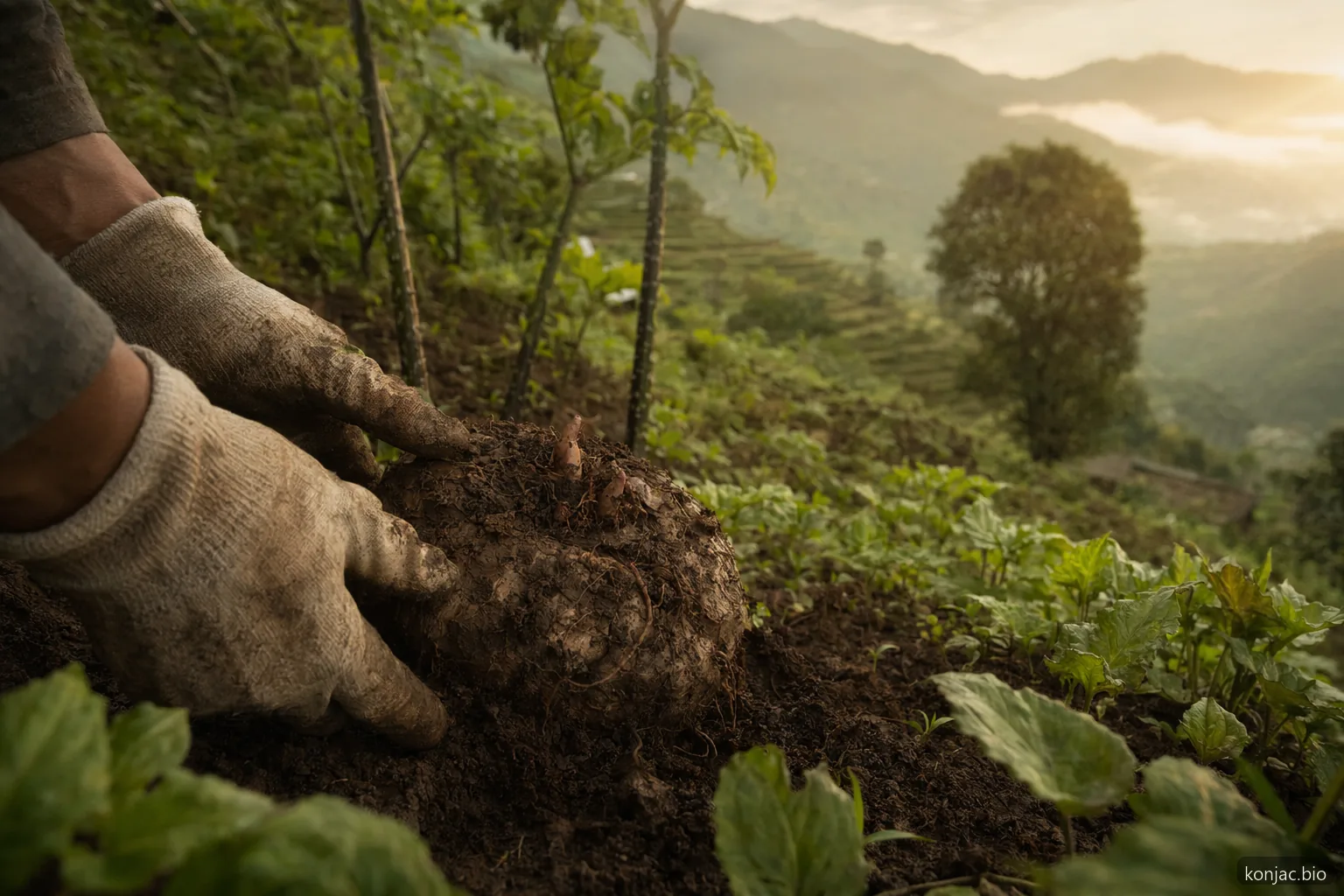
The konjac plant comes from East and Southeast Asian growing regions, with long food traditions in China and Japan and modern cultivation across China, Japan, Indonesia, and nearby areas.
Botanical databases identify Amorphophallus konjac as a recognized species within Araceae, and distribution records place it in China and neighboring regions via Kew Plants. In trade, the largest industrial supply chain is strongly associated with China, where corm cultivation, flour milling, and glucomannan refining are clustered near suitable mountainous growing zones.
Konjac plants prefer humid conditions, well-drained soil, and a growing cycle that supports corm enlargement. The commercial crop is not a one-week vegetable crop. Growers normally manage planting material, disease pressure, soil moisture, harvest timing, and drying capacity because the corm must reach a useful size before processing.
The edible history is closely tied to konnyaku konjac in Japan and konjac tofu-style foods in China. Konnyaku is commonly made as a gray or white gel block, then sliced into soups, hot pots, skewers, and simmered dishes. Chinese regional products also include spicy konjac snacks, konjac shuang, konjac liquor in niche beverage contexts, and gel foods designed for hot pot or ready-to-eat snack formats.
Several names create confusion for readers searching what is konjac. In English, the underground corm is often called konjac root, konjac plant root, or root of konjac. Botanically, corm is more precise than root because the storage organ is a swollen stem base rather than a true root. In consumer search language, both terms point to the same food raw material.
- Konjac plants: the crop grown for corm production.
- Konjac root: the market phrase for the harvested corm.
- Konnyaku konjac: traditional Japanese-style gel food.
- Konjac shuang: spicy or savory Chinese snack-style konjac strips or sheets.
- Konjac liquor: a niche term sometimes used for beverages or fermented concepts, not a mainstream konjac category.
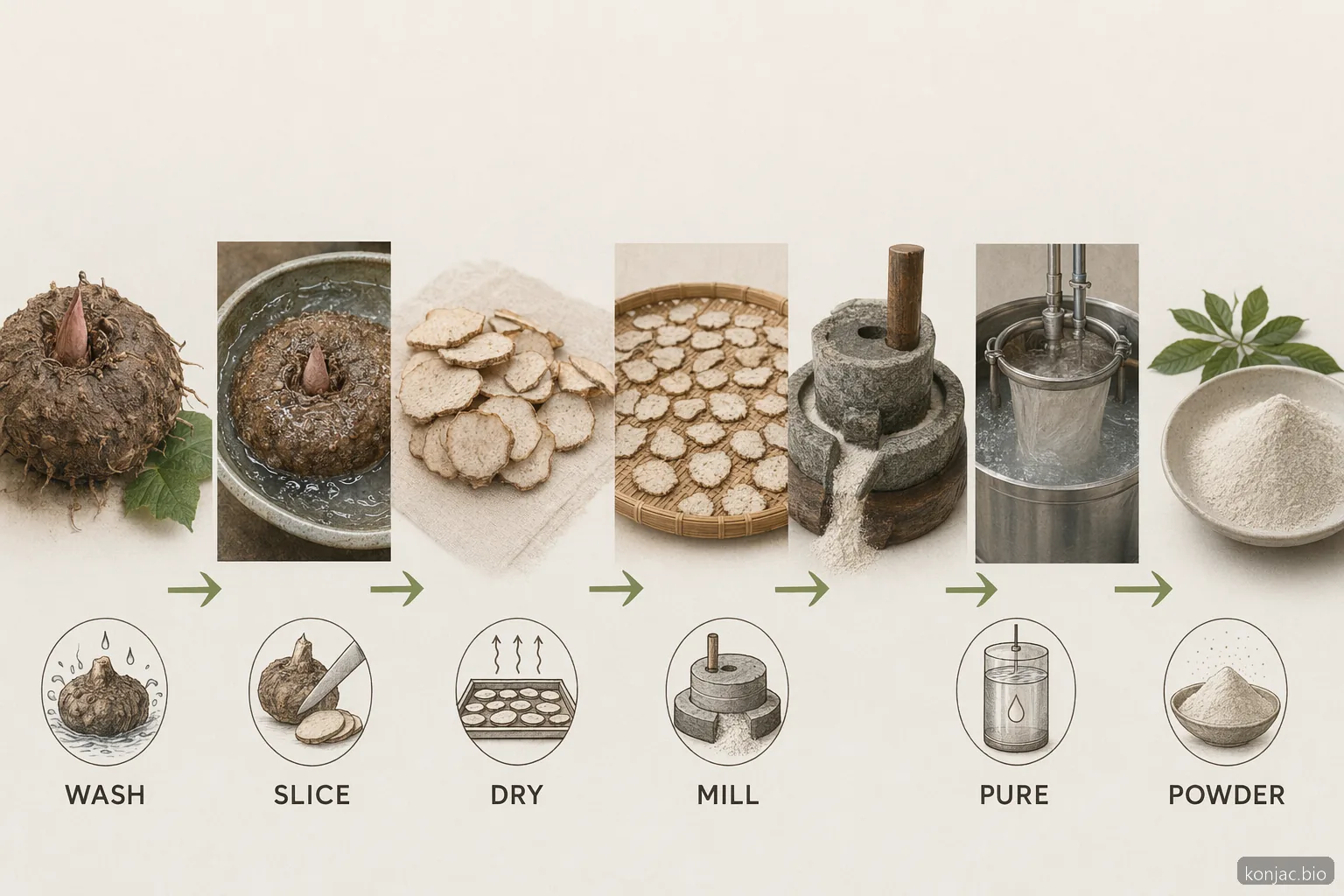
Modern konjac supply connects traditional food knowledge with industrial processing. Fresh corms are washed, sliced, dried, milled, refined, packed, and shipped as ingredients or finished products. That chain supports retail noodles and jellies, supplement powders, food-service rice alternatives, and private-label konjac product lines.
For buyers, konjac origin matters because growing region, harvest age, drying method, and milling grade can affect viscosity, odor, color, sulfur dioxide residue, and microbial quality. A noodle factory may accept a different grade than a supplement capsule brand, while a jelly brand may need tight particle-size control and predictable gel strength.
How is konjac root processed into flour and glucomannan powder?
Konjac root is processed by washing the corm, slicing it, drying it, milling it, then refining the powder to concentrate glucomannan and remove starch, protein, ash, odor, and color.
The raw material enters the factory as a high-moisture corm. Fresh konjac cannot simply be stored like dry grain because moisture and enzymatic changes can reduce quality. Processors therefore move quickly from harvest to slicing and drying, or they use controlled storage before drying.
- Harvest: mature corms are lifted, trimmed, graded, and separated from damaged material.
- Washing: soil, stones, and outer residues are removed before slicing.
- Slicing: corms are cut into chips to increase surface area for drying.
- Drying: chips are dried with hot air or other controlled methods to reduce moisture.
- Milling: dried chips are ground into crude konjac flour.
- Purification: air classification, sieving, washing, or alcohol-based refining may raise glucomannan purity.
- Blending and packing: final lots are standardized for viscosity, mesh size, color, moisture, and microbiology.
Konjac flour and glucomannan powder are related but not identical. Konjac flour usually means a milled corm product that still contains non-fiber components. Glucomannan powder usually means a more purified fraction with higher soluble fiber concentration and more consistent viscosity. Food additive specifications may use the term konjac flour or konjac gum depending on jurisdiction and application.
| Grade | Typical buyer | Key quality checks |
|---|---|---|
| Food-grade konjac flour | Noodle, rice, konnyaku, and jelly manufacturers | Viscosity, gel strength, odor, mesh, moisture |
| Refined glucomannan powder | Supplement and functional beverage brands | Glucomannan level, purity, heavy metals, microbiology |
| Konjac gum, E425 | Industrial food formulators | Additive compliance, viscosity, labeling, allergen controls |
| Sponge-grade material | Skincare sponge producers | Fiber structure, whiteness, cleanliness, shape control |
In the United States, konjac flour is listed in federal food additive regulations for specific uses, including as a stabilizer and thickener, with conditions described in 21 CFR. In the European Union, konjac is associated with additive numbers E425(i) konjac gum and E425(ii) konjac glucomannan under the broader additive framework described in EU additives.
Quality is not determined by one number. A high-glucomannan powder with poor odor may be unsuitable for clear beverages. A flour with excellent gel strength may be perfect for shirataki but too coarse for capsules. Buyers usually request a certificate of analysis covering viscosity, particle size, moisture, ash, sulfur dioxide, lead, arsenic, cadmium, mercury, total plate count, yeast, mold, E. coli, Salmonella, and Staphylococcus aureus.
Processing also shapes consumer experience. Better washing and deodorizing can reduce the fishy or alkaline aroma sometimes noticed when opening shirataki bags. Stronger gel control gives noodles that do not break easily. Consistent particle size helps konjac jelly set evenly rather than forming weak spots.
Konjac foods: konnyaku, shirataki, rice, jelly, pasta, and shuang
Konjac foods share one technical idea: glucomannan absorbs water, then forms a stable gel when processed with alkaline or calcium-based setting systems. The final shape can be a block, noodle, rice grain, jelly cup, strip, sheet, or pasta-style form.
Konnyaku konjac is the classic gel block. In Japan, it is often cut into triangles, cubes, or sheets and simmered in broth. The texture is springy rather than creamy, and the flavor is intentionally neutral so it can carry soy sauce, miso, dashi, chili, sesame, or hot pot broth.
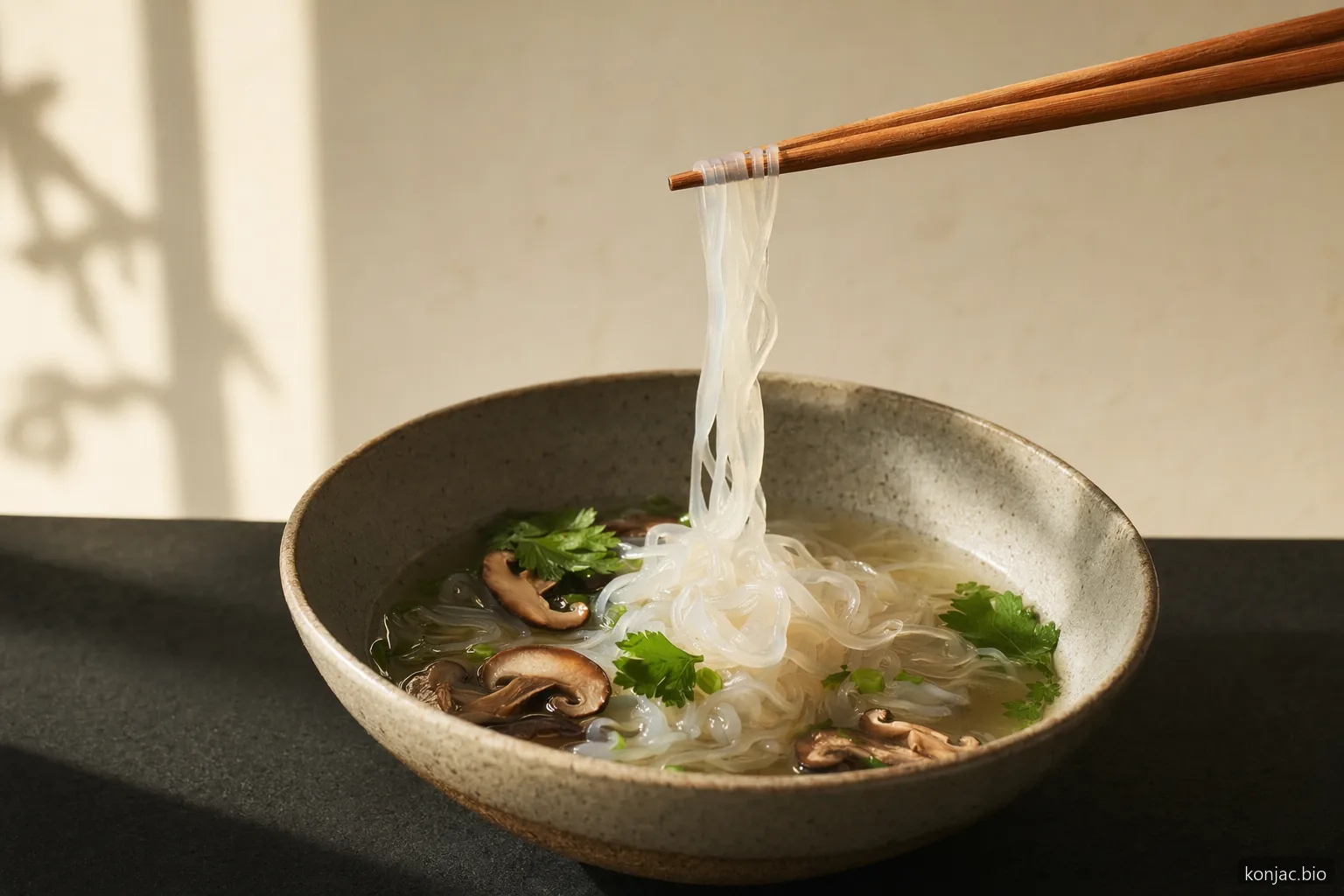
Shirataki is the noodle form. A konjac noodle may be packed in water, dry-packed, or blended with oat fiber, soy fiber, tapioca, or other ingredients for texture. Plain shirataki is usually very low in calories because it contains mostly water and fiber. For a full cooking guide, see shirataki noodles.
Konjac rice uses the same principle but changes the extrusion or cutting pattern into rice-like grains. It is used as a lower-calorie substitute for steamed rice, fried rice, rice bowls, and meal-prep bases. Many products blend konjac with small amounts of oat fiber, tapioca, or other starches to reduce bounce and create a more rice-like bite.
Konjac jelly is a sweet gel snack or dessert format. People searching what is konjac jelly usually mean fruit-flavored cups, pouches, or jelly drinks made with konjac gum or glucomannan plus sweetener, acid, flavor, and sometimes carrageenan or other hydrocolloids. Mini-cup jelly design matters because the U.S. FDA has warned about choking risk in small gel candies with konjac, especially when firm gels are sold in one-bite cups via FDA warning.
Konjac pasta is a Western retail phrase for noodle shapes designed to replace spaghetti, fettuccine, penne, or lasagna strips. Some products are pure konjac gel, while others are hybrid recipes with vegetable fiber, soy, or starch for a less slippery texture. Lowercase miracle noodles is another generic phrase shoppers use for shirataki-style products.
Konjac shuang is a Chinese snack-style category that may appear as spicy strips, sheets, knots, or thin pieces in chili oil and seasoning. It is closer to a ready-to-eat savory snack than a pasta substitute. Product developers often focus on chew, spice adhesion, oil control, and shelf stability.
| Product | Shape | Typical format | Main buyer concern |
|---|---|---|---|
| Konnyaku | Block, sheet, knot | Fresh pack or retort pouch | Gel strength and neutral taste |
| Shirataki | Noodle | Water pack, shelf-stable pouch, chilled pack | Odor, breakage, texture |
| Konjac rice | Rice-like grains | Water pack or ready meal | Grain separation and bite |
| Konjac jellies | Cup, pouch, drink jelly | Sweet snack or dessert | Choking-risk design and gel firmness |
| Konjac pasta | Spaghetti, fettuccine, penne-style | Retail pouch | Sauce adhesion and aroma |
| Konjac shuang | Strip, sheet, knot | Seasoned snack | Chew, spice level, oil control |
Consumers usually judge konjac foods by smell, chew, satiety, calorie count, and convenience. Food manufacturers judge the same products by pH, water activity, sterilization conditions, package integrity, shelf life, labeling, and cost per finished serving. Both perspectives matter because a product that is technically stable but unpleasant will not earn repeat purchase.
How does konjac glucomannan work in foods and supplements?
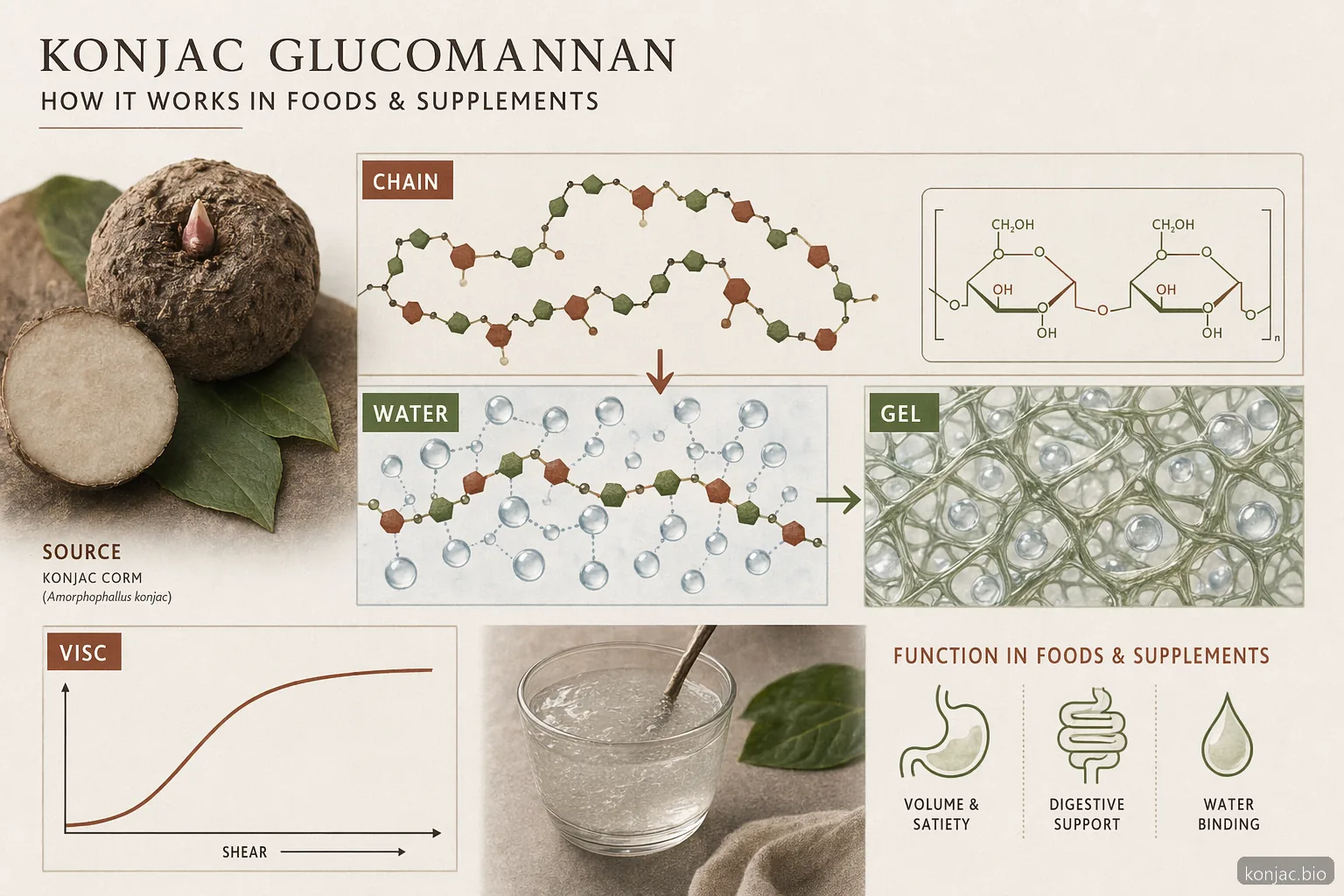
Konjac glucomannan works by binding large amounts of water, increasing viscosity, and forming gels that change texture, serving volume, and digestion speed.
Chemically, glucomannan is a polysaccharide made mainly from glucose and mannose units. Its high molecular weight and soluble fiber behavior explain why small percentages can strongly thicken water-based systems. A product with 1 percent konjac gum can behave very differently from the same product without it.
In foods, glucomannan has three practical jobs. First, it holds water, which allows low-solids foods such as shirataki noodles to keep shape. Second, it thickens liquids, which helps sauces, beverages, and jelly drinks. Third, it forms elastic gels when used with alkaline salts or selected hydrocolloid systems.
In supplements, glucomannan is sold as capsules, tablets, powders, and drink mixes. The key safety factor is water. Dry glucomannan expands when hydrated, so labels should tell users to take it with adequate liquid and avoid dry swallowing. Capsule size, disintegration timing, and serving instructions are important quality details, not minor packaging choices.
EFSA has evaluated glucomannan health claims. The approved wording for weight management is: “Glucomannan in the context of an energy restricted diet contributes to weight loss,” with conditions described in the EFSA opinion. EFSA has also evaluated a claim that glucomannan contributes to the maintenance of normal blood cholesterol concentrations in a separate EFSA opinion.
Plain-language claims should stay careful. A compliant consumer summary can say glucomannan may support weight management when used with an energy-restricted diet and adequate water. It should not be presented as a stand-alone solution, and it should not be framed with exaggerated before-and-after promises.
For formulators, glucomannan is a hydrocolloid tool. It can be paired with carrageenan, xanthan gum, starch, agar, gellan gum, or cellulose fibers depending on the target texture. Each pairing changes gel elasticity, syneresis, freeze-thaw stability, clarity, bite, and cost.
- Shirataki noodles: high water, firm gel, neutral taste, low breakage.
- Konjac jelly: controlled firmness, clean flavor release, safe package geometry.
- Capsules: predictable expansion, label instructions, purity, microbiology.
- Drink mixes: rapid dispersion, low clumping, acceptable mouthfeel.
- Bakery and sauces: thickening, moisture retention, calorie reduction strategies.
Konjac does not perform like wheat gluten, gelatin, or starch. It gives bounce and viscosity rather than bread structure, meat-like protein texture, or creamy fat. Successful products use konjac where spring, thickness, water holding, or serving volume is the goal.
Is konjac safe to eat?
Konjac is widely used in foods, but safety depends on product form, hydration, serving size, package design, and clear directions.
Most everyday konjac foods are high-water gels: noodles, rice, blocks, and pouches. These products are already hydrated, so their main quality concerns are texture, pH, storage, odor, and labeling. Dry powders and capsules require more caution because glucomannan expands after contact with water.
For consumers, the practical guidance is simple. Eat hydrated konjac foods in normal portions, chew well, and follow package directions. For powders or capsules, take with the amount of water stated on the label. People with swallowing difficulty should avoid dry expanding-fiber formats unless a qualified professional has given personalized advice.
Konjac jelly needs special attention because small, firm, slippery gels can create a choking risk. The FDA has issued warnings about mini-cup gel candies containing konjac, especially when the gel is firm and designed as a one-bite product via FDA warning. Safer jelly design uses pouches, spoonable cups, softer gels, larger serving geometry, or textures that break apart more easily.
Regulators handle konjac through food additive, food ingredient, or supplement frameworks depending on country and product type. In the United States, konjac flour appears in federal food additive regulations under 21 CFR. In the EU, konjac gum and konjac glucomannan are identified as E425 forms under food additive rules via EU additives.
| Product form | Main safety point | Practical control |
|---|---|---|
| Shirataki noodles | Hydrated gel food | Rinse, heat, chew normally |
| Konjac rice | Hydrated gel grains | Drain well and follow storage label |
| Konjac jelly | Choking risk if too firm or small | Use safer pack shape and softer gel design |
| Glucomannan capsules | Expansion after swallowing | Take with adequate water |
| Konjac powder | Clumping and rapid thickening | Disperse fully in liquid before drinking |
Food manufacturers should validate pH, heat process, package seal integrity, microbial limits, and shelf-life stability. Supplement brands should check heavy metals, microbiology, identity, purity, serving instructions, and warning language. Importers should confirm the destination market’s rules before ordering because konjac jelly, E425 additives, and supplements may face different documentation requirements.
Konjac can be part of a sensible diet, but it is not nutritionally complete. Plain shirataki noodles are low in energy, protein, fat, and micronutrients. A balanced meal usually adds protein, vegetables, sauce, and healthy fat rather than relying on konjac alone.
Konjac sponge and other non-food uses
Konjac sponge products use the same plant origin but a different manufacturing goal: a porous, soft, water-swollen cleansing tool rather than an edible gel. The finished sponge is typically made by forming konjac material into a wet gel, shaping it, freezing or drying it, then rehydrating it before use.
A dry konjac sponge feels hard and lightweight. After soaking, it becomes soft, elastic, and slightly springy. Consumers use it for facial cleansing, body cleansing, and gentle exfoliation, often with water alone or a small amount of cleanser. For a dedicated skincare guide, see konjac sponge.
Some sponges include charcoal, clay, green tea, turmeric, aloe, or other cosmetic ingredients. These additions mostly affect color, positioning, and skin-feel claims. The base structure still comes from konjac’s gel-forming and water-holding behavior.
Quality concerns differ from food products. A sponge buyer checks shape, softness after hydration, breakage during use, drying behavior, odor, packaging hygiene, and cosmetic compliance. A food buyer checks viscosity, gel strength, pH, microbial limits, heavy metals, and additive status. The raw plant link is the same, but the specification sheet should not be copied from one category to another.
Konjac is also used in technical hydrocolloid contexts. Food formulators use it for thickening, stabilizing, gelling, and texture modification. Researchers study glucomannan films, biodegradable materials, and edible coatings, often because the polymer is water-binding, plant-derived, and compatible with other polysaccharides. A review of konjac glucomannan properties is available through PubMed review.
For consumers, the biggest distinction is ingestion. Food-grade konjac products are made for eating under food controls. Cosmetic sponges are not food, even if the plant name sounds edible. The package category, factory controls, and intended use should match how the item is used.
For brand owners, cross-category storytelling should be accurate. A skincare sponge can say it is made from konjac plant material, but it should not borrow supplement claims. A noodle brand can explain low-calorie texture, but it should not imply that a facial sponge and a food pouch have the same compliance pathway.
How should buyers evaluate konjac ingredients and OEM products?
Buyers should evaluate konjac ingredients and OEM products by matching the exact application to viscosity, purity, gel strength, microbiology, certifications, regulatory status, and factory capability.
A supplement brand, jelly brand, noodle importer, and sponge company may all ask for konjac, but they need different materials. A high-viscosity glucomannan powder can be excellent for capsules and difficult in a ready-to-drink beverage. A lower-cost flour can work in noodles but fail a clean-label jelly if odor or color is too strong.
Start with the product form. Ingredient sourcing begins with whether the buyer needs konjac flour, refined glucomannan, E425 konjac gum, pregelled konnyaku blocks, water-packed shirataki, dry konjac noodles, konjac rice, jelly pouches, ready-to-eat konjac shuang, or cosmetic sponges. Each form has a different bill of materials, processing line, label, and test plan.
Then request documentation. A serious supplier should be able to provide a certificate of analysis, specification sheet, allergen statement, GMO statement where relevant, flow chart, ingredient declaration, safety data sheet for industrial handling where relevant, and proof of certifications such as ISO 22000, HACCP, BRCGS, FSSC 22000, Halal, Kosher, or organic when claimed. Certification names should match the factory and scope, not only a trading company brochure.
| Buyer goal | Best starting material | Must-check items |
|---|---|---|
| Private-label shirataki | Finished noodle OEM | Texture, odor, shelf life, pouch quality, label compliance |
| Konjac jelly brand | OEM jelly pouches or gum blend | Gel safety, pH, sweetness, package geometry, heat process |
| Supplement capsules | Refined glucomannan powder | Purity, viscosity, heavy metals, microbiology, capsule fill behavior |
| Food manufacturing | Konjac flour or E425 gum | Viscosity, mesh, gel strength, additive status, batch consistency |
| Skincare line | Konjac sponge OEM | Softness, shape, drying, cosmetic documentation, packaging hygiene |
Pricing should be compared at the finished-use level, not only per kilogram. A cheaper powder with lower viscosity may require a higher dosage. A low-cost noodle may have weak texture or a strong alkaline smell that hurts repeat purchase. A jelly with attractive flavor but risky cup geometry can create compliance and reputation problems.
Buyers should also define tolerance ranges before sampling. Useful ranges include viscosity method and value, mesh size, moisture, ash, sulfur dioxide, pH, gel strength, total plate count, yeast and mold, heavy metal limits, and target shelf life. Without test methods, two suppliers can report the same word, such as high viscosity, while using different measurement conditions.
For buyers, konjac.bio can help with wholesale, private-label, and OEM sourcing across flour, glucomannan powder, noodles, rice, jelly, and sponge formats, with specifications routed through contact.
Logistics matter because konjac products span dry powder, ambient pouches, retort packs, chilled items, and bulky sponge cartons. A container of dry powder is not planned like a mixed retail shipment of noodles and jelly. Lead time should include sample approval, artwork, label review, pre-production testing, production slot, inspection, export documents, sea freight, customs, and domestic delivery.
Cooking with konjac at home
Cooking with konjac is mostly about improving aroma, removing excess pack liquid, and pairing the neutral gel with strong flavors. The most common complaint about shirataki or konjac rice is not safety or nutrition, but the first smell after opening the pouch.
That smell usually comes from the alkaline packing liquid used to keep the gel stable. It is reduced by draining, rinsing under cold water, boiling briefly, then dry-pan heating before adding sauce. Dry-pan heating removes surface water and helps the noodle or rice absorb seasoning.
- Drain: pour off the package liquid.
- Rinse: rinse under cold running water for 30 to 60 seconds.
- Boil: simmer for 1 to 3 minutes for a cleaner aroma.
- Dry-pan: heat in a skillet until excess water evaporates.
- Sauce: add to stir-fries, soups, curries, ramen broth, or tomato sauce.
Konjac noodles do not cook like wheat pasta. They do not soften from starch gelatinization because there is little starch. Long boiling will not turn them into spaghetti. The best results come from flavoring the surface and choosing sauces that cling well.
For Asian-style dishes, konjac works well with soy sauce, sesame oil, chili crisp, miso, ginger, garlic, scallion, curry paste, hot pot broth, and peanut sauce. For Western-style konjac pasta, stronger sauces such as tomato basil, mushroom cream-style sauce, pesto, or spicy arrabbiata usually perform better than thin butter sauces.
Konjac rice works best when water is driven off before mixing. For fried rice, dry-pan the grains first, then add egg, vegetables, protein, and seasoning. For rice bowls, pair konjac rice with saucy toppings such as curry, mapo tofu-style sauce, stir-fried vegetables, or braised mushrooms.
Konnyaku blocks and knots are better when simmered. Scoring the surface with shallow cuts helps broth cling. In hot pots, the gel holds shape and gives chew without turning mushy. In skewers or stir-fries, small pieces absorb sauce better than large cubes.
Konjac jelly and konjac jellies are ready-to-eat formats, so home preparation is minimal. Serve spoonable cups with a spoon, squeeze pouch jellies slowly, and avoid giving firm one-bite gels to small children. The safest enjoyment pattern is slow eating, chewing, and following the age and serving guidance on the package.
Konjac is useful for people building lower-calorie meals, but it works best as a texture base rather than the whole meal. Add tofu, eggs, fish, chicken, beans, or other protein, plus vegetables and a flavorful sauce. For recipe ideas across noodles, rice, hot pots, and stir-fries, see konjac recipes.
Frequently asked questions
01 What is konjac made from?
02 Is konjac the same as glucomannan?
03 What does konjac taste like?
04 What is konjac jelly?
05 Are shirataki noodles and konjac noodles the same?
06 Can konjac support weight management?
07 Is konjac safe for children?
08 What should wholesale buyers check before ordering konjac?
- Shirataki Noodles: The Complete Guide to Konjac Pasta
- Glucomannan Guide: Benefits, Dosage, Safety, and Forms
- Konjac Jelly: Pouches, Cups, Drinks, and Choking Safety
- Konjac Sponge: The Natural Skincare Tool
- Konjac Flour and Powder: The Food-Ingredient Guide
- Konjac Rice: The Low-Carb Rice Swap, Cooked Right
- Konjac Recipes for Shirataki, Konjac Rice, Jelly, and Flour
- Amorphophallus konjac K.Koch · Plants of the World Online, Royal Botanic Gardens Kew · 2024
- Scientific Opinion on glucomannan and body weight claim · EFSA Journal · 2010
- Scientific Opinion on the substantiation of health claims related to konjac mannan (glucomannan) and maintenance of normal blood cholesterol concentrations · European Food Safety Authority, EFSA Journal 2009;7(9):1258 · 2009
- Import Alert 33-15: Detention Without Physical Examination of Gel Candies Containing Konjac · U.S. Food and Drug Administration · 2024
- Regulation (EC) No 1333/2008 on food additives · EUR-Lex · 2008
- Konjac Glucomannan: From Molecular Architecture to Translational Applications. A Critical Review of Structure-Function Relationships, Emerging Biomedical Frontiers, and Industrial Challenges · Foods (PubMed) · 2026