What is dry konjac rice?
Dry konjac rice is a shelf-stable, dehydrated rice substitute made mainly from konjac glucomannan, water, and a setting agent such as calcium hydroxide.
The key ingredient comes from Amorphophallus konjac, a corm crop used to make konjac flour and glucomannan. EFSA identifies konjac mannan, also called glucomannan, as a soluble dietary fiber from the tuber of Amorphophallus konjac in its assessment of konjac mannan.
Dry formats are produced as small grains, pearls, or rice-shaped pieces. They are designed to absorb hot water, broth, or sauce before cooking, which is why one dry pouch can yield several cooked servings.
Unlike white rice, dry konjac rice is not a cereal grain. It is built around soluble fiber, so it has a springier bite, less starch, and much lower energy density than cooked rice. For a broader foundation on formats, ingredients, and use cases, see our konjac rice guide.
How is dry konjac rice different from wet konjac rice?
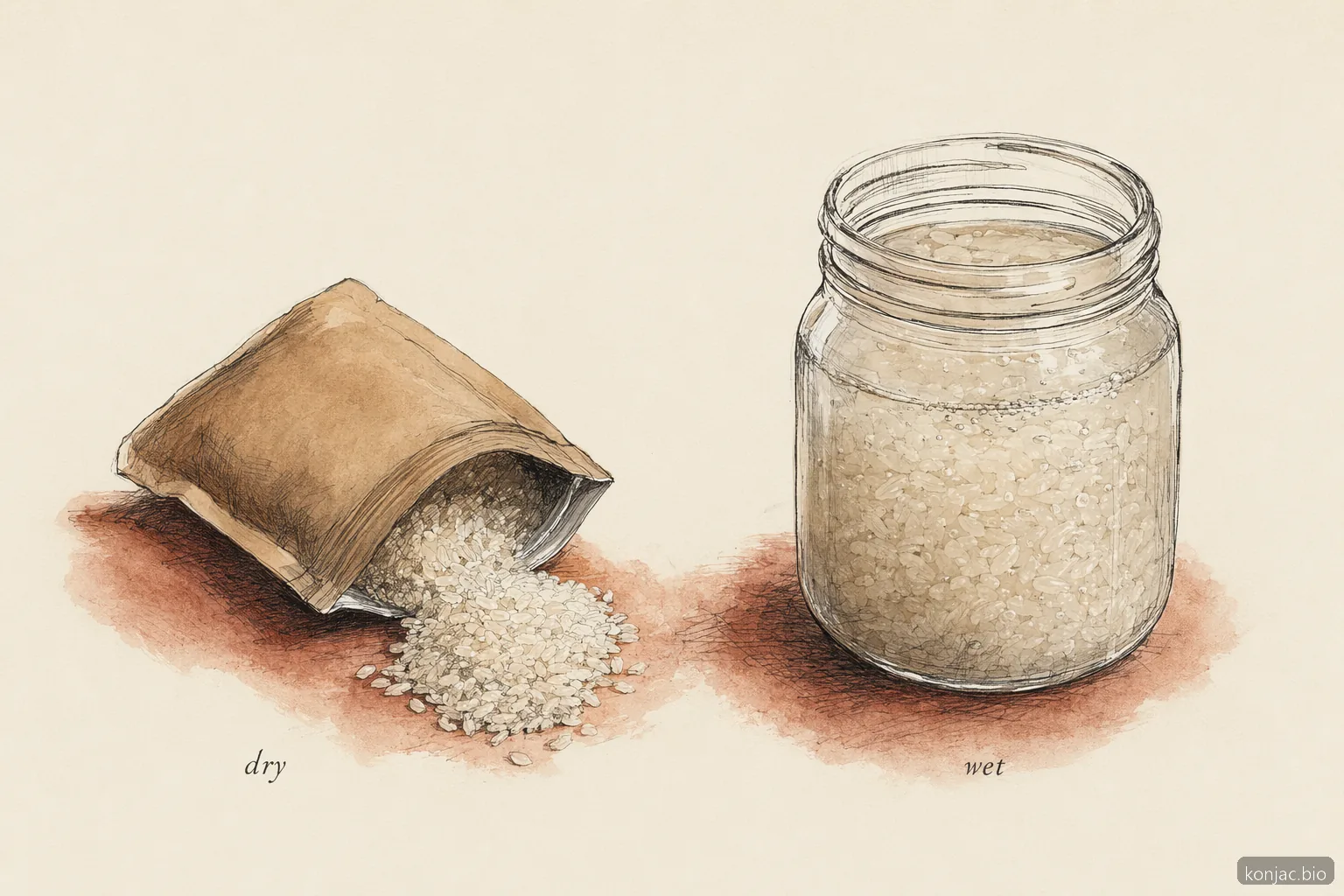
Dry konjac rice differs from wet konjac rice because it is dehydrated before packing, while wet konjac rice is usually stored in liquid inside a ready-to-rinse pouch.
The difference affects shipping weight, shelf storage, cooking workflow, and texture control. Dry rice takes more preparation, but it gives cooks more control over hydration level and final chew.
| Feature | Dry konjac rice | Wet konjac rice |
|---|---|---|
| Pack format | Dehydrated grains or pearls | Rice-shaped pieces in liquid |
| Prep time | Usually 8 to 15 minutes hydration | Usually rinse, drain, heat |
| Storage | Pantry-stable when sealed | Pantry-stable until opened, then refrigerate |
| Odor | Often milder before cooking | Can have alkaline pack-water aroma |
| Texture control | Higher, because hydration can be adjusted | Lower, because moisture is already high |
| Best uses | Meal kits, dry blends, camping food, export packs | Fast bowls, retail pouches, quick sides |
Dry konjac rice is especially useful when freight, storage density, or shelf display weight matters. Wet formats are more convenient for consumers who want the shortest path from pouch to plate.
If texture is the main purchase driver, compare preparation methods in our konjac rice cooking guide. If shoppers are comparing vegetable-based swaps, our konjac rice vs cauliflower rice guide explains the main nutrition and texture differences.
How do you cook dry konjac rice for the best texture?
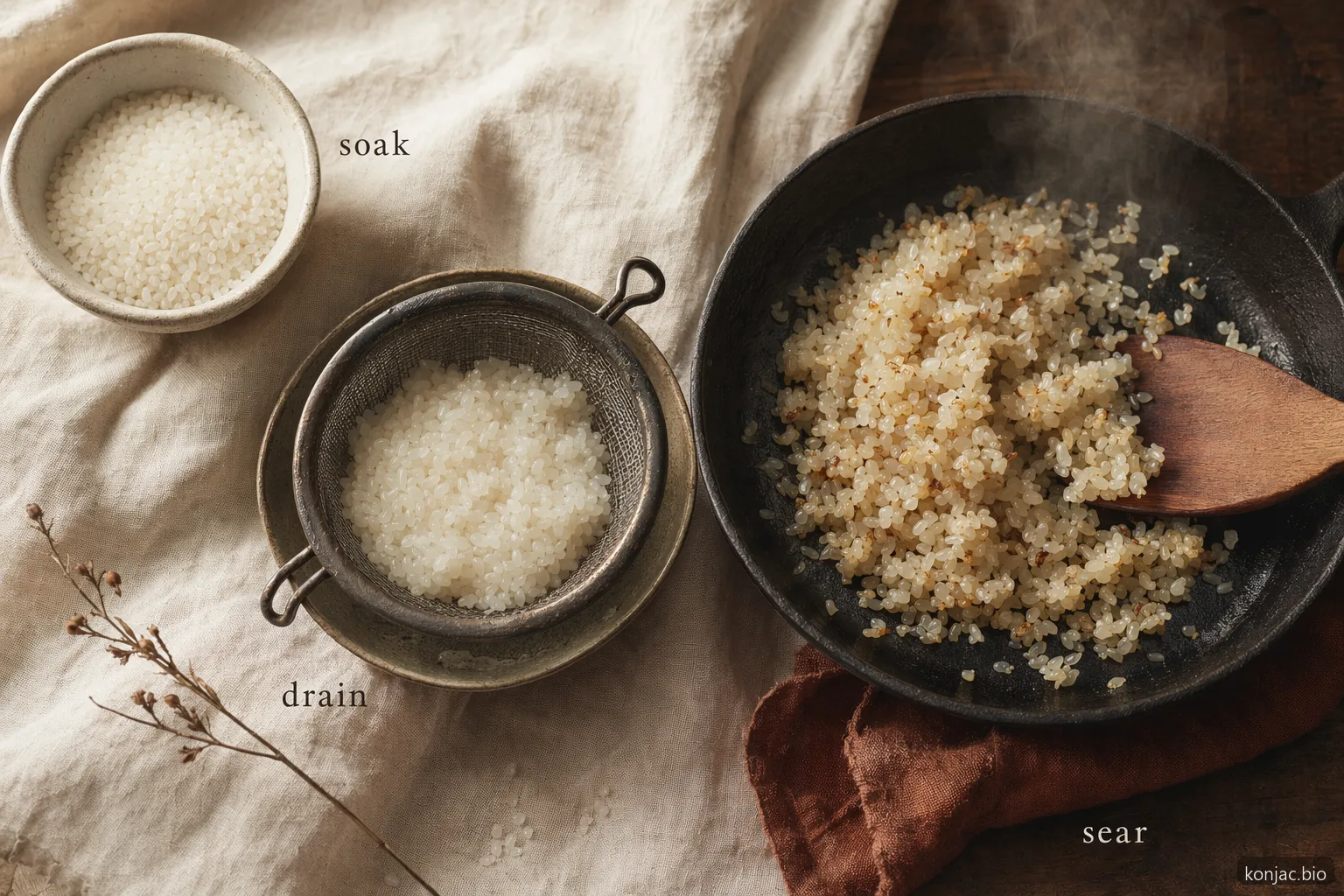
You cook dry konjac rice best by hydrating it fully, draining it well, then heating it in a dry pan to remove excess surface moisture.
Package instructions should lead because grain size, formulation, and drying method vary. A small pearl may soften faster than a larger rice-shaped piece, and flavored blends can need different water ratios.
- Hydrate: Add dry konjac rice to boiling water or broth. Many products work in a 1:4 dry rice to liquid ratio, but labels should override any general ratio.
- Simmer: Cook for 8 to 15 minutes, or until the center is tender rather than rubbery.
- Drain: Use a fine sieve. Let it sit for 1 to 2 minutes so surface water runs off.
- Dry-pan finish: Heat in a nonstick or stainless pan for 2 to 4 minutes, stirring often, until steam slows down.
- Season late: Add salt, soy sauce, vinegar, spices, or aromatics after draining so flavor clings to the surface.
For fried rice, cool the drained rice before stir-frying. A cooler grain surface releases less steam, which helps eggs, vegetables, tofu, seafood, or meat brown instead of stew.
For soup bowls, hydrate the rice separately when clarity matters. Adding dry konjac rice directly to broth can thicken the liquid slightly because glucomannan is a water-binding soluble fiber.
Can dry konjac rice support low-carb meal planning?
Dry konjac rice can support low-carb meal planning because its finished serving is usually much lower in digestible carbohydrate and calories than cooked white rice.
Exact values depend on the product. Some labels list 5 to 20 calories per prepared serving, while blends that include oat fiber, tapioca starch, rice flour, or seasoning can be higher. Always compare the prepared serving size, not only the dry weight.
Glucomannan is the functional fiber behind konjac rice. FDA lists 28 grams as the Daily Value for dietary fiber on U.S. Nutrition Facts labels, based on a 2,000-calorie diet, in its fiber guidance.
EFSA has also authorized specific glucomannan wording for weight-management contexts: “Glucomannan in the context of an energy restricted diet contributes to weight loss.” EFSA also states that the effect is obtained with 3 grams of glucomannan daily in three 1-gram doses with 1 to 2 glasses of water before meals, within an energy-restricted diet, in its EFSA opinion.
That claim is about glucomannan under defined conditions, not every konjac rice bowl. A finished serving of dry konjac rice may contain less than 1 gram, 2 grams, or more fiber depending on the formulation and serving size.
For practical meals, pair konjac rice with protein, vegetables, and fat-containing sauces. A bowl with konjac rice, 120 grams grilled chicken, 150 grams mixed vegetables, and 1 tablespoon sesame dressing is more filling than plain konjac rice with salt.
Buying, storage, and safety checklist for dry konjac rice
Good dry konjac rice should be easy to hydrate, neutral in flavor, consistent in grain size, and clear about prepared nutrition per serving.
Use this checklist before buying for retail, foodservice, or manufacturing:
- Ingredient list: Look for konjac flour, glucomannan, water, and a food-grade setting agent. Blends with starch or grains are not automatically bad, but they change carbs and calories.
- Prepared yield: Compare cooked grams per pouch. A 100-gram dry pack may produce several servings, depending on hydration ratio.
- Fiber disclosure: Check fiber per prepared serving, not only per dry 100 grams.
- Texture target: Ask whether the product is designed for rice bowls, fried rice, soups, meal kits, or dry seasoning blends.
- Certifications: For B2B, ask about HACCP, ISO 22000, BRCGS, halal, kosher, organic, or gluten-free documentation where relevant.
- Packaging: Moisture-barrier pouches matter because dry konjac absorbs water from humid air after opening.
Store sealed packs in a cool, dry place. After opening, reseal tightly or move the rice to an airtight container. Moisture exposure can cause clumping and uneven hydration.
Do not eat dry konjac rice without hydrating it according to the label. Konjac products bind water strongly, and the FDA has warned about choking hazards in certain konjac mini-cup gel candy formats because product format affects safe consumption, as noted in an FDA warning.
For manufacturers, konjac.bio sources konjac ingredients at wholesale scale for dry rice, wet rice, noodles, blends, and private-label development. Contact our team for specifications, bulk pricing, and format guidance.
Frequently asked questions
01 Is dry konjac rice the same as shirataki rice?
02 Does dry konjac rice taste like white rice?
03 How many carbs are in dry konjac rice?
04 Can dry konjac rice be used in fried rice?
05 How should dry konjac rice be stored after opening?
- Scientific Opinion on health claims related to konjac mannan · European Food Safety Authority · 2010
- Questions and Answers on Dietary Fiber · U.S. Food and Drug Administration · 2024
- FDA warning on certain mini-cup gel candies · U.S. Food and Drug Administration · 2001
- Konjac glucomannan literature index · PubMed · 2024