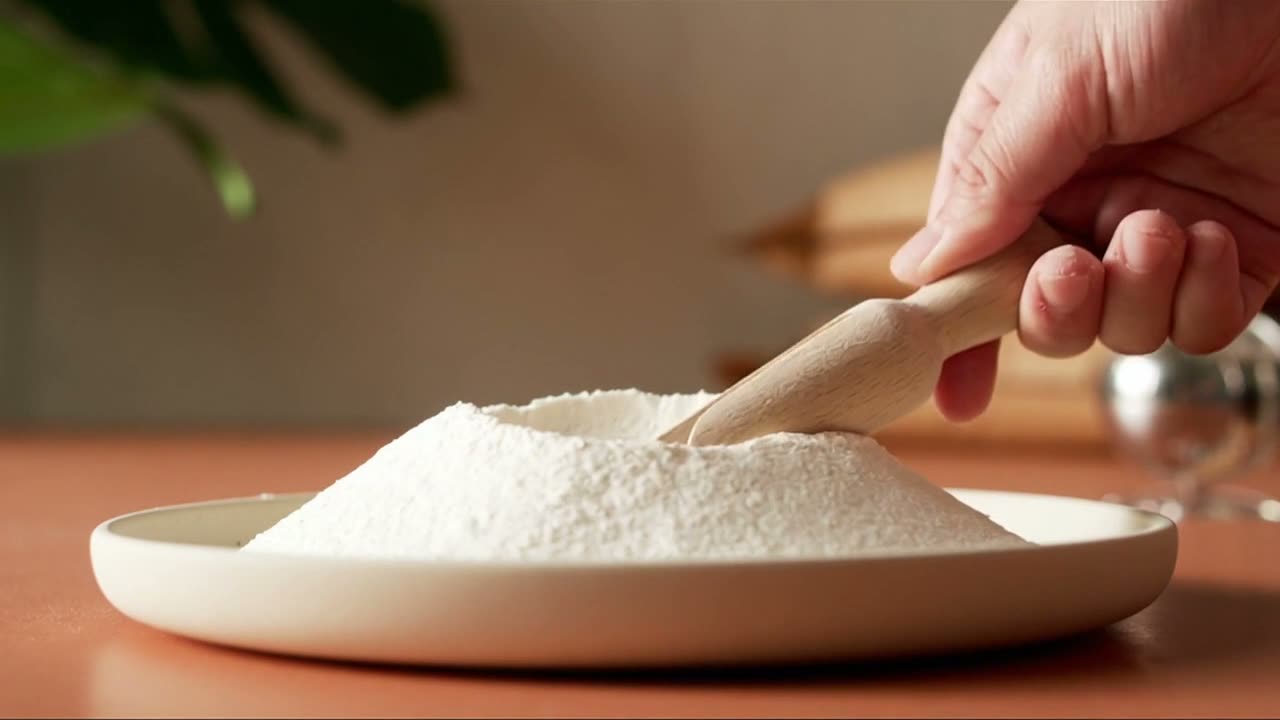
What is konjac flour made from?
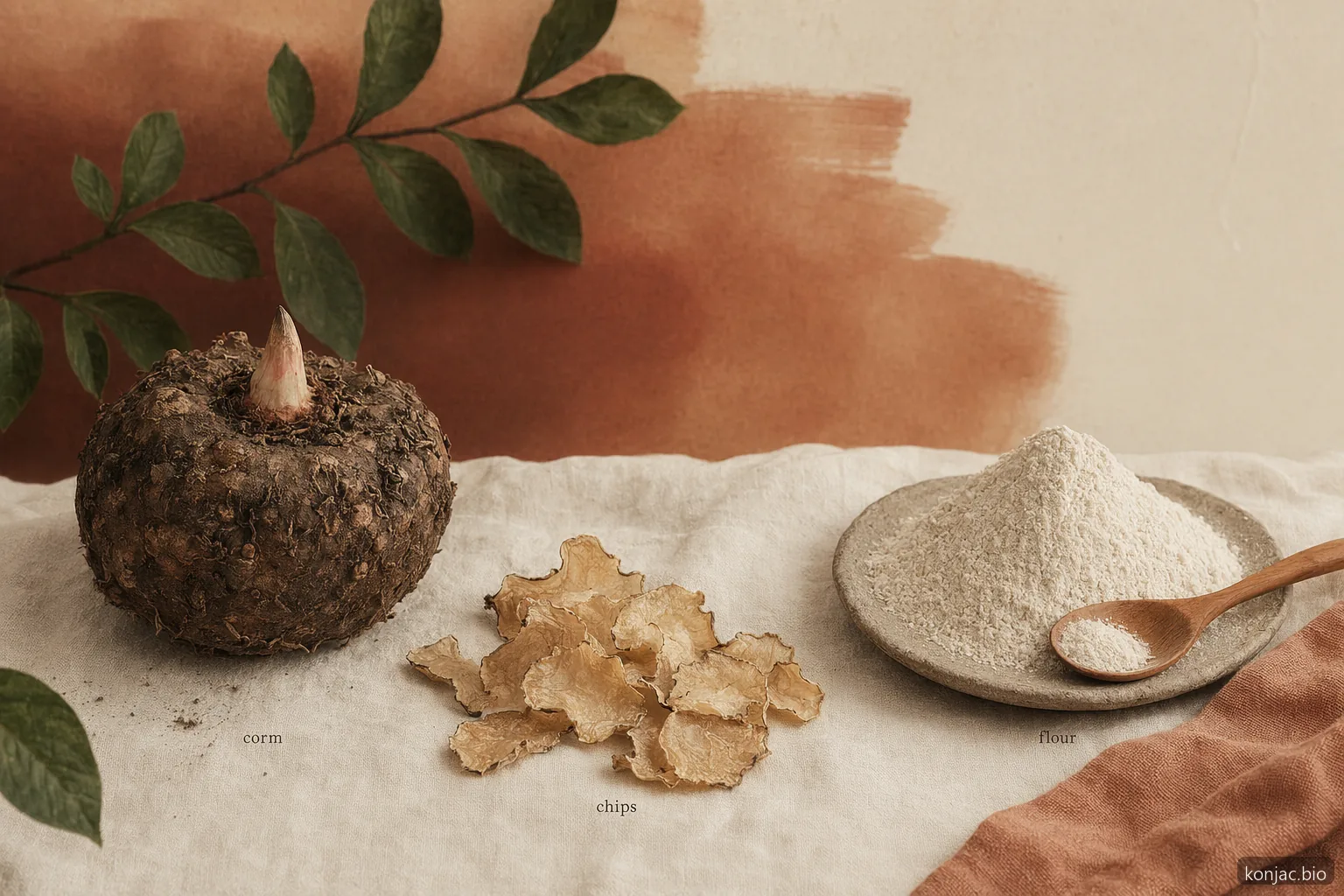
Konjac flour is made from the dried, milled corm of Amorphophallus konjac, a perennial aroid plant cultivated mainly in East and Southeast Asia.
The useful fraction is glucomannan, a soluble polysaccharide concentrated in the corm. In food ingredient commerce, the same source material may be sold as konjac flour, konjac powder, purified konjac gum, or glucomannan powder, depending on refining level, viscosity, and intended use.
The plant itself is different from cereal grains. A konjac corm is an underground storage organ, not a wheat, barley, or rye seed. That distinction matters for shoppers asking whether konjac flour is gluten-free and for formulators replacing starches, gums, or wheat-derived thickeners.
Industrial production usually follows a controlled sequence:
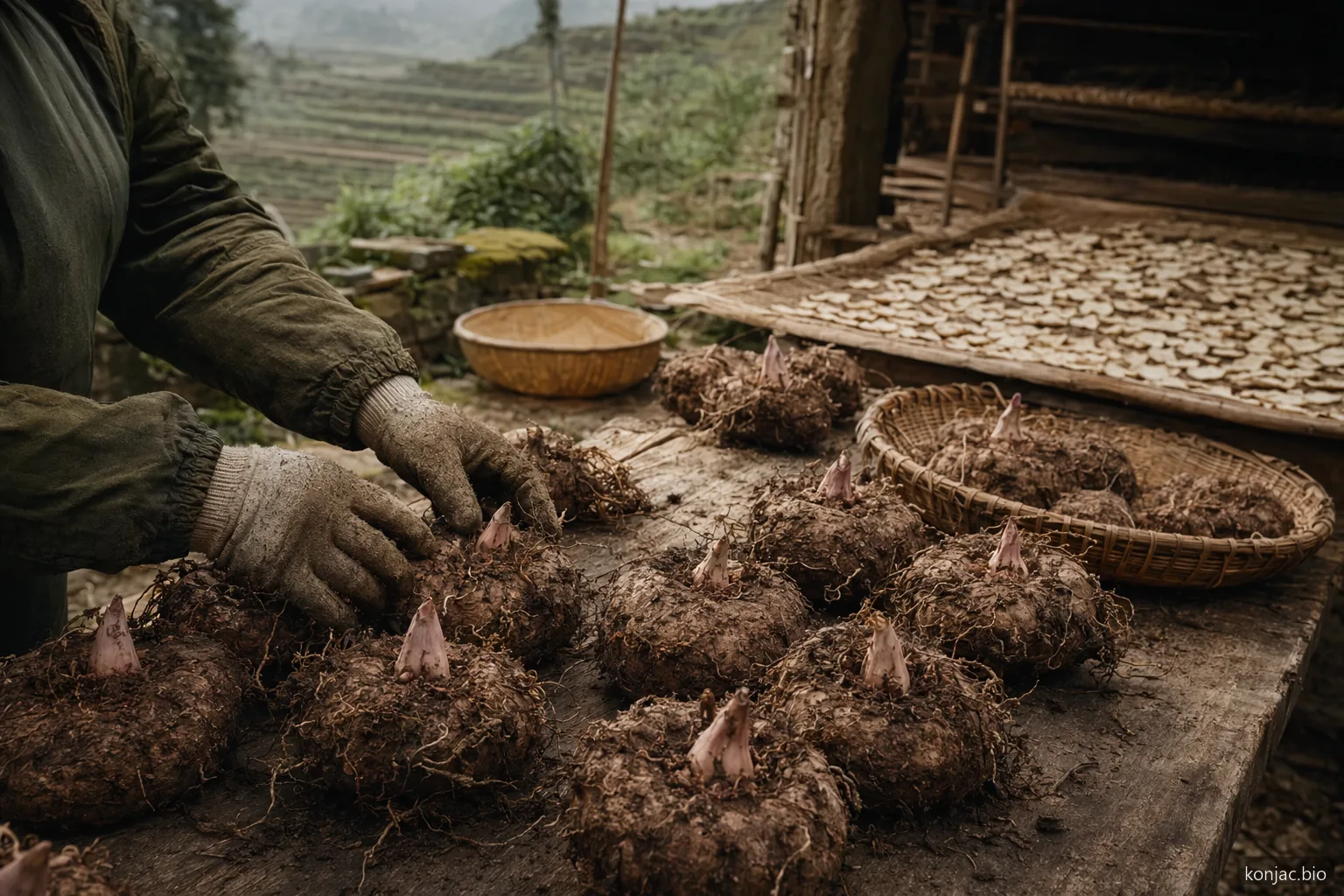
- Corm selection: mature corms are graded for age, size, damage, and glucomannan potential.
- Cleaning and slicing: soil, peel, and outer tissue are removed before slicing.
- Drying: slices are dried to reduce moisture and stabilize the raw material.
- Milling: dried chips are ground into coarse or fine powder.
- Purification: starch, ash, pigments, and low-grade fiber may be reduced through sieving, washing, or alcohol-assisted refining.
- Standardization: lots are tested for viscosity, particle size, moisture, ash, glucomannan level, sulfur dioxide, and microbiology.
Regulators recognize konjac-derived ingredients by specific food-additive identities. The European Food Safety Authority reviewed konjac gum E425(i) and konjac glucomannan E425(ii), describing both as high-molecular-weight polysaccharides from Amorphophallus konjac EFSA E425. In the United States, konjac flour is listed in 21 CFR 184.1498 as a direct human food ingredient with specified uses and good manufacturing practice limits 21 CFR.
For a broader plant overview, see the konjac pillar. For the purified fiber used in supplements and functional foods, see glucomannan.
How is konjac flour different from konjac powder and glucomannan powder?
Konjac flour, konjac powder, and glucomannan powder come from the same corm, but they usually differ in purity, viscosity, particle size, and labeling purpose.
Every supplier uses slightly different commercial language, so the product specification is more reliable than the front-label name. A powder advertised as glucomannan konjac powder may contain a high standardized glucomannan percentage, while a culinary konjac powder may be less refined but easier to disperse in sauces or doughs.
| Term | Typical meaning | Common use | Buyer focus |
|---|---|---|---|
| Konjac flour | Milled corm powder, sometimes partially purified | Noodles, rice analogues, sauces, gels, bakery trials | Viscosity, odor, color, sulfur dioxide, microbiology |
| Konjac powder | Broad retail or B2B term for konjac-derived powder | Home cooking, beverage mixes, small-batch food products | Hydration behavior, granulation, gluten-free statement |
| Glucomannan powder | More purified or standardized soluble fiber fraction | Capsules, sachets, fiber-enriched foods | Glucomannan percentage, assay method, viscosity grade |
| Konjac gum E425 | Food additive identity used in many regulatory contexts | Stabilizer, thickener, gelling aid | Food-additive compliance, purity criteria, technical dossier |
In practice, a high-viscosity glucomannan konjac powder can thicken faster than a lower-purity culinary flour. That can be useful in a beverage powder or fiber sachet but frustrating in home cooking because lumps form quickly if the powder is added too fast.
Food-grade and supplement-grade are also not identical. Food-grade konjac flour is usually evaluated for use inside a food matrix, such as noodles, jelly, meat analogues, sauces, and gluten-free baked goods. Supplement-grade glucomannan powder often emphasizes fiber assay, capsule flow, serving size, and compliance with supplement labeling rules in the target market.
The phrase konjac foods glucomannan powder is often used by sellers who want to signal both origin and application. For procurement, request the complete certificate of analysis rather than relying on that phrase. The most important numbers are glucomannan content, viscosity, particle size, moisture, ash, pH, microbial limits, heavy metals, allergen statement, and pesticide screen if the product is organic.
Is konjac flour gluten free?
Pure konjac flour is naturally gluten-free because it is made from Amorphophallus konjac corms, not wheat, barley, rye, or their hybrids.
Natural origin does not automatically equal certified gluten-free. Cross-contact can occur in milling, blending, packing, or shared warehouse systems. In the United States, foods labeled gluten-free must meet the FDA threshold of less than 20 parts per million gluten FDA gluten.
For consumers, the safest buying hierarchy is simple:
- Certified gluten-free konjac flour: best for households that require audited controls.
- Gluten-free labeled konjac powder: useful when the brand states the claim and testing basis.
- Plain konjac flour with no claim: likely plant-based and grain-free, but not verified for cross-contact.
- Blended flour mixes: check every ingredient, because wheat starch, malt, or shared wheat processing can change the status.
For manufacturers, an ingredient specification should separate composition from claim support. Composition can state that the raw material is derived from konjac corm. Claim support should include allergen statements, gluten test method, detection limit, facility controls, country-specific labeling review, and certificate validity dates.
Two search phrases, is konjac flour gluten free and konjac flour gluten-free, often point to the same practical answer. The ingredient itself is gluten-free by botanical source, while the packaged product needs verified handling if a gluten-free claim appears on finished food packaging.
Konjac flour can help formulators build gluten-free texture, but it does not behave like wheat flour. It brings viscosity, water retention, gel strength, and fiber. It does not bring gluten network elasticity, browning proteins, or cereal starch structure, so it is usually paired with rice flour, tapioca starch, corn starch, psyllium, xanthan gum, egg, or plant proteins.
How does konjac flour work in food?
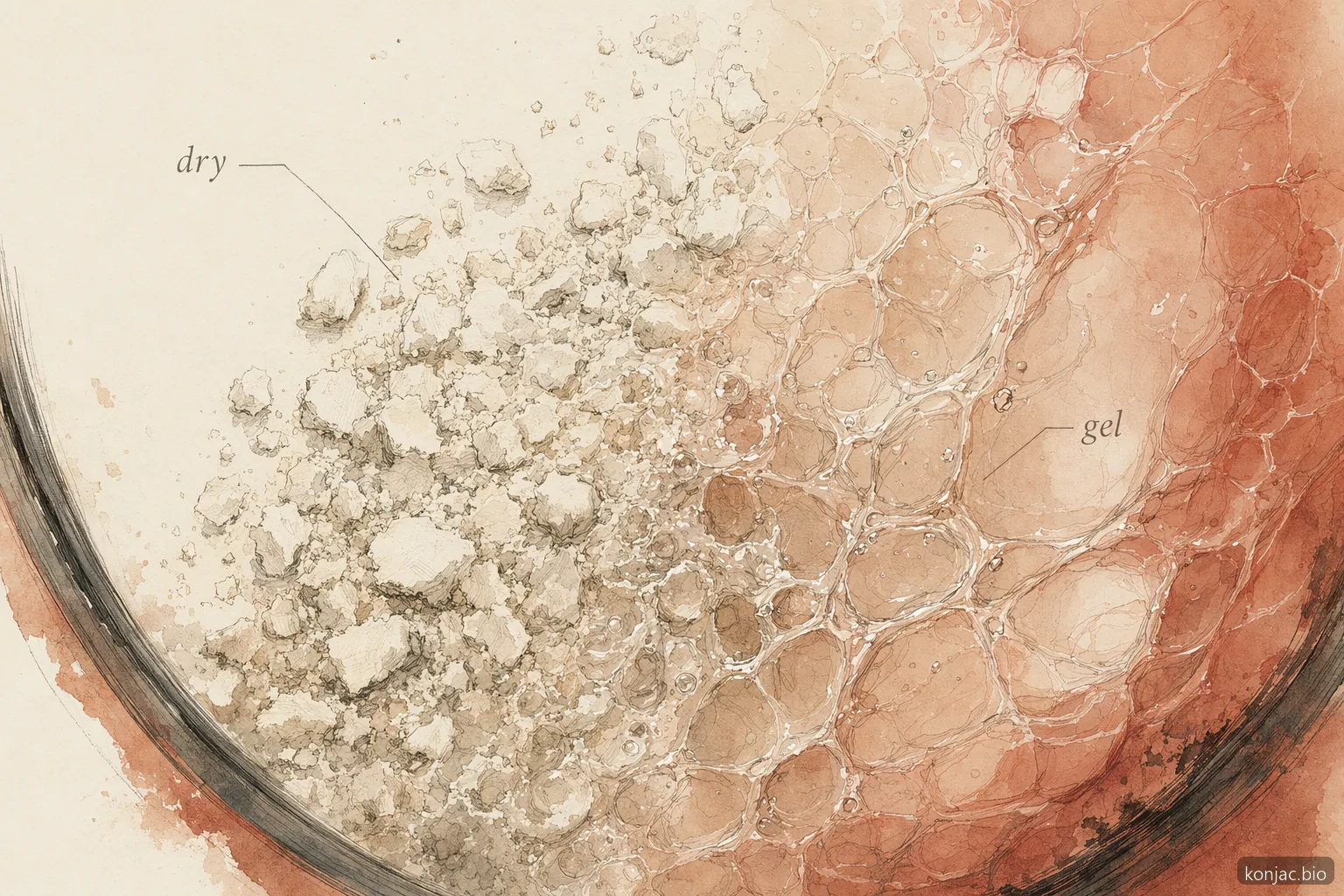
Konjac flour works by hydrating into a highly viscous glucomannan network that binds water, thickens liquids, stabilizes emulsions, and forms gels under the right conditions.
Glucomannan is built mainly from mannose and glucose units. Its high molecular weight and soluble-fiber structure allow it to absorb water far beyond its dry weight, which explains why small use levels can change an entire formula. EFSA identifies konjac glucomannan as a high-molecular-weight polysaccharide and separately evaluated its use as food additive E425(ii) E425 review.
The most important functional properties are:
- Water-binding: useful in gluten-free doughs, frozen foods, sauces, and high-moisture fillings.
- Viscosity: gives body to liquids at low addition rates, often below 1%.
- Gelation: forms firmer gels when combined with alkaline conditions or synergistic hydrocolloids.
- Stabilization: helps reduce separation in suspensions, dressings, and some dairy-style products.
- Texture modification: can create chew, slipperiness, bounce, or soft gel depending on formula pH, salts, heat, and hydration.
Konjac flour hydrates slowly if the particles clump. Dry blending with sugar, salt, starch, or other powders improves dispersion because it separates particles before water contact. High-shear mixing also helps, especially in beverages and sauces where visible specks are unacceptable.
In alkaline noodle and rice formats, calcium hydroxide or another food-grade alkali can deacetylate glucomannan, strengthening the gel network. This is one reason shirataki noodles and some konjac rice products hold together even though they are mostly water. For a finished product view, see shirataki noodles and konjac rice.
Konjac also interacts with other hydrocolloids. With xanthan gum, it can create elastic gels and higher viscosity than either ingredient alone. With carrageenan, locust bean gum, or starches, it can improve water retention, bite, or freeze-thaw performance depending on the system.
How do you use konjac flour in home cooking?
Use konjac flour in home cooking at very low levels, usually by whisking 0.1% to 1.0% of the recipe weight into dry ingredients before adding liquid.
A kitchen scale is strongly recommended because a teaspoon can overshoot the needed amount. Konjac thickens gradually and can continue hydrating after mixing, so a sauce that looks slightly thin at first may become spoon-coating after 5 to 15 minutes.
| Food | Starting dose | Method | Expected effect |
|---|---|---|---|
| Soup or sauce | 0.1% to 0.3% | Dry blend with salt or starch, whisk into warm liquid | Light body and reduced separation |
| Gluten-free batter | 0.2% to 0.6% | Mix into flour blend before hydration | More water retention and softer crumb |
| Smoothie | 0.1% to 0.2% | Blend immediately with cold liquid | Thicker mouthfeel and fiber addition |
| Low-carb noodles | 0.5% to 1.5% | Combine with water and food-grade alkali in tested recipes | Elastic gel texture |
| Fruit gel | 0.3% to 1.0% | Disperse fully, then combine with acid, sugar, or calcium system as needed | Soft to firm gel depending on formula |
The easiest mistake is adding dry konjac powder directly into a cup of hot liquid. The outer layer hydrates instantly and traps dry powder inside, creating gummy beads. A better method is to blend the powder with 10 to 20 times its weight of another dry ingredient, then sprinkle slowly while whisking.
Konjac flour pasta is possible, but it is usually a hybrid formula rather than a one-ingredient pasta. Home cooks often combine konjac powder with oat fiber, egg white, rice flour, tapioca, psyllium, or starches to balance bite and flexibility. For meal ideas built around finished konjac products, see konjac recipes.
Konjac is not a direct cup-for-cup substitute for wheat flour, almond flour, or rice flour. It is closer to a functional gum or soluble fiber. In baking, replacing even 1% of a flour blend can noticeably increase water demand, so formula adjustments should be made in small steps.
How should buyers specify food-grade konjac flour?
Buyers should specify food-grade konjac flour by viscosity, glucomannan content, particle size, moisture, ash, microbial limits, contaminants, certifications, and intended application.
A clear specification prevents expensive mismatches. A powder that works in capsules may hydrate too fast for a sauce line. A low-odor flour suitable for beverages may cost more than a standard grade for noodles. A very fine particle size can disperse smoothly under high shear but clump in manual blending.
Core specification items include:
- Identity: botanical source, plant part, processing method, and food-additive identity if relevant.
- Glucomannan content: percentage and test method, often central for standardized glucomannan konjac powder.
- Viscosity: test concentration, water temperature, hydration time, spindle, speed, and instrument.
- Particle size: mesh size or laser distribution, matched to dispersion method.
- Moisture and ash: indicators of storage stability and refining level.
- Color and odor: especially important for beverages, white sauces, and neutral-flavor foods.
- Microbiology: total plate count, yeast and mold, coliforms, Salmonella, and E. coli as required by market.
- Contaminants: heavy metals, pesticide residues, sulfur dioxide, and regional limits.
- Certifications: organic, kosher, halal, ISO 22000, FSSC 22000, BRCGS, gluten-free, vegan, and non-GMO where needed.
Organic konjac flour requires more than a farm claim. Buyers should request the organic certificate, certified scope, product listing, transaction certificate if used, and residue testing plan. For private-label goods, label compliance must also match the selling market, not just the manufacturing country.
Konjac.bio supports wholesale, private-label, and OEM konjac sourcing for brands that need ingredient matching, documentation, and realistic MOQ guidance. Contact the team for procurement support.
Regulatory identity should be checked early. In the United States, 21 CFR 184.1498 lists conditions for konjac flour as a food ingredient konjac CFR. In the European Union, konjac gum and konjac glucomannan fall under E425 identities evaluated by EFSA EFSA opinion. Japan, China, the EU, and the United States may differ in additive naming, maximum use, and finished-food category rules.
Comparing konjac flour with xanthan, agar, psyllium, and starch
Konjac flour sits between a soluble fiber and a hydrocolloid: it can thicken like a gum, bind water like a fiber, and gel under conditions that are not identical to agar, starch, xanthan, or psyllium.
The best alternative depends on the texture target. A salad dressing may need suspension and pourability. A vegan jelly may need a clean cut. Gluten-free bread may need moisture retention and dough handling. Low-carb noodles may need elastic gel strength.
| Ingredient | Main function | Texture | Typical strength | Common limitation |
|---|---|---|---|---|
| Konjac flour | Water-binding, viscosity, gelation | Elastic, slippery, gelled, or thick depending on formula | Very high water uptake at low use levels | Clumps if poorly dispersed |
| Xanthan gum | Viscosity and suspension | Shear-thinning, smooth, sometimes slimy | Excellent cold hydration and stability | Can feel ropy at high levels |
| Agar | Thermoreversible gelation | Firm, brittle, clean-breaking | Strong plant-based gels | Less elastic than konjac systems |
| Psyllium husk | Fiber, water retention, dough structure | Gel-like, bread-like when hydrated | Useful in gluten-free bread | Color, flavor, gritty texture in some grades |
| Starch | Thickening and bulk | Creamy, pasty, or elastic depending on source | Familiar, inexpensive, high solids contribution | Needs higher use levels and may add digestible carbohydrate |
Konjac and xanthan are often used together because the blend can create a more cohesive network than either ingredient alone. This synergy is useful in sauces, meat analogues, vegan gels, and some gluten-free systems. The exact ratio depends on gum grade, salt level, pH, heating step, and shear.
Agar gives a firmer, more brittle gel than konjac. That makes agar useful for cuttable desserts, microbiology media, and clear gels, while konjac is often chosen for chew, elasticity, water retention, or noodle-like bite.
Psyllium is popular in gluten-free baking because it adds dough-like structure and fiber. Konjac flour is more potent by weight, so it is better used as a micro-ingredient. A bread formula may use grams of psyllium but only tenths of a gram to a few grams of konjac depending on batch size.
Starch is a bulk ingredient as well as a thickener. Konjac does not provide the same solids, opacity, or cereal flavor. In reduced-carbohydrate foods, formulators may use konjac to replace part of starch function, but the formula often needs protein, fiber, or other solids to maintain body.
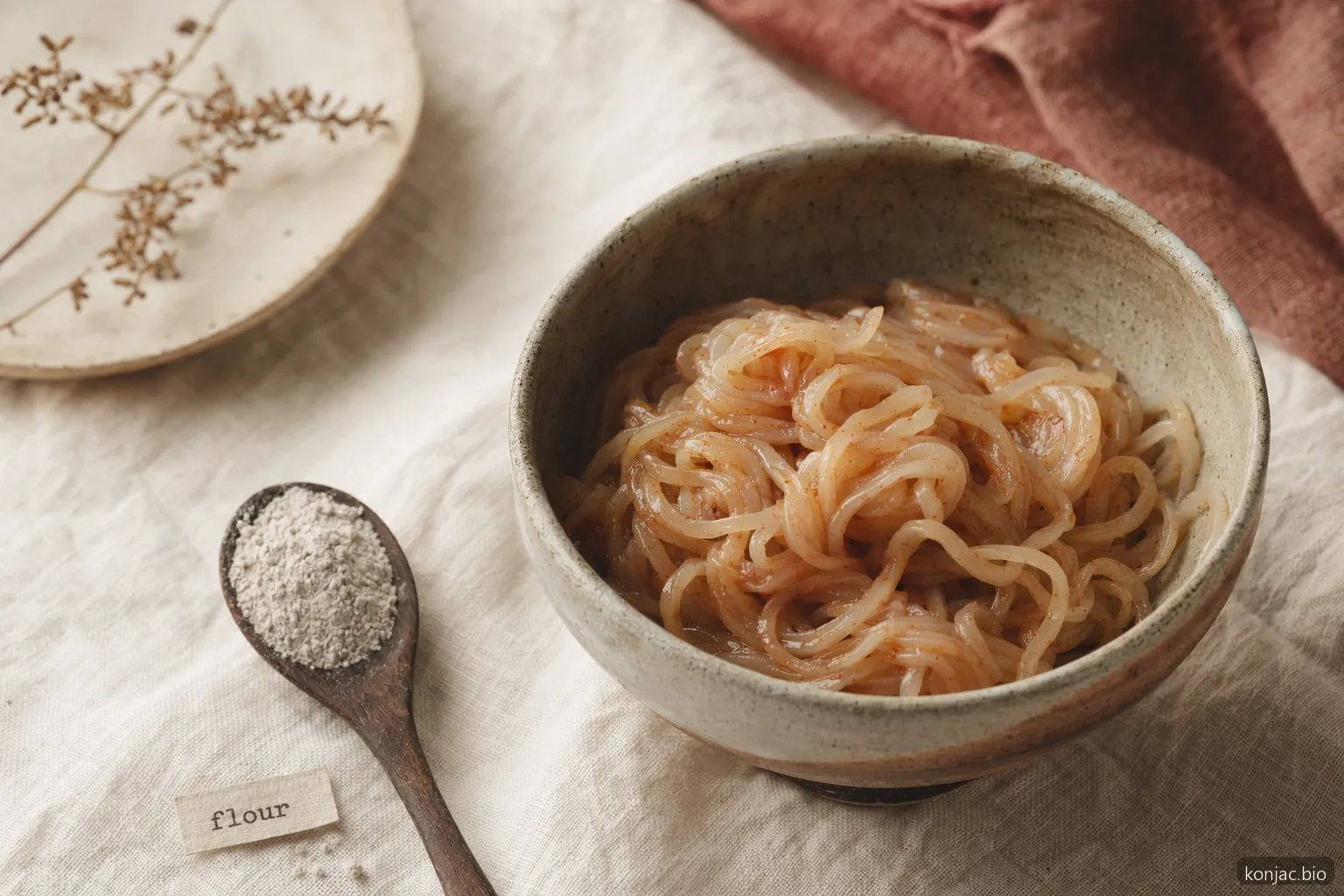
Konjac flour pasta, noodles, rice, jelly, and other formats
Konjac flour appears in many finished foods because one ingredient system can create noodles, rice-shaped gels, jelly desserts, meat analogues, sauces, and fiber-enriched dry mixes.
The most familiar format is shirataki, a noodle made from water, konjac flour or glucomannan, and a setting aid such as calcium hydroxide. The result is a high-moisture gel with very low energy contribution per serving when compared with wheat pasta. Texture varies by formula: some products are springy and translucent, while others include oat fiber, soy, or starch for a more pasta-like bite.
Konjac rice uses the same logic but changes the shape. Grain-sized pieces can be packed in water or mixed with other fibers. Consumers often use them as lower-calorie rice substitutes in stir-fries, bowls, and soups, while manufacturers focus on bite, water release, odor control, and microwave stability.
Konjac jelly uses glucomannan gelation to build a chewy dessert. This category needs special attention because mini-cup gel candies have been associated with choking risk when gel strength, cup shape, and serving style are poorly controlled. The FDA has issued import actions covering certain gel candies that may present choking risk FDA alert. For category-specific details, see konjac jelly.
Konjac flour pasta in the strict sense is usually a formulated product rather than classic pasta dough. Wheat pasta relies on gluten and starch gelatinization. Konjac pasta relies on hydrated glucomannan networks, hydrocolloid synergy, or blends with starch, protein, egg, or fibers. This is why ingredient lists can vary widely even when packages use similar words.
In dry mixes, konjac powder can support instant soups, sauces, smoothie powders, and meal replacements. The challenge is dispersion. Agglomerated grades, dry blending carriers, lecithin systems, or customer instructions can reduce lumping. For retail use, a packet format often performs better than a jar because each dose is controlled.
For skincare, the same plant family appears in a very different format: the konjac sponge. That product uses konjac fiber structure for cleansing texture, not as a food ingredient. See konjac sponge for the non-food application.
Safety, labeling, benefits, and evidence boundaries
Konjac flour is widely used as a food ingredient, but safe use depends on hydration, serving form, label accuracy, and evidence-based claims.
The main physical concern is rapid swelling. Dry glucomannan powder should be consumed with adequate liquid when used in supplement-like formats, and products should not encourage swallowing dry powder directly. In food processing, the same swelling power is useful because the powder is hydrated before eating.
Konjac powder benefits are mostly linked to soluble fiber, water-binding, and texture. In foods, these benefits include lower energy density when konjac replaces higher-calorie ingredients, improved moisture retention, and satiety-supporting texture. In supplements, glucomannan has been studied for body weight and cholesterol-related endpoints.
European claim language is specific. EFSA supported the wording: Glucomannan in the context of an energy restricted diet contributes to weight loss, with conditions including 3 g glucomannan daily in three 1 g doses with 1 to 2 glasses of water before meals EFSA claim. EFSA also evaluated a cholesterol-related claim for glucomannan and maintenance of normal blood cholesterol concentrations EFSA cholesterol.
Is konjac flour healthy? In normal food amounts, it can be a useful soluble-fiber ingredient and a practical way to reduce energy density in noodles, rice analogues, and thickened foods. The overall health value of a finished product still depends on the full recipe, serving size, sodium, sweeteners, protein, micronutrients, and eating pattern.
Clinical evidence is mixed by endpoint, dose, and study design. A systematic review in the Journal of the American College of Nutrition reported that glucomannan supplementation was associated with improvements in several body-weight and lipid measures, while also noting variability across trials PubMed review. Ingredient pages should avoid overpromising and keep claims aligned with local law.
Labeling should distinguish ingredient function from nutrition or structure-function language. A food label can usually identify konjac flour as a thickener, stabilizer, gelling agent, fiber source, or konjac-derived ingredient if the jurisdiction allows. Weight-management language, cholesterol language, gluten-free claims, organic claims, and child-oriented jelly formats require closer review.
For low-carb and keto audiences, konjac flour is often attractive because glucomannan contributes fiber with minimal digestible carbohydrate. Finished foods still need a full nutrition panel. See konjac keto weight loss for diet-context guidance that separates ingredient properties from broader eating patterns.
Frequently asked questions
01 Is konjac flour the same as glucomannan powder?
02 Is konjac flour gluten-free?
03 What is konjac flour used for in food manufacturing?
04 How much konjac flour should I use in recipes?
05 Can konjac flour replace wheat flour?
06 What should be on a konjac flour specification sheet?
07 Is organic konjac flour different from regular konjac flour?
08 What are the main konjac powder benefits?
- Konjac: The Plant Behind Shirataki, Jelly, Flour, and Sponges
- Shirataki Noodles: The Complete Guide to Konjac Pasta
- Glucomannan Guide: Benefits, Dosage, Safety, and Forms
- Konjac Jelly: Pouches, Cups, Drinks, and Choking Safety
- Konjac Rice: The Low-Carb Rice Swap, Cooked Right
- Konjac Recipes for Shirataki, Konjac Rice, Jelly, and Flour
- Re-evaluation of konjac gum (E 425 i) and konjac glucomannan (E 425 ii) as food additives · EFSA · 2017
- Gluten-Free Labeling of Foods · U.S. Food and Drug Administration · 2024
- Scientific Opinion on glucomannan related to reduction of body weight · EFSA · 2010
- Scientific Opinion on glucomannan and maintenance of normal blood cholesterol concentrations · EFSA · 2009
- Effect of glucomannan on plasma lipid and glucose concentrations, body weight, and blood pressure: systematic review and meta-analysis · American Journal of Clinical Nutrition (PubMed) · 2008
- Import Alert 33-15: Detention Without Physical Examination of Gel Candies Containing Konjac · U.S. Food and Drug Administration · 2024