What is amorphophallus rivieri konjac?
Amorphophallus rivieri konjac refers to konjac material associated with the older botanical name Amorphophallus rivieri and the modern commercial crop Amorphophallus konjac.
In practical sourcing, the key entity is the konjac plant in the Araceae family, grown for its underground corm. The species is indexed in major biological databases as Amorphophallus konjac, with taxonomy records available through NCBI Taxonomy and botanical name searches through Kew POWO.
The crop is valued because the corm contains konjac glucomannan, a water-soluble polysaccharide used in food gels, shirataki noodles, flour systems, and dietary fiber applications. EFSA evaluated glucomannan in relation to authorized nutrition and health wording, including the EU-approved claim: “Glucomannan in the context of an energy restricted diet contributes to weight loss” EFSA claim.
For a broader botanical overview, see the parent guide: The Konjac Plant: Cultivation, History, and Botany.
Why does the name amorphophallus rivieri konjac still appear?
The name amorphophallus rivieri konjac still appears because older horticultural, nursery, and trade records often preserve historical plant names after commercial usage has moved to Amorphophallus konjac.
This matters because buyers may see several name formats in documents, including Amorphophallus rivieri, Amorphophallus konjac, konjac root, konjac corm, konnyaku potato, and konjac flour. These may not always mean the same specification, so the botanical identity should be paired with a product grade, test method, and country of origin.
A clean B2B specification usually contains 5 identity fields:
- Latin name: Amorphophallus konjac, with legacy synonym noted only if needed.
- Plant part: corm, sliced corm, flour, gum, or refined glucomannan.
- Processing level: dried chip, crude flour, purified powder, or food-grade gum.
- Functional metric: viscosity, particle size, moisture, ash, sulfur dioxide, and glucomannan content.
- Compliance target: food, supplement, noodle, gel, or industrial application.
For sourcing teams, name discipline reduces risk. A purchase order that says only “rivieri konjac” is weaker than one that states Amorphophallus konjac corm-derived powder with a defined specification and test report.
Botanical traits that separate konjac from lookalikes
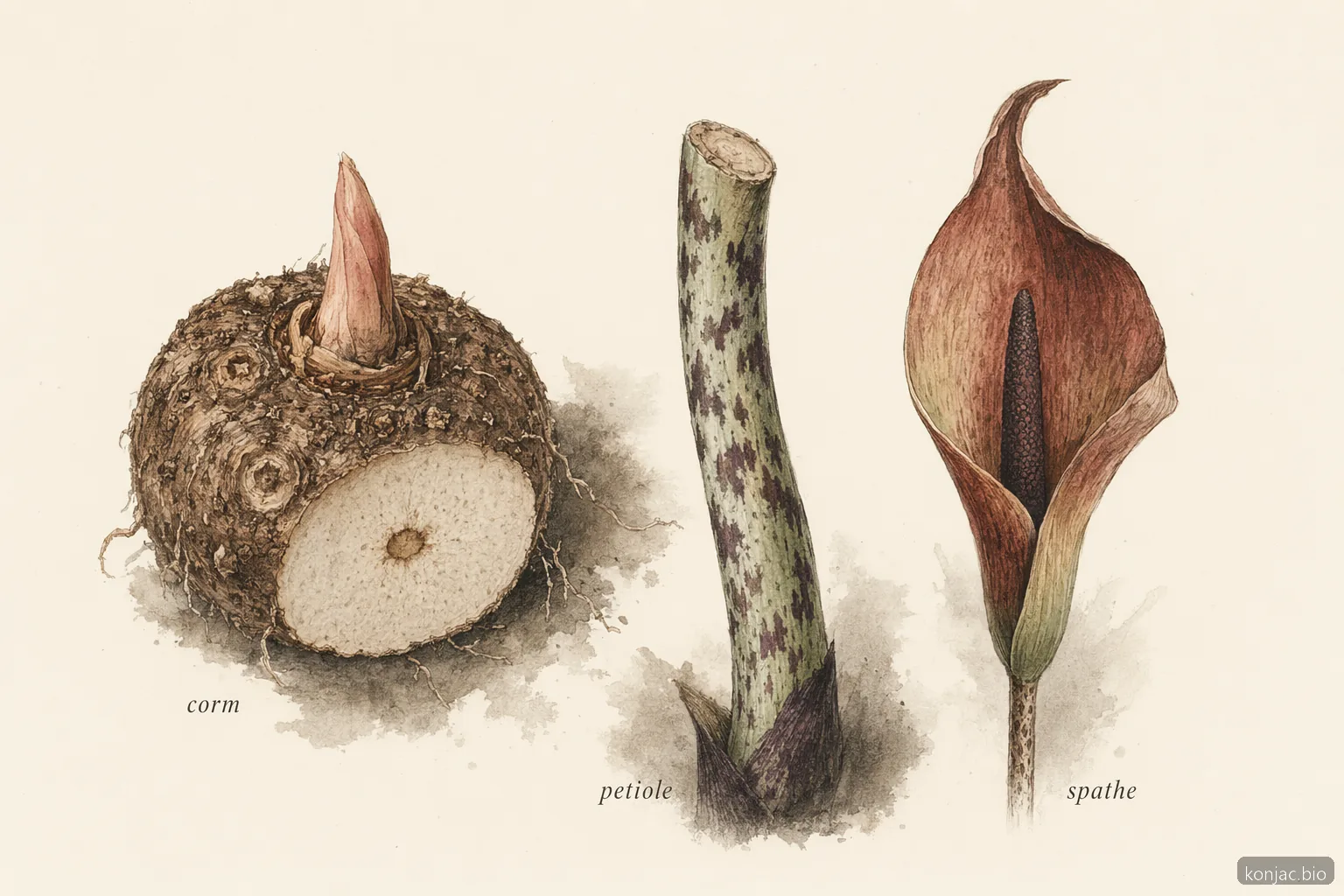
Konjac belongs to Amorphophallus, a genus known for large underground storage organs, seasonal leaf growth, and distinctive inflorescences. The crop’s economic value is concentrated in the corm, not the leaf, flower, or seed.
Botanically, a konjac plant usually cycles through a dormant corm phase, a single umbrella-like leaf phase, and, under mature conditions, a flowering phase. The corm stores carbohydrates and glucomannan, which is why harvest timing and postharvest drying affect commercial quality.
| Trait | Konjac relevance | Buyer check |
|---|---|---|
| Corm | Main harvested organ | Confirm corm-derived material |
| Leaf | Seasonal photosynthesis | Not the commercial fiber source |
| Inflorescence | Useful for botanical identification | Rarely present in traded material |
| Powder | Processed from dried corm | Check viscosity and purity |
Konjac is sometimes confused with other aroids because common names can be vague. The safest commercial practice is to document the Latin name, plant part, processing grade, and analytical profile on the certificate of analysis.
For corm-specific terminology, see konjac root and corm. For agronomy context, see konjac growing conditions.
How is Amorphophallus konjac grown from corm to harvest?
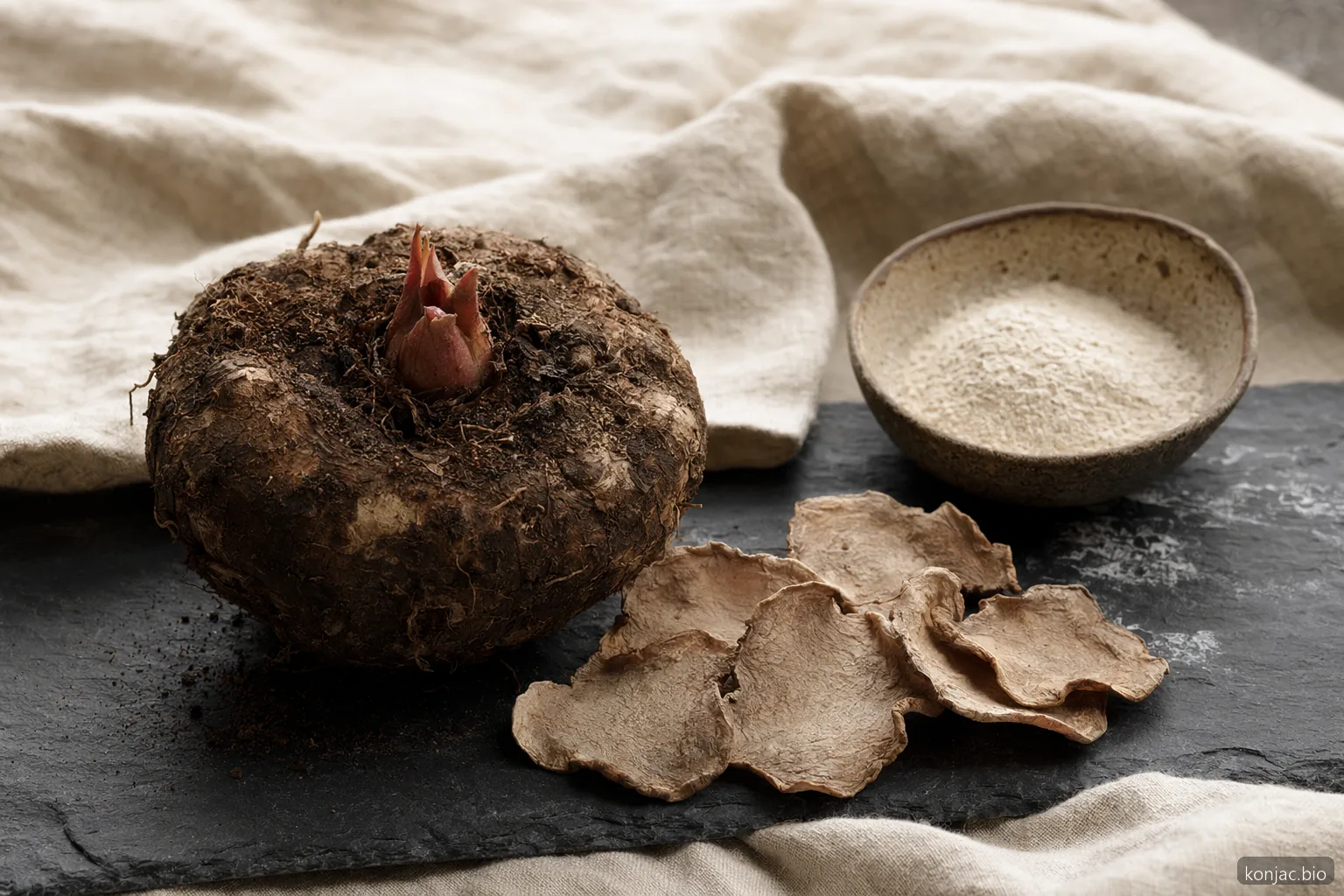
Amorphophallus konjac is grown by planting seed corms or corm pieces, building leaf biomass during the warm season, then harvesting enlarged corms after senescence.
The crop behaves like a storage-organ plant. The above-ground leaf captures energy, while the underground corm increases in size and dry matter. Growers typically select healthy planting corms, avoid waterlogged soils, and maintain enough shade or filtered light to reduce stress in hot regions.
A simplified konjac crop cycle follows 6 steps:
- Select firm planting corms with visible buds and no soft rot.
- Plant into loose, well-drained soil once cold risk has passed.
- Maintain moisture without standing water around the corm.
- Support canopy growth through the main warm-season leaf stage.
- Allow natural senescence so storage compounds move into the corm.
- Harvest, clean, slice, dry, and mill according to the intended grade.
Postharvest handling is decisive because konjac corms contain high moisture before drying. Delayed drying can reduce quality, while careful slicing and controlled dehydration support stable flour and gum production.
B2B aside: konjac.bio helps buyers source konjac materials at wholesale, including corm-derived flour and glucomannan specifications. For pricing and documentation, contact the team.
Safety, food use, and commercial specification
Konjac materials are widely used in foods, but format and hydration behavior matter. Konjac glucomannan absorbs large amounts of water, creating viscous solutions and gels that are useful in noodles, jellies, bakery systems, sauces, and fiber blends.
Regulators have paid special attention to konjac mini-cup gel candies because their shape and texture can create choking hazards, especially when swallowed whole. FDA has published konjac mini-cup jelly information for consumers and import control context FDA jelly.
For health-related wording, suppliers should stay precise. The EU-authorized wording is: “Glucomannan in the context of an energy restricted diet contributes to weight loss” EFSA claim. Broader statements should use careful language such as “may support satiety,” “has been studied for viscosity-driven effects,” or “is associated with soluble fiber intake.”
A commercial konjac specification should normally include:
- Botanical source: Amorphophallus konjac corm.
- Grade: food grade, supplement grade, or application-specific grade.
- Assay: glucomannan percentage or viscosity benchmark.
- Physical data: particle size, color, odor, moisture, and ash.
- Compliance data: microbiology, heavy metals, sulfur dioxide, and allergen statement.
Scientific reviews describe konjac glucomannan as a soluble, fermentable dietary fiber with strong water-binding and viscosity properties NIH review. Those functional properties explain why the same plant can serve both traditional konnyaku foods and modern texture systems.
Frequently asked questions
01 Is amorphophallus rivieri konjac the same as Amorphophallus konjac?
02 What part of the konjac plant is used commercially?
03 Why does konjac naming matter for wholesale buyers?
04 Does konjac glucomannan have an authorized EU health claim?
05 Are konjac foods safe to eat?
- Amorphophallus konjac taxonomy record · NCBI Taxonomy · 2025
- Plants of the World Online search for Amorphophallus konjac · Royal Botanic Gardens, Kew · 2025
- Scientific Opinion on the substantiation of health claims related to glucomannan · European Food Safety Authority · 2010
- Konjac Mini-Cup Gel Candies · U.S. Food and Drug Administration · 2024
- Glucomannan and obesity: a critical review · NIH, PubMed Central · 2014