What is konjac flour made from?
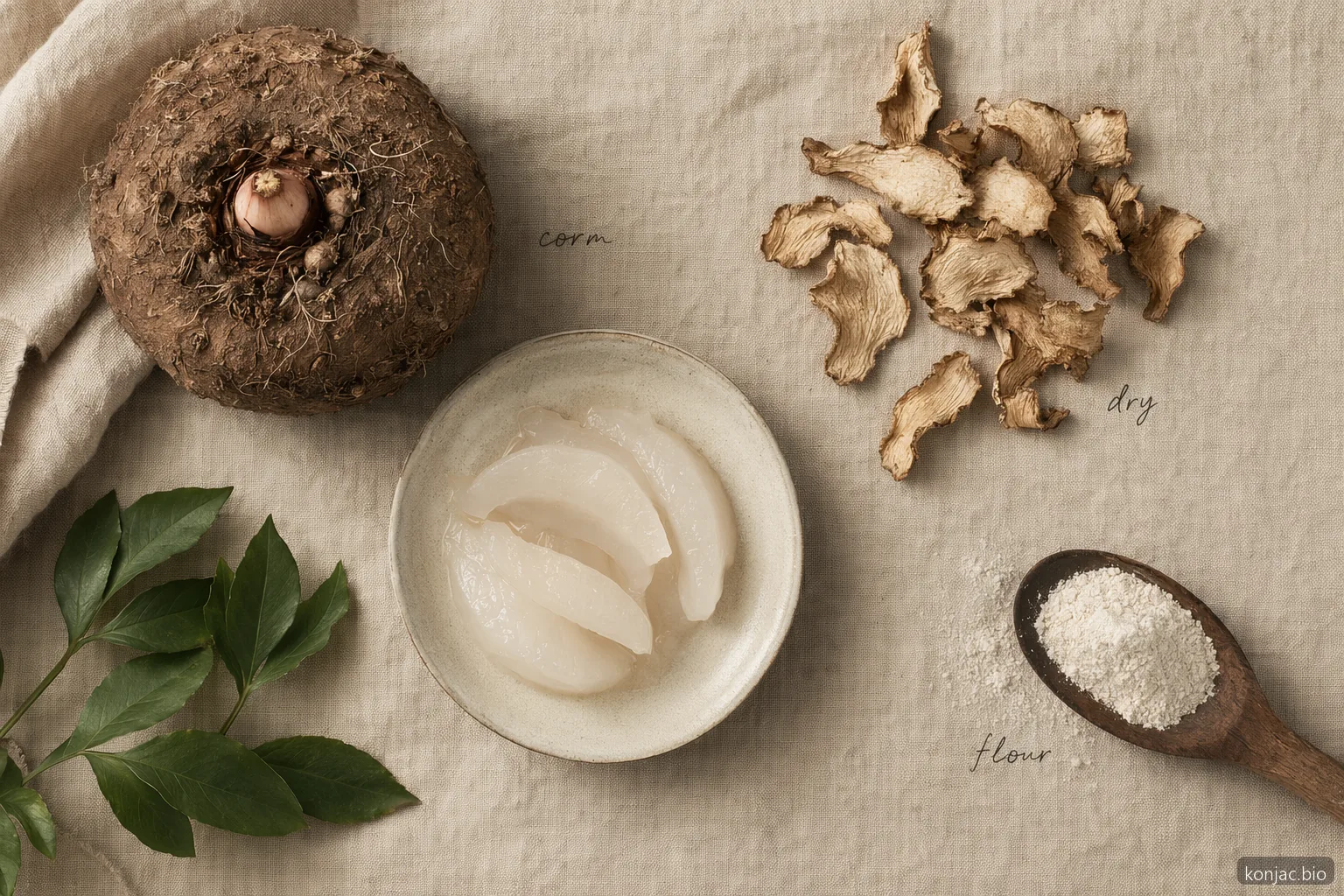
Konjac flour is made from the corm of Amorphophallus konjac, a tuber-like underground plant structure rich in glucomannan fiber.
The word “root” is often used in consumer language, but the more precise botanical term is corm. The species Amorphophallus konjac is listed by the Royal Botanic Gardens, Kew as a member of the Araceae plant family, the same broad family that includes many aroid plants Kew plant.
The food ingredient is produced by separating usable corm material from peel, insoluble matter, starch, color bodies, and odor-active compounds. The resulting flour or powder is valued because glucomannan hydrates into a viscous solution at low inclusion rates.
- Plant source: Amorphophallus konjac
- Plant part: corm, often called konjac root in retail language
- Main functional component: glucomannan, a soluble dietary fiber
- Common uses: noodles, gels, sauces, bakery blends, meat alternatives, beverages, and supplements
How is konjac flour made from the corm?
Konjac flour is made from the corm by cleaning, slicing, drying, milling, classifying, and purifying the glucomannan-rich fraction.
Industrial processing is designed to protect viscosity while removing material that can darken color, reduce purity, or create earthy aroma. Drying temperature, particle size, and alcohol washing are key variables because glucomannan is highly water-interactive.
- Harvest and sorting: mature corms are selected by size, appearance, and freshness.
- Washing and peeling: soil, peel, and damaged tissue are removed.
- Slicing or crushing: the corm is reduced into smaller pieces for controlled drying.
- Drying: moisture is lowered to stabilize the ingredient for milling and storage.
- Milling: dried chips are ground into flour or powder.
- Air classification: lighter fiber-rich fractions are separated from heavier starch and residue.
- Purification: food-grade alcohol washing may improve whiteness, odor, and glucomannan concentration.
- Testing and packing: lots are checked for viscosity, moisture, ash, particle size, and microbiology.
Processing matters because two samples with the same botanical origin can perform differently in water. A higher-glucomannan flour generally builds more viscosity, forms stronger gels with alkaline coagulants, and needs lower dosage in a finished formula.
Konjac flour, konjac powder, and glucomannan compared
Konjac flour, konjac powder, and glucomannan are closely related terms, but they are not always identical in specification.
“Konjac flour” is often used for ground and partially refined corm material. “Konjac powder” may mean the same thing in food trade, although some suppliers use it for finer particle sizes. “Glucomannan” usually refers to the purified soluble fiber fraction, which the U.S. Food and Drug Administration recognizes among non-digestible carbohydrates that meet its dietary fiber definition FDA fiber.
| Term | Typical meaning | What buyers should check |
|---|---|---|
| Konjac flour | Ground, refined corm ingredient | Glucomannan %, viscosity, ash, color |
| Konjac powder | Often flour with a specified mesh size | Particle size, hydration speed, odor |
| Konjac glucomannan | Purified soluble fiber fraction | Purity, viscosity, labeling basis |
| Konjac gum | Hydrocolloid name used in formulation | Gel strength, compatibility, regulatory status |
For a broader ingredient overview, see Konjac Flour & Powder: The Food-Ingredient Guide. For naming and specification differences, compare konjac flour vs konjac powder.

Why does the source corm matter for function?
The source corm matters because glucomannan concentration, maturity, drying method, and purification level determine viscosity, gel behavior, color, and flavor neutrality.
Glucomannan is known for high water binding and viscosity, which is why a small dose can noticeably change texture. The NIH Office of Dietary Supplements describes glucomannan as a soluble dietary fiber derived from konjac that absorbs water and forms a gel-like mass NIH ODS.
In food applications, this translates into practical formulation effects:
- Hydration: finer powders disperse faster but can clump without shear or dry blending.
- Viscosity: higher-purity material usually thickens more efficiently.
- Gelation: konjac can form heat-stable gels with alkaline salts such as calcium hydroxide.
- Color: better purification typically produces a lighter powder for pale foods.
- Flavor: lower-odor grades fit beverages, sauces, and delicate fillings better.
Health-benefit language must stay precise. EFSA-authorized wording includes “Glucomannan contributes to the maintenance of normal blood cholesterol levels” and “Glucomannan in the context of an energy restricted diet contributes to weight loss,” with conditions of use defined by the claim file EFSA claim.
Safety, labeling, and sourcing checks
Konjac flour sourcing should verify identity, purity, hydration behavior, microbiology, heavy metals, allergen status, and food-safety documentation.
Konjac is a high-water-binding ingredient, so finished products must be designed for safe consumption format and clear preparation instructions. The FDA has maintained an import alert for certain mini-cup gel candy products containing konjac because small, firm gels can create a choking hazard in that format FDA alert.
For packaged food, labeling depends on jurisdiction, grade, and usage. In the United States, glucomannan may be relevant to dietary fiber declarations when it meets applicable FDA criteria. In the European Union, any cholesterol or weight-management wording must follow the exact authorized wording and conditions of use.
Commercial buyers should ask suppliers for a current specification sheet and lot-level certificate of analysis. Useful checks include:
- Botanical source: Amorphophallus konjac
- Glucomannan content, reported by test method
- Viscosity range, usually measured at a defined concentration and temperature
- Moisture, ash, sulfur dioxide if applicable, and particle size
- Total plate count, yeast and mold, coliforms, and pathogens
- Heavy metals, pesticide residues, and allergen statement
- Food-safety system, such as HACCP, ISO 22000, BRCGS, or FSSC 22000
B2B note: konjac.bio sources food-grade konjac ingredients at wholesale scale for brands, manufacturers, and distributors. For specification matching and bulk pricing, contact the team.
For application ideas across noodles, sauces, gels, bakery, and plant-based foods, see konjac flour uses.
Frequently asked questions
01 Is konjac flour made from a root or a corm?
02 Is konjac flour made from wheat or grain?
03 What is the main ingredient in konjac flour?
04 Why does konjac flour thicken so strongly?
05 Is konjac flour the same as konjac gum?
06 What should manufacturers request from a konjac flour supplier?
- Scientific Opinion on the substantiation of health claims related to glucomannan · European Food Safety Authority · 2010
- Questions and Answers on Dietary Fiber · U.S. Food and Drug Administration · 2024
- Dietary Supplements for Weight Loss: Fact Sheet for Health Professionals · NIH Office of Dietary Supplements · 2024
- Import Alert 33-15 · U.S. Food and Drug Administration · 2024
- Amorphophallus konjac K. Koch · Royal Botanic Gardens, Kew · 2024