Where can I find konjac jelly near me today?
You can usually find konjac jelly near me at Asian supermarkets, Japanese and Korean grocery stores, larger Chinese markets, and mainstream retailers with Asian snack aisles.
Start with stores that already stock nata de coco, grass jelly, aloe drinks, mochi, seaweed snacks, and shelf-stable dessert cups. Konjac jelly often sits in 1 of 4 places: the snack aisle, the refrigerated dessert case, the bottled drink aisle, or the checkout display for individually packed sweets.
- Asian supermarkets: Best selection of jelly cups, pouches, and fruit-flavored assortments.
- Japanese and Korean grocers: Strong odds for pouch-style jelly drinks and low-sugar fruit flavors.
- Chinese and Taiwanese markets: Good for assorted cup packs, lychee flavors, grape flavors, and mixed jelly desserts.
- Mainstream grocers: Look in the international aisle, better-for-you snack aisle, or grab-and-go refrigerated section.
- Pickup apps: Search “konjac jelly,” “jelly drink,” “konjac pouch,” and “fruit jelly cups.”
Local inventory changes quickly because imported Asian snacks often rotate by distributor, season, and warehouse availability. If a store app shows no result for “konjac jelly,” search adjacent terms like “konnyaku jelly,” “jelly snack,” “fiber jelly,” or “fruit jelly pouch.”
Use the parent guide, Konjac Jelly: The Asian Dessert and Its Western Successors, if you want the category background before comparing store options.
What should I check before buying konjac jelly near me?
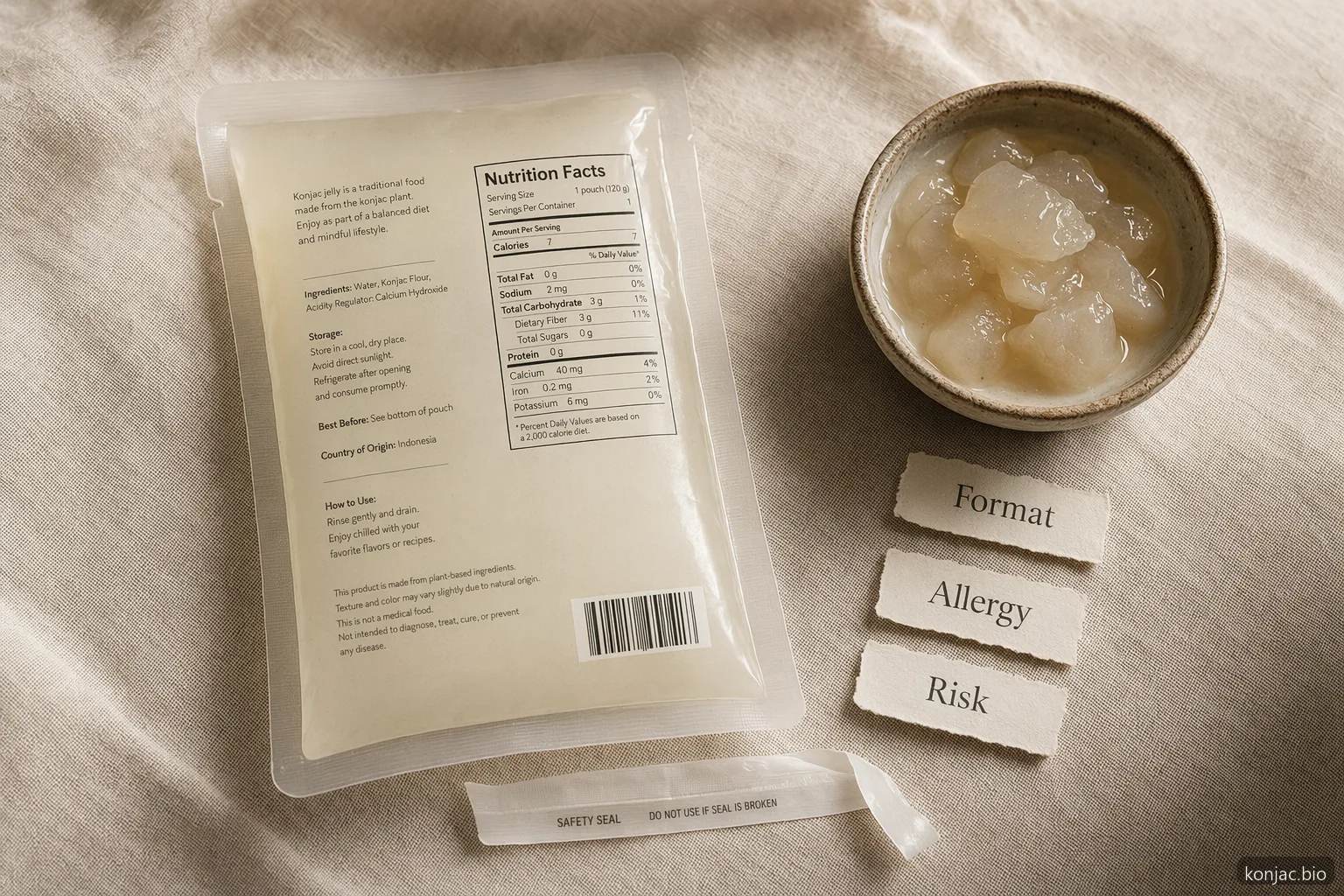
Before buying konjac jelly near me, check format, ingredient list, serving size, Nutrition Facts, allergen statement, and country-of-origin labeling.
The ingredient list tells you whether the product uses konjac powder, konjac flour, glucomannan, carrageenan, agar, pectin, or another gelling system. Glucomannan is the soluble dietary fiber associated with Amorphophallus konjac, and EFSA has evaluated glucomannan claims related to body weight and blood cholesterol under defined intake conditions in its EFSA opinion.
| Label item | Why it matters | What to look for |
|---|---|---|
| Format | Controls how the jelly is eaten | Pouch, large cup, mini cup, drinkable jelly, or dessert bowl |
| Serving size | Changes calorie, sugar, and fiber totals | Per pouch, per cup, or per multi-piece serving |
| Sweeteners | Impacts taste and nutrition profile | Sugar, fruit juice, erythritol, sucralose, stevia, or mixed sweeteners |
| Allergens | Important for shoppers avoiding specific ingredients | Milk, soy, wheat, sesame, tree nuts, peanuts, egg, fish, shellfish |
| Warnings | Helps assess choking risk by format | Age guidance, chew instructions, and mini-cup warnings |
The FDA explains that the Nutrition Facts label shows calories, serving size, added sugars, and nutrients in a standardized panel, which helps compare snacks on the shelf using the same format Nutrition Facts. For allergens, FDA guidance explains that major food allergens must be identified on packaged food labels in the United States allergen labels.
If you are comparing jelly ingredients, read our sibling guide to konjac jelly ingredients for a closer look at gelling agents, sweeteners, flavors, and texture systems.
Konjac jelly formats in local stores
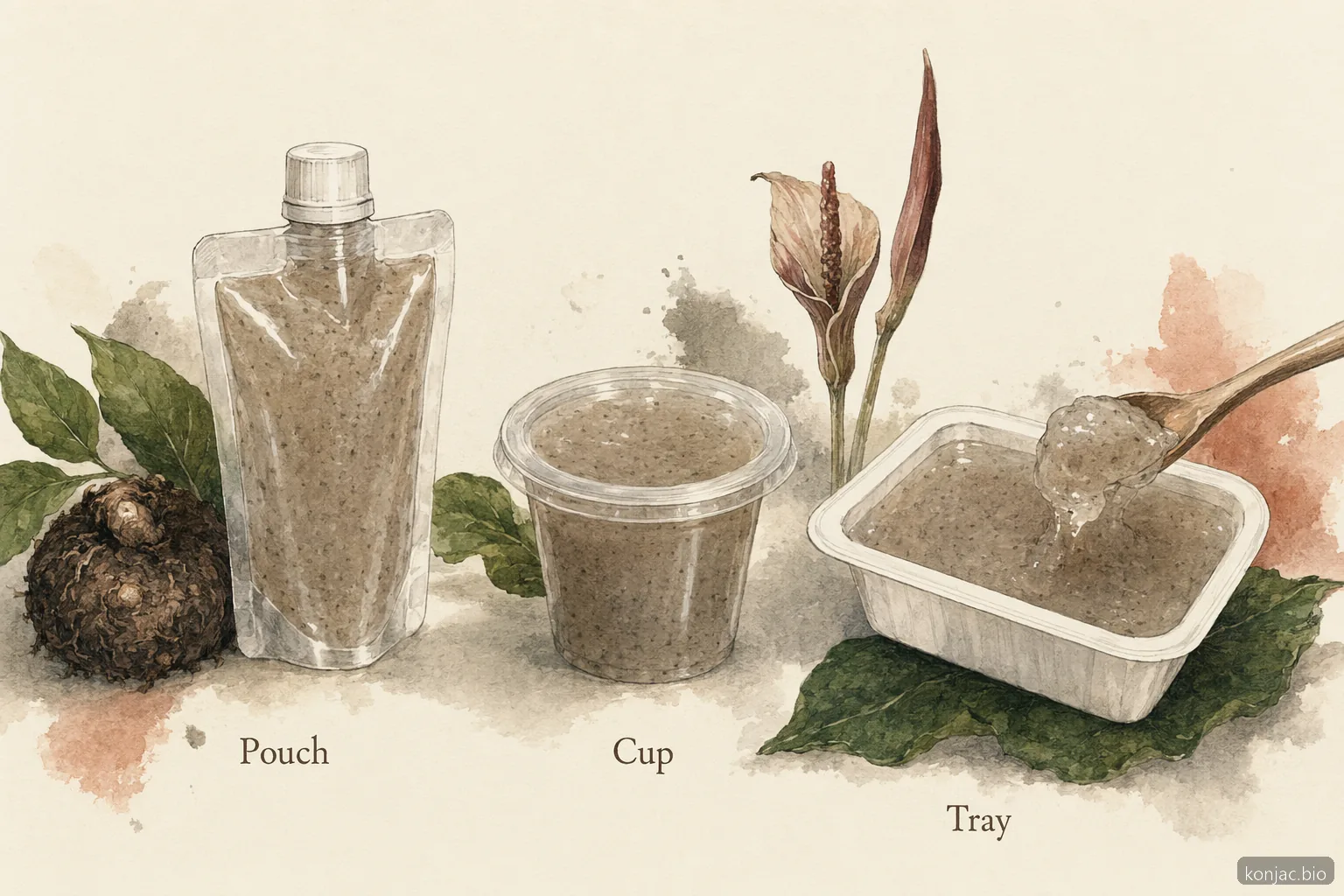
Konjac jelly appears in several retail formats, and the package shape matters as much as the flavor. A pouch, a large cup, and a tiny mini cup can all contain konjac, but they create different eating experiences and different practical considerations.
Pouch-style konjac jelly is common in Japanese and Korean snack aisles. It is usually squeezed slowly through a spout, chilled before eating, and sold as single pouches or multipacks. This format is popular for lunch boxes, office snacks, and convenience-store style displays.
Larger jelly cups are closer to a spoonable dessert. They may contain fruit pieces, nata de coco, aloe, or fruit juice, depending on the product. These are easier to portion into a bowl and are often stocked near shelf-stable puddings or refrigerated desserts.
Mini-cup gel candies are small, firm, and bite-sized. They deserve extra scrutiny because regulators have flagged certain mini-cup gel candy formats containing konjac as a choking hazard in import enforcement actions FDA alert.
Jelly drink bottles and squeezable gel drinks may contain konjac, but not always. Some use carrageenan, gellan gum, agar, or pectin instead. Check the ingredient list rather than relying on the front label.
For product developers and foodservice buyers, konjac.bio sources konjac ingredients at wholesale scale and can support specification review, documentation, and supply planning. Contact the team for wholesale pricing.
Is konjac jelly near me safe for everyone?
Konjac jelly near me is not a one-size-fits-all snack, because mini-cup gel candies containing konjac have been flagged by the FDA as a choking hazard.
The highest-risk retail format is the small, firm, slippery mini cup that can be sucked directly from the package. FDA import enforcement has targeted candy products that pose a choking hazard, including certain gel candies containing konjac, because the product can lodge in the throat import alert.
- Be cautious with small children: Choose larger cups, spoonable formats, or avoid firm mini cups.
- Read age warnings: Packages may include age guidance or chew-before-swallowing instructions.
- Serve in a bowl: Cutting larger gels into smaller spoonable pieces reduces reliance on suction-style eating.
- Check texture: Very firm, elastic jellies behave differently from soft pudding-like desserts.
- Supervise eating: This is especially relevant for children and anyone who eats quickly.
Konjac jelly is a food product, not a health product. EFSA’s approved wording for one glucomannan claim is specific: “Glucomannan in the context of an energy restricted diet contributes to weight loss,” and the conditions require 3 g of glucomannan daily in 3 doses of 1 g each with 1 to 2 glasses of water before meals EFSA claim. Most jelly snacks are bought for flavor, texture, and convenience, not to meet that exact intake pattern.
For a dedicated retail safety checklist, see our sibling guide to konjac jelly safety.
Online pickup, delivery, and wholesale sourcing
Local search does not have to end at the closest store aisle. Pickup, delivery, and wholesale channels each work better for different buyers.
| Buyer type | Best channel | Why it works |
|---|---|---|
| One-time shopper | Asian supermarket or grocery pickup | Fastest way to test flavors and formats |
| Repeat household buyer | Multipack online delivery | Better flavor consistency and fewer store trips |
| Small cafe or dessert shop | Foodservice distributor | Case quantities, invoices, and repeat supply |
| CPG brand or manufacturer | Ingredient wholesaler | Specifications, certificates, and production planning |
For online pickup, search both the product name and the format. “Konjac jelly pouch,” “konnyaku jelly,” “fruit jelly cup,” and “jelly drink” can return different inventory in the same grocery app. Filter for “in stock” and check the product images for warning labels, serving size, and ingredient details before placing an order.
For wholesale sourcing, ask for the konjac grade, viscosity range, mesh size, microbiological specifications, country of origin, allergen statement, and food safety documentation. Certifications such as ISO 22000, BRCGS, or FSSC 22000 may be relevant depending on your buyer requirements, export market, and co-manufacturer standards.
If you are building a konjac jelly, beverage gel, dessert cup, or low-sugar fruit jelly line, ingredient consistency matters more than a single retail sample. Konjac.bio can help commercial buyers evaluate wholesale konjac options and supply documentation through our contact page.
Frequently asked questions
01 Where is konjac jelly usually stocked in a grocery store?
02 Is konjac jelly near me the same as konnyaku jelly?
03 What is the safest konjac jelly format to buy?
04 Does konjac jelly contain glucomannan?
05 Can I buy konjac jelly wholesale instead of searching store by store?
- Scientific Opinion on the substantiation of health claims related to glucomannan · European Food Safety Authority · 2010
- Import Alert 33-15: Candy Products Due to Potential Choking Hazard · U.S. Food and Drug Administration · 2024
- How to Understand and Use the Nutrition Facts Label · U.S. Food and Drug Administration · 2024
- Food Allergies · U.S. Food and Drug Administration · 2025