What is a konjac gummy?
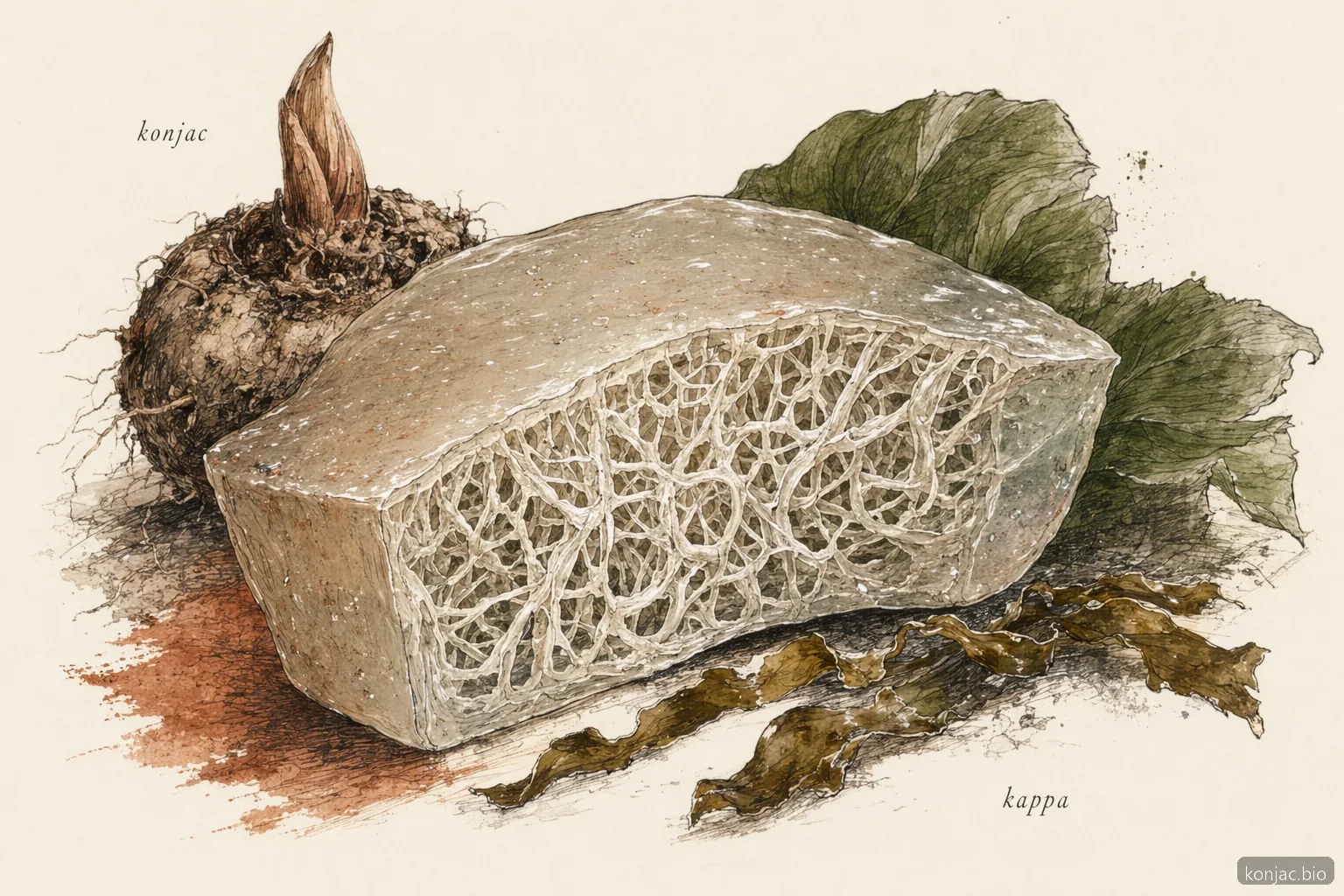
A konjac gummy is a chewy gel product made with konjac gum, a purified glucomannan hydrocolloid from the corm of Amorphophallus konjac.
Konjac gum is used as a thickener, stabilizer, and gelling aid in foods, and its main polymer is glucomannan, a high-molecular-weight soluble dietary fiber described in peer-reviewed food science literature as a major component of konjac flour and konjac gum konjac review. For ingredient background, specifications, and E425 positioning, see the parent guide: Konjac Gum (E425).
In confectionery, konjac gum is rarely used as a one-ingredient gel. Brands usually combine it with another structure builder because konjac contributes chew, elasticity, water binding, and gel strength, while the partner hydrocolloid controls set speed and bite.
| Konjac gummy type | Common structure system | Typical texture goal |
|---|---|---|
| Vegan fruit gummy | Konjac plus carrageenan or pectin | Clean bite, elastic chew |
| Functional fiber bite | Konjac plus starch or pectin | Dense chew, low stickiness |
| Jelly cup | Konjac plus carrageenan | Firm gel, spoonable or bite-sized |
| Low-sugar gummy | Konjac plus polyols, pectin, or starch | Moisture control, less weeping |
The commercial appeal is simple: konjac can help replace animal gelatin while maintaining a satisfying chew. It also supports fiber-forward positioning when used with compliant label language and validated serving data.
How does a konjac gummy set without gelatin?
A konjac gummy sets without gelatin by using konjac glucomannan with heat, water, controlled shear, and a compatible gelling partner.
Gelatin forms thermoreversible animal-protein gels, while konjac systems rely on polysaccharide hydration and network formation. Konjac glucomannan has been studied for its thickening, film-forming, and gel-forming behavior in food applications food uses.
The practical challenge is hydration. Konjac gum can clump when added directly to hot liquid, so processors usually pre-blend it with sugar, dextrose, erythritol, or another dry carrier before dispersion. High-shear mixing helps separate particles before viscosity rises.
- Dry blend: disperse konjac gum with 5 to 20 parts dry carrier for each part gum.
- Hydrate: add to water under agitation, often at 60 to 90°C depending on the full formula.
- Combine: add pectin, carrageenan, starch, acid, colors, flavors, and sweeteners in the validated order.
- Deposit: fill molds or cups before the viscosity becomes too high for clean dosing.
- Set and condition: cool, demold, and equilibrate moisture before packing.
Formula developers often compare konjac with xanthan, guar, pectin, and carrageenan because each hydrocolloid changes chew differently. For a broader thickener comparison, see konjac versus xanthan.
Konjac.bio sources food-grade konjac gum at wholesale volumes for confectionery, beverage, noodle, and prepared-food manufacturers. For lot options, documentation, and pricing, contact the team.
Konjac gummy texture targets and formula ranges
Konjac gummy formulation is a balance of gum level, soluble solids, acid, water activity, and bite geometry. A vegan gummy can fail even when the gum is high quality if the final pH, solids, and hydration sequence are not aligned.
Most prototypes start with low konjac levels because viscosity rises quickly. In many confectionery trials, konjac gum is screened around 0.1% to 1.0% of the total formula, then adjusted with carrageenan, pectin, starch, or sugar alcohols to reach the desired chew. Exact use levels depend on viscosity grade, particle size, processing heat, and local food rules.
| Design variable | Common target | What it changes |
|---|---|---|
| Konjac gum level | 0.1% to 1.0% starting screen | Elasticity, water binding, chew length |
| pH | Often acidic for fruit gummies | Flavor brightness, pectin behavior, gel stability |
| Soluble solids | Medium to high | Sweetness, shelf stability, firmness |
| Piece size | Small chewable pieces | Bite safety, portion control, drying rate |
| Partner gel | Pectin, carrageenan, starch, or blends | Set speed, snap, melt profile |
Gel strength should be measured, not guessed. Useful plant-floor checks include Brookfield viscosity for hydrated gum, Brix for syrup solids, pH for acid balance, water activity for shelf-stability modeling, and texture analyzer readings for hardness and springiness.
Konjac gummies and konjac noodles share the same core ingredient family, but their product goals are different. Noodles prioritize firmness, low calories, and heat stability, while gummies prioritize chew, flavor release, and piece integrity. For noodle applications, see konjac in shirataki.
Is a konjac gummy safe for children and adults?
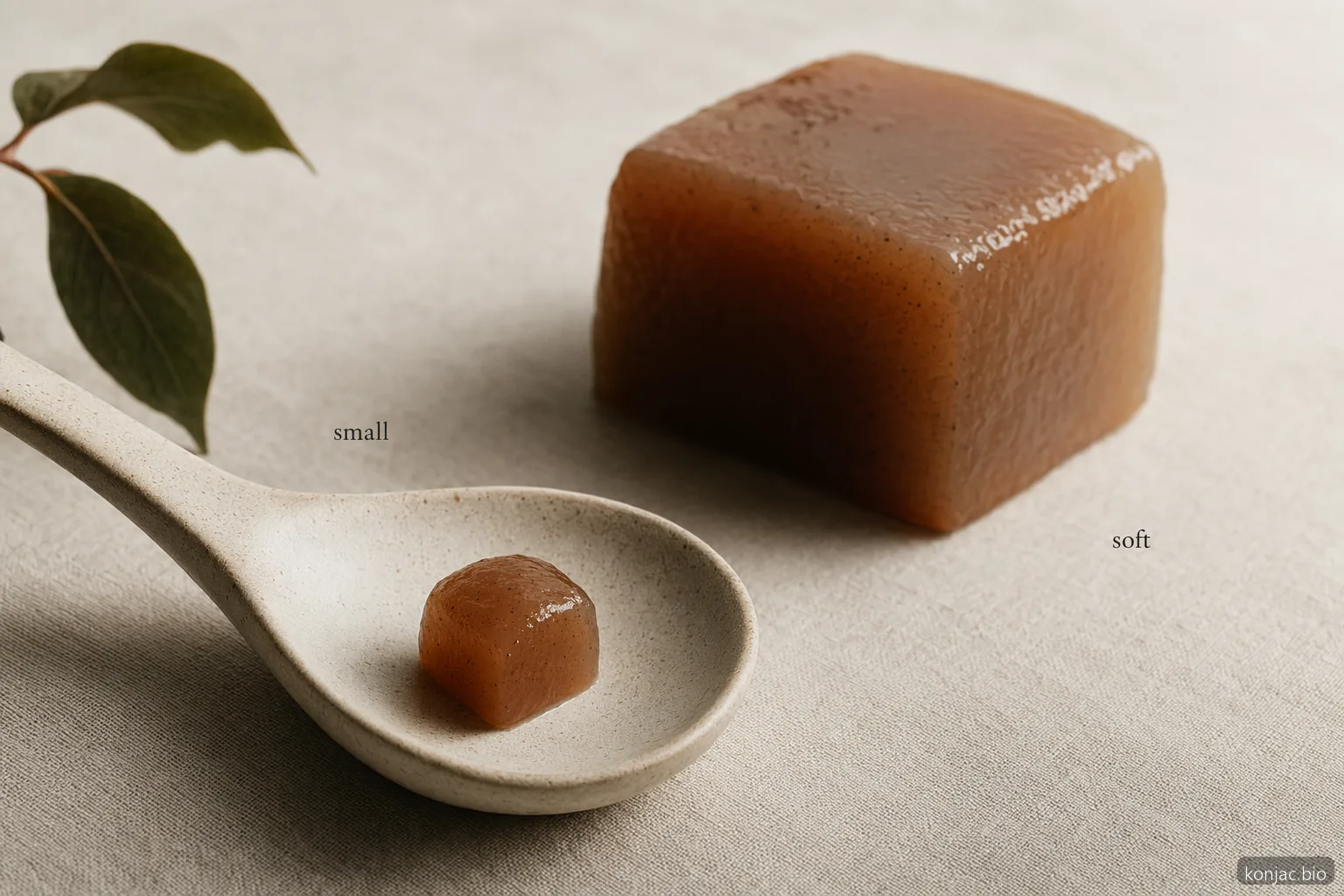
A konjac gummy can be safe when it is formulated as a chewable food with appropriate piece size, labeling, and choking-risk controls.
The highest-profile safety issue is not ordinary gummy candy, but small gel cups that can be swallowed whole. The U.S. Food and Drug Administration warned consumers about mini-cup gel candy products containing konjac because their shape, firmness, and slipperiness were linked with choking risk FDA warning.
For developers, the risk controls are concrete. Avoid round mini-cup formats that can be inhaled or swallowed intact. Design pieces that require chewing, break apart under bite force, and carry age-appropriate warnings when needed.
- Piece geometry: avoid plug-like shapes sized for the airway.
- Gel fracture: target a bite that breaks instead of sliding whole.
- Serving instructions: tell consumers to chew thoroughly.
- Audience fit: review products separately for young children and older adults.
- Market rules: check local restrictions before selling jelly cups or novelty gels.
Konjac glucomannan also absorbs water and increases viscosity. Dry powder is not the same risk profile as a finished gummy, but manufacturing teams should control dust, hydration, and worker instructions so the ingredient is handled as a powerful water-binding hydrocolloid.
Konjac gummy labels, claims, and quality checks
Konjac gummy labels should separate ingredient facts from health-positioning language. Konjac gum may appear as konjac gum, konjac flour, glucomannan, or E425 depending on jurisdiction, formula role, and supplier documentation.
For health-related wording, use cautious and compliant language. EFSA has authorized the exact claim that “glucomannan in the context of an energy restricted diet contributes to weight loss” under specified conditions EFSA opinion. Outside that precise framework, safer wording is “contains konjac glucomannan,” “source of fiber” when analytically supported, or “may support satiety” where local rules allow.
Procurement teams should treat konjac gum like a functional ingredient, not a commodity filler. The best suppliers provide traceability, allergen statements, heavy metals data, microbiology, viscosity, mesh size, and country-of-origin documentation. Food safety systems such as ISO 22000 define requirements for food safety management systems across the supply chain ISO 22000.
| Document | Why it matters |
|---|---|
| Specification sheet | Confirms viscosity, particle size, moisture, and purity targets |
| Certificate of analysis | Verifies each lot against agreed parameters |
| Microbiology report | Supports finished-product safety and release review |
| Heavy metals statement | Supports compliance checks for lead, cadmium, arsenic, and mercury |
| Allergen statement | Supports label review and customer questionnaires |
A strong konjac gummy brief includes target texture, pH, Brix, piece size, shelf life, claim region, and preferred label name. With those details, suppliers can recommend a viscosity grade that fits real processing conditions instead of sending a generic sample.
Frequently asked questions
01 Is a konjac gummy vegan?
02 Does a konjac gummy taste like konjac?
03 Can konjac gummies make weight-loss claims?
04 Why do some konjac jelly cups carry choking warnings?
05 What is the difference between konjac gummy and gelatin gummy texture?
- Konjac glucomannan, a promising polysaccharide for food, biomedical and pharmaceutical applications · PubMed · 2015
- Scientific Opinion on the substantiation of health claims related to konjac mannan · European Food Safety Authority · 2010
- FDA warns consumers not to eat mini-cup gel candy products containing konjac · U.S. Food and Drug Administration · 2001
- ISO 22000 Food safety management systems · International Organization for Standardization · 2018