What is glucomannan konjac powder?
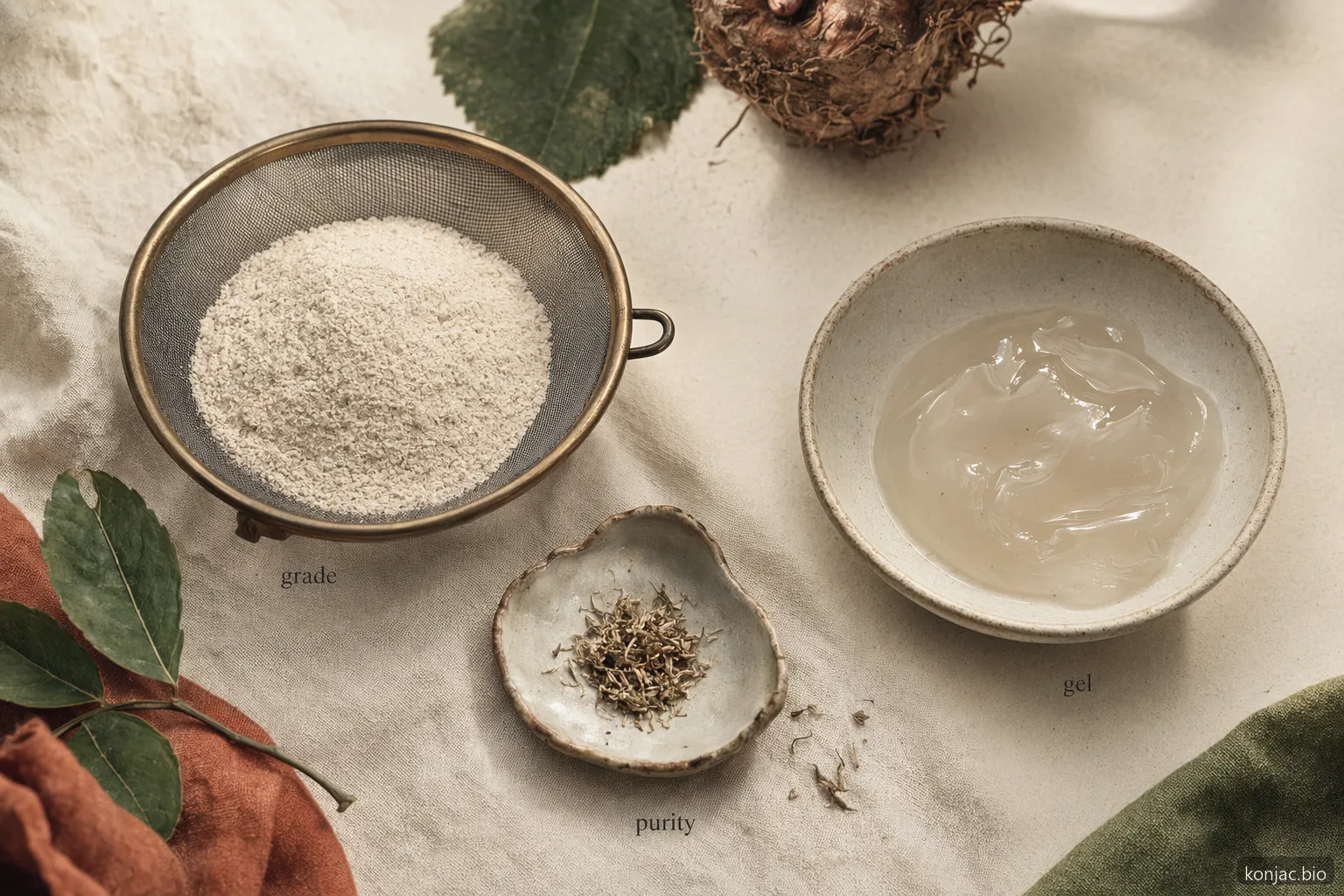
Glucomannan konjac powder is the refined glucomannan-rich fraction of Amorphophallus konjac, a corm crop used to make konjac flour, konjac gum, and shirataki foods.
EFSA describes konjac mannan, also called glucomannan, as a soluble dietary fiber from konjac that absorbs water and increases viscosity in the gut and in food systems EFSA opinion. For a broader ingredient map, see our parent guide to konjac flour and powder.
Commercially, the naming can be confusing. “Konjac flour” may refer to a less refined milled ingredient, while “glucomannan konjac powder” usually signals higher glucomannan content, lighter color, lower odor, and tighter viscosity specs.
| Ingredient name | Typical meaning | Best use |
|---|---|---|
| Konjac flour | Milled konjac ingredient with fiber and native plant solids | General thickening and traditional foods |
| Glucomannan konjac powder | More purified soluble fiber fraction | Fiber enrichment, texture systems, premium formulations |
| Konjac gum | Food additive form selected for gelling and viscosity | Stabilizers, gels, sauces, plant-based foods |
Formulators choose the refined powder when color, odor, and hydration consistency matter more than the lowest ingredient cost. Buyers usually request a certificate of analysis, viscosity method, particle size, and microbiology limits before approving a production lot.
How does glucomannan konjac powder work in food?
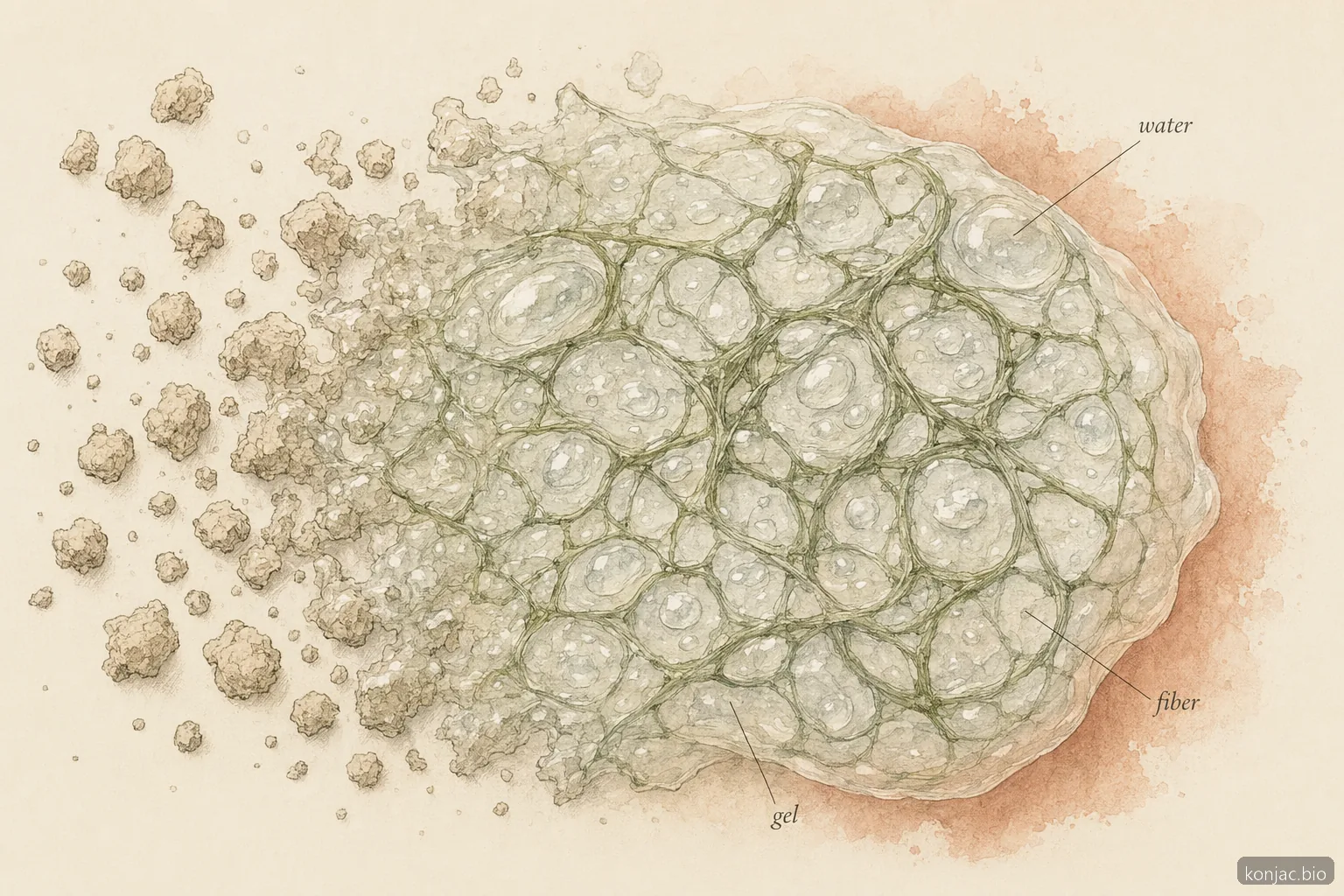
Glucomannan konjac powder works by absorbing water, raising viscosity, and forming elastic gels when combined with the right heat, pH, minerals, or synergistic gums.
The functional behavior comes from glucomannan’s high water-binding capacity and soluble fiber structure, which EFSA connects with increased viscosity after hydration EFSA opinion. In food production, that same hydration behavior helps build thickness, suspend particles, reduce syneresis, and create bite in low-carbohydrate gel foods.
Common applications include:
- Shirataki and konjac noodles: Glucomannan hydrates, then sets into a springy gel. See our related guide to shirataki noodles.
- Sauces and dressings: Low inclusion rates help improve cling and reduce watery separation.
- Plant-based meats: Hydrated konjac improves juiciness, binding, and slice stability.
- Bakery and gluten-free systems: It can add water retention and soft texture when balanced with starches.
- Beverages and meal replacements: Fine mesh grades disperse more easily, but process control is critical.
Processing sequence matters. Many formulators pre-blend the powder with sugar, starch, salt, or another dry carrier before adding it to a vortex of water. Directly dumping fine powder into still liquid can create fish-eye lumps: dry powder trapped inside hydrated outer shells.
Glucomannan konjac powder specifications buyers compare
Buyers compare glucomannan konjac powder by viscosity, glucomannan assay, mesh size, moisture, ash, odor, color, microbiology, and food-safety documentation.
A practical specification should state the test method, not only the target number. Viscosity can shift with concentration, water temperature, shear, hydration time, and instrument settings, so a “high-viscosity” claim has limited value without a defined method.
| Spec | Why it matters | Typical buyer question |
|---|---|---|
| Viscosity | Controls thickness, gel strength, and batch consistency | What method and concentration are used? |
| Glucomannan content | Signals purity and fiber contribution | Is the assay reported on a dry basis? |
| Mesh size | Affects dispersion speed and lumping risk | Is the powder fine enough for beverages? |
| Moisture | Impacts shelf stability and flow | What is the maximum moisture limit? |
| Ash | Indicates mineral and residual plant material | Is the lot suitable for light-colored foods? |
| Microbiology | Supports release into food production | Are total plate count, yeast, mold, E. coli, and Salmonella tested? |
Documentation can matter as much as the powder. Importers and manufacturers often request allergen statements, non-GMO statements, heavy metal testing, pesticide screening, country of origin, halal or kosher certificates, and a food safety plan aligned with systems such as ISO 22000.
B2B note: konjac.bio sources food-grade konjac ingredients at wholesale scale for formulators, importers, and private-label teams. For lot specs, documentation, and pricing, use the contact form.
When comparing offers, avoid buying from price alone. A lower-cost lot can raise the real cost of production if it hydrates slowly, darkens a finished product, has stronger odor, or requires extra filtration, mixing time, or quality holds.
What benefits of glucomannan konjac powder are supported?
Glucomannan konjac powder may support satiety, weight-management positioning, and normal blood cholesterol messaging when used with compliant wording and qualifying conditions.
The strongest regulatory language in Europe comes from EFSA. For weight management, the approved wording is: "Glucomannan in the context of an energy restricted diet contributes to weight loss" EFSA opinion. EFSA states the claimed effect is obtained with 3 g of glucomannan daily in three 1 g doses, each taken with 1 to 2 glasses of water before meals and within an energy-restricted diet EFSA opinion.
EFSA also concluded that glucomannan "contributes to the maintenance of normal blood cholesterol concentrations" when the daily intake is 4 g of glucomannan EFSA cholesterol. U.S. brands should not copy European claim wording automatically, because U.S. structure-function and Nutrition Facts rules follow FDA requirements, including dietary fiber labeling criteria FDA guidance.
Human evidence is not a blank check for broad claims. A PubMed-indexed critical review described glucomannan as promising for body weight and lipid outcomes, but also noted variability across study designs and the need for careful interpretation PubMed review. For product copy, the safest route is specific dosage, specific condition, and jurisdiction-specific review.
Safety, labeling, and formulation limits for glucomannan konjac powder
Glucomannan konjac powder needs controlled hydration, clear directions, and careful product design because dry or poorly hydrated material can swell quickly.
EFSA’s weight-management opinion links safe use with taking each 1 g dose with 1 to 2 glasses of water before meals EFSA opinion. For supplements or powdered beverage formats, directions should tell consumers to mix fully with enough liquid and drink promptly after dispersion.
Finished food design also matters. FDA import controls have targeted mini-cup gel candies containing konjac because firm gels in small cups can create a choking hazard, especially when the gel does not dissolve readily in the mouth FDA alert. That issue is product-format specific, not a general rejection of konjac as a food ingredient.
For labels, formulators should separate three topics: ingredient naming, Nutrition Facts fiber declaration, and voluntary benefit claims. U.S. dietary fiber labeling must align with FDA rules for non-digestible carbohydrates and beneficial physiological effects FDA guidance.
- Use validated mixing instructions for powders and instant beverages.
- Confirm viscosity after real processing, not only in a lab beaker.
- Challenge-test acidic, sweetened, or mineral-rich formulas for texture drift.
- Review claim language by sales market before printing packaging.
- Keep lot-specific certificates of analysis tied to each production batch.
Frequently asked questions
01 Is glucomannan konjac powder the same as konjac flour?
02 What is glucomannan konjac powder used for in foods?
03 How much glucomannan konjac powder is used in a formula?
04 Can brands make weight-management claims for glucomannan konjac powder?
05 Is glucomannan konjac powder safe in beverages and gels?
- Scientific Opinion on konjac mannan and reduction of body weight · European Food Safety Authority · 2010
- Scientific Opinion on konjac mannan and normal blood cholesterol · European Food Safety Authority · 2010
- Glucomannan and obesity: a critical review · PubMed · 2005
- Questions and Answers on Dietary Fiber · U.S. Food and Drug Administration · 2024
- Import Alert 33-15 · U.S. Food and Drug Administration · 2024
- ISO 22000 Food safety management · International Organization for Standardization · 2018