
What is organic konjac flour?
Organic konjac flour is flour from Amorphophallus konjac corms that has been produced and handled under a recognized organic certification program.
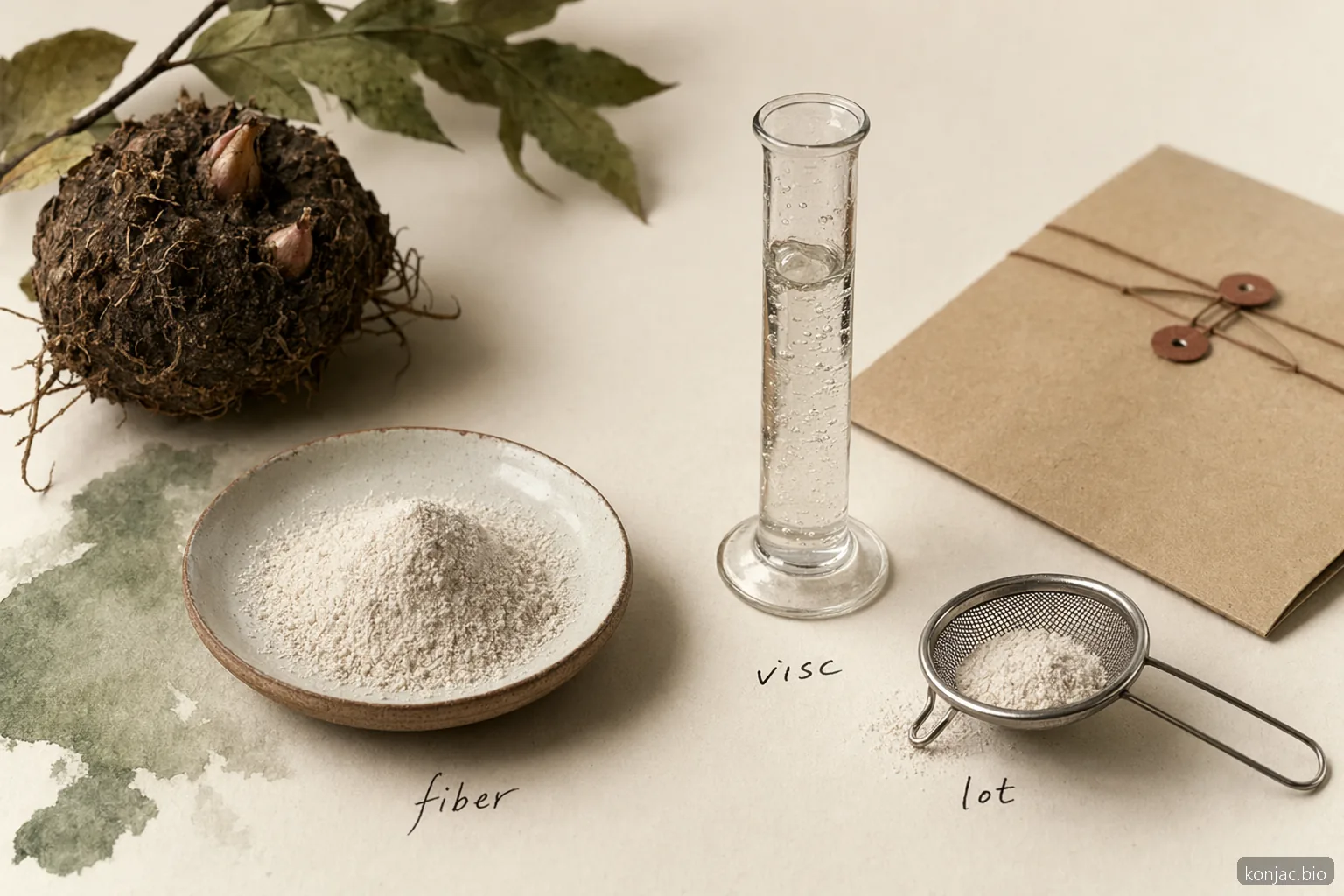
Functionally, it is still konjac flour: a high-viscosity ingredient rich in glucomannan, the soluble fiber that gives konjac its thickening, gelling, and water-binding behavior. Konjac flour is a substance made from the tuber of Amorphophallus konjac and is commonly used in foods as a stabilizer, thickener, and gelling agent.
The organic part describes how the crop, processing site, storage, and transaction documents are controlled. It does not automatically mean higher viscosity, higher fiber, or better sensory performance than conventional konjac flour of the same grade.
For a full ingredient overview, including how konjac flour differs from other hydrocolloids, see our parent guide to konjac flour.
How is organic konjac flour certified?
Organic konjac flour is certified when the farm, processor, handler, and importer can show compliance with organic production and handling rules for the target market.
For the United States, the National Organic Program covers production, handling, labeling, certification, and enforcement under USDA organic rules. For the European Union, organic production and labeling are governed by EU organic regulations and control systems described by EU organic guidance.
A serious buyer should request five documents before approving a supplier:
- Current organic certificate showing konjac flour in scope.
- Transaction certificate or lot-specific organic verification when required.
- Certificate of analysis for the exact lot.
- Food-safety certificate, such as ISO 22000, BRCGS, or FSSC 22000 where applicable.
- Traceability documents linking farm, processor, batch, and shipment.
Certification names matter because organic claims are market-specific. A U.S. retail product usually needs USDA organic compliance, while an EU product needs EU-recognized certification and import controls.
konjac.bio sources organic and conventional konjac flour at wholesale scale for food, beverage, and supplement manufacturers. Share your target viscosity, mesh, certification market, and pack size through the contact page for pricing.
Organic konjac flour versus conventional konjac flour
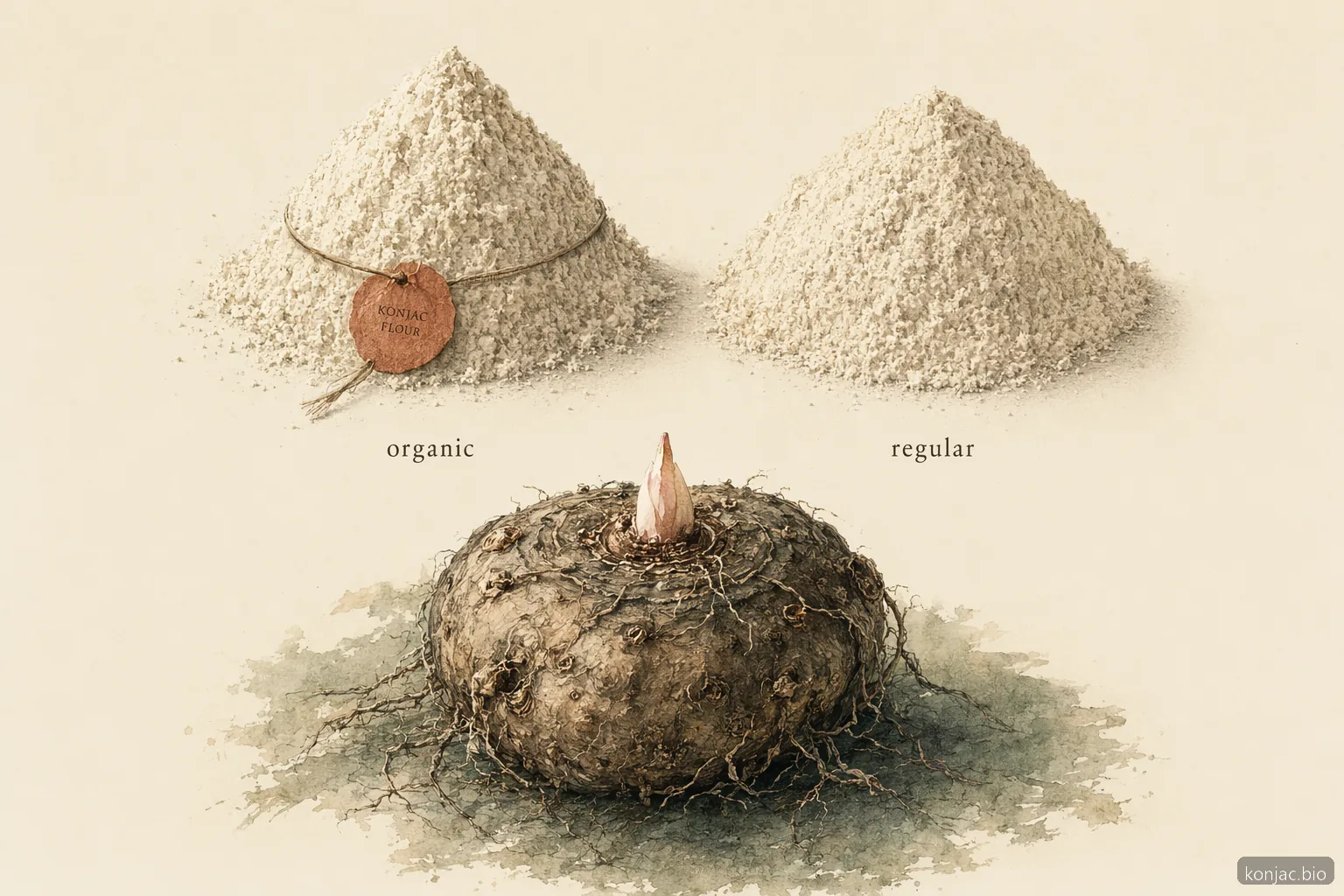
Organic konjac flour and conventional konjac flour can perform similarly when the glucomannan level, viscosity, particle size, and hydration method are matched. The practical difference is supply-chain claim value, not a separate ingredient identity.
Organic grades usually cost more because certified farming, segregated storage, certified processing, documentation, and audits add cost. Conventional grades can be the better choice when a product does not carry an organic label or when performance targets are the only priority.
| Factor | Organic konjac flour | Conventional konjac flour |
|---|---|---|
| Label value | Supports certified organic positioning | No organic claim |
| Botanical source | Amorphophallus konjac | Amorphophallus konjac |
| Main function | Thickening, gelling, water binding | Thickening, gelling, water binding |
| Cost | Usually higher | Usually lower |
| Documentation | Certificate plus lot traceability | COA and food-safety documents |
Terminology can also create confusion. Some suppliers use konjac flour and konjac powder loosely, while others reserve flour for higher-purity glucomannan-rich material and powder for less refined material. For naming and purchasing differences, see konjac powder.
Specification checklist for organic konjac flour
A purchase specification should define organic status, functional performance, food-safety limits, and shipment documentation. A certificate alone is not enough for industrial formulation.
The most useful specifications are measurable. Viscosity tells formulators how strongly the flour thickens water, while mesh size affects dispersion speed and lumping risk. Glucomannan percentage indicates fiber-rich purity, but it should be read together with ash, moisture, and residue data.
| Spec item | Why it matters | Typical buyer check |
|---|---|---|
| Organic certificate | Supports label claim | Certifier, scope, validity, lot link |
| Glucomannan | Core soluble-fiber component | Percent by lot COA |
| Viscosity | Controls texture and dosage | Method, concentration, temperature |
| Mesh size | Affects dispersion and mouthfeel | 80, 100, 120 mesh or custom |
| SO2 | Important for residue and labeling review | ppm result and market limit |
| Microbiology | Food-safety release criterion | TPC, yeast, mold, coliforms, pathogens |
| Heavy metals | Retail and export compliance | Lead, cadmium, arsenic, mercury |
Health-positioned foods need additional care. EFSA has approved the wording, “Glucomannan in the context of an energy restricted diet contributes to weight loss,” with stated conditions of use in its EFSA opinion. That claim is about glucomannan use conditions, not a blanket claim for every organic konjac flour product.
How should formulators use organic konjac flour?
Formulators should use organic konjac flour by dispersing it carefully, hydrating it fully, and matching the dosage to the target texture.
In sauces, beverages, bakery fillings, and plant-based foods, starting use levels often fall around 0.1% to 0.8%, depending on viscosity grade and the presence of salts, sugars, acids, proteins, or other gums. High-viscosity grades may need lower use rates than low-viscosity grades.
For best dispersion, dry-blend konjac flour with sugar, starch, or another powder before adding it to water under shear. Adding konjac directly to still water can create surface gel lumps that hydrate slowly and reduce batch consistency.
Konjac flour also appears in shirataki-style noodles, gels, and low-calorie texture systems. The FDA has specifically flagged choking risks for certain konjac mini-cup gel candies, so product shape, gel strength, and serving format require careful safety review in high-gel applications under FDA jelly guidance.
For broader formulation ideas, see konjac flour uses.
Frequently asked questions
01 Is organic konjac flour healthier than conventional konjac flour?
02 What certification should I ask for when buying organic konjac flour?
03 Is organic konjac flour gluten-free?
04 How much organic konjac flour should a food formulator use?
05 Can organic konjac flour be used in shirataki noodles?
06 Does organic konjac flour have fewer additives?
- Organic Regulations · USDA Agricultural Marketing Service · 2024
- Organics at a Glance · European Commission · 2025
- Scientific Opinion on Glucomannan Health Claims · European Food Safety Authority · 2010
- Import Alert 33-15: Detention Without Physical Examination of Gel Candies Containing Konjac · U.S. Food and Drug Administration · 2024
- Gluten-Free Labeling of Foods · U.S. Food and Drug Administration · 2024