How does glucomannan and weight loss evidence actually connect?
Glucomannan may support weight loss by forming a viscous gel that increases meal volume, slows digestion, and helps some people eat fewer calories. It is a soluble fiber from the corm of Amorphophallus konjac, and its high water-binding capacity is central to how it works. NIH ODS
The strongest approved wording comes from EFSA: "Glucomannan in the context of an energy restricted diet contributes to weight loss." EFSA ties that claim to 3 grams per day, taken as 1 gram before each of three meals with 1 to 2 glasses of water. EFSA opinion
That wording matters because it does not say glucomannan works without diet structure. The claim depends on an energy-restricted diet, which means total calorie intake still has to be lower than energy expenditure.
| Mechanism | Practical meaning |
|---|---|
| Water binding | Creates bulk in the stomach when taken with enough fluid |
| Viscosity | May increase fullness after meals |
| Low digestible carbohydrate | Fits keto meals more easily than starch-based thickeners |
| Pre-meal timing | Works best when used before planned meals, not after overeating |

What dose of glucomannan and weight loss timing is used in studies?
The best-studied dose for glucomannan and weight loss is 3 grams per day, split as 1 gram before each of three meals with 1 to 2 glasses of water. EFSA names this exact condition for its weight-management claim. EFSA opinion
A practical schedule is simple:
- Breakfast: 1 gram glucomannan with 1 to 2 glasses of water, before eating.
- Lunch: 1 gram glucomannan with 1 to 2 glasses of water, before eating.
- Dinner: 1 gram glucomannan with 1 to 2 glasses of water, before eating.
Powder, capsules, and tablets are not identical in use. Powder hydrates quickly and can thicken shakes, soups, or sauces. Capsules and tablets are more convenient, but they must be swallowed with enough water because dry glucomannan expands rapidly.
Starting lower can improve tolerance. A cautious routine is 1 gram once daily for 3 to 4 days, then 1 gram twice daily, then the full 3 grams daily if digestion feels normal.
Realistic results: what trials and reviews have found
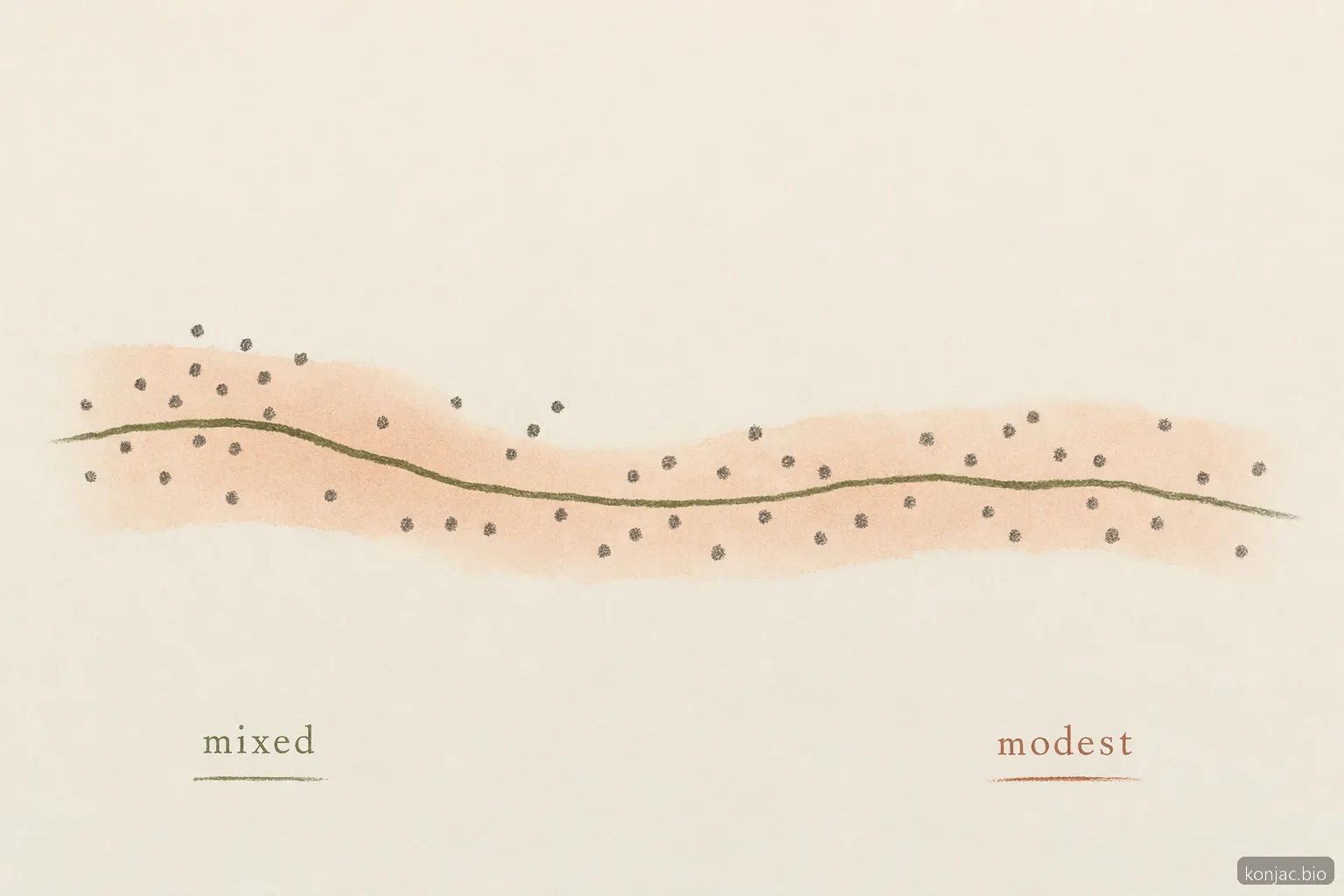
Clinical evidence is mixed rather than dramatic. EFSA accepted a specific weight-management claim in 2010, but later randomized trials and reviews reported smaller or inconsistent effects across populations, diets, and study designs. PubMed review
One 8-week randomized, placebo-controlled trial in adults with overweight or obesity found no significant difference in body weight, body composition, hunger, or fullness between glucomannan and placebo groups. The trial used 1.33 grams before meals, three times daily. RCT trial
A realistic expectation is that glucomannan can be useful as a compliance tool, not as a primary driver. It may help a structured plan feel easier, especially when appetite is the limiting factor, but total diet quality, protein intake, sleep, and calorie control still dominate outcomes.
| Evidence type | What it suggests | How to interpret it |
|---|---|---|
| EFSA 2010 claim | 3 grams daily may support weight loss in an energy-restricted diet | Use the exact dose and meal timing |
| Randomized trial | Some trials show little or no added weight change | Do not expect large results from fiber alone |
| Systematic review | Findings vary by study quality and protocol | Best used as one part of a plan |
How can glucomannan and weight loss fit a keto meal plan?
Glucomannan can fit a keto weight loss plan by adding fiber, texture, and fullness without relying on starch-heavy foods. For a full framework, see Konjac for Keto and Weight Loss.
Many keto plans are low in bread, pasta, beans, oats, and fruit, which can make fiber harder to reach. The FDA Daily Value for dietary fiber is 28 grams per day based on a 2,000-calorie diet, so low-carb eaters often need deliberate fiber sources. FDA values
Glucomannan can be used in two practical ways. First, it can be taken before meals as a measured supplement. Second, it can appear in konjac foods such as shirataki noodles, konjac rice, and low-carb thickened sauces.
- For volume: pair shirataki with eggs, tofu, fish, chicken, or beef.
- For texture: use konjac rice with cauliflower rice to improve bite.
- For satiety: combine glucomannan with protein and non-starchy vegetables.
- For tracking: check the label for serving size, fiber, and net carbohydrate.
For recipe-style use, compare shirataki noodles and konjac rice, since their texture, rinsing needs, and meal fit differ.
Safety, tolerability, and buying criteria
Glucomannan is generally used as a food fiber, but dry forms need care because they expand quickly in water. Capsules, tablets, and powder should be taken with a full glass of water, and people with swallowing difficulty should avoid dry formats. NIH ODS
The FDA has taken action on gel candies containing konjac because mini-cup formats created choking risks. That issue is format-specific, but it shows why hydration, serving size, and product design matter for konjac ingredients. FDA alert
Common digestive effects include bloating, gas, loose stool, or abdominal fullness, especially when someone jumps to 3 grams daily on day one. A step-up schedule and adequate water usually make use more comfortable.
For finished products, buying criteria should include viscosity specification, mesh size, purity, microbiology, heavy metals, allergen status, country of origin, and a current certificate of analysis. Food manufacturers may also ask suppliers about HACCP, ISO 22000, BRCGS, or other food safety systems.
B2B aside: konjac.bio sources konjac ingredients for wholesale buyers, including food brands developing keto, low-carb, and fiber-forward products. For specifications and volume pricing, contact the team.
Frequently asked questions
01 Does glucomannan cause weight loss by itself?
02 How much glucomannan should I take for weight loss?
03 When should glucomannan be taken before meals?
04 Is glucomannan keto-friendly?
05 What are the main safety concerns with glucomannan?
- Scientific Opinion on the substantiation of health claims related to konjac mannan and reduction of body weight · EFSA Journal · 2010
- Dietary Supplements for Weight Loss: Fact Sheet for Health Professionals · NIH Office of Dietary Supplements · 2022
- Safety and efficacy of glucomannan for weight loss in overweight and moderately obese adults · PubMed · 2013
- The efficacy of glucomannan supplementation in overweight and obesity: a systematic review and meta-analysis of randomized clinical trials · PubMed · 2014
- Import Alert 33-15: Detention Without Physical Examination of Gel Candies Containing Konjac · U.S. Food and Drug Administration · 2024
- Daily Value on the New Nutrition and Supplement Facts Labels · U.S. Food and Drug Administration · 2024