What are konjac sponges for face?
Konjac sponges for face are porous cleansing tools made by hydrating, molding, and drying glucomannan-rich fiber from the konjac corm. Glucomannan is a water-absorbing polysaccharide found in Amorphophallus konjac, described in food science references as a high-viscosity soluble fiber from the plant tuber or corm glucomannan overview.
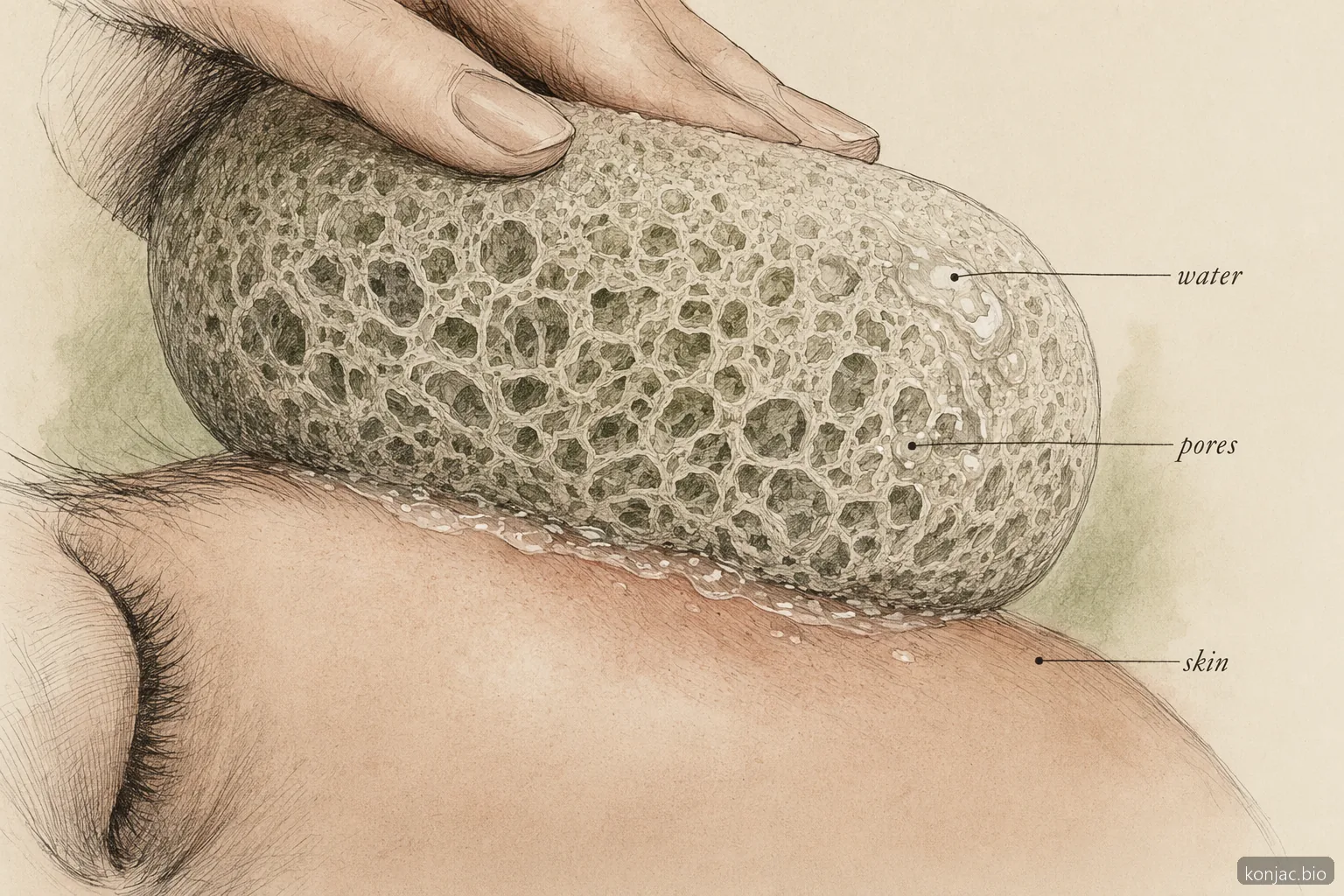
A dry konjac facial sponge feels hard and shrunken. After 3 to 5 minutes in warm water, it expands into a springy pad that can glide across cheeks, nose, chin, and forehead with light circular movement.
Facial konjac sponges are different from dietary konjac powders or capsules. The EFSA-2010 weight-management claim applies to consumed glucomannan and states: 'Glucomannan in the context of an energy restricted diet contributes to weight loss' EFSA claim. That claim does not apply to a sponge used on the skin.
For a broader overview of the material, formats, and sourcing terms, see the parent guide: Konjac Sponge: The Natural Skincare Tool. For brands building a facial cleansing line, konjac.bio sources konjac sponge inputs and finished options at wholesale scale, with specifications available through the contact page.
How do konjac sponges for face exfoliate skin?
Konjac sponges for face exfoliate by using very light mechanical friction on the outer skin surface after the sponge has been fully softened with water. The target is the stratum corneum, the outermost layer of the epidermis, which is made of flattened, dead surface cells in a lipid matrix skin anatomy.
This is physical exfoliation, not chemical exfoliation. A konjac sponge does not work like glycolic acid, lactic acid, salicylic acid, or enzyme powders. Its effect comes from water-softened texture, movement, and how much pressure the user applies.
The American Academy of Dermatology advises choosing exfoliation methods based on skin type and being gentle because aggressive exfoliation can irritate skin exfoliate safely. That guidance fits konjac sponges well: the sponge should be soft enough to fold easily, and the hand should barely press into the face.
- Time: 30 to 60 seconds is enough for most facial cleansing routines.
- Pressure: use the weight of the wet sponge, not a scrubbing motion.
- Frequency: start 2 to 3 times weekly if skin is reactive, then adjust.
- Pairing: use with water alone or a small amount of mild cleanser.
A konjac sponge should never feel sharp, scratchy, or hot on the skin. If redness or stinging appears, stop using it and simplify the routine until the skin feels comfortable again.
Who should use a konjac face sponge?
A konjac face sponge suits people who want a soft, low-friction cleansing tool and can keep it clean between uses. It is most useful for removing light residue, smoothing flaky surface texture, and making cleanser spread more evenly across the face.
Skin type matters more than marketing labels such as charcoal, green tea, clay, or pink clay. Additives can change color and positioning, but the core user experience still depends on the hydrated konjac fiber, pressure, drying speed, and replacement timing.
| Skin type | Best use | Watch-outs |
|---|---|---|
| Normal | Daily or near-daily with gentle cleanser | Do not add pressure for extra polish |
| Dry | 2 to 4 times weekly with creamy cleanser | Follow with moisturizer while skin is damp |
| Oily | Focus on nose, chin, and forehead | Avoid harsh cleanser combinations |
| Sensitive | Use water only at first | Skip fragranced or heavily colored versions |
| Acne-prone | Use gently on non-tender areas | Do not rub raised or broken spots |
For acne-prone routines, the American Academy of Dermatology recommends gentle cleansing and avoiding skin irritation from scrubbing or rough washcloths acne care. A konjac sponge can fit that style only when fully soft, used lightly, and kept personal to one user.

How to use and care for facial konjac sponges
Good results come from hydration first, light movement second, and drying after every cleanse. A konjac sponge that is used while partly hard can drag across the face, while a sponge stored wet can develop odor or discoloration faster.
- Soak: place the dry sponge in warm water for 3 to 5 minutes until it is fully expanded.
- Squeeze: press out extra water between clean palms. Do not twist hard because twisting can tear the fiber network.
- Cleanse: move in small circles for 30 to 60 seconds. Use water alone or add a pea-sized amount of mild cleanser.
- Rinse: rinse the sponge until water runs clear and cleanser foam is gone.
- Dry: press out water, then hang it in moving air. Do not leave it flat in a puddle or sealed in a travel case.
- Replace: discard it when it smells musty, feels slimy, cracks, sheds, or stays damp between uses.
Most facial konjac sponges last about 4 to 8 weeks with daily use. Hard water, heavy makeup residue, humid bathrooms, and poor airflow can shorten that window.
For a step-by-step routine with timing and cleanser pairing, see how to use konjac sponge. For positioning claims and consumer benefits, see konjac sponge benefits.
Konjac sponges for face vs washcloths, brushes, and scrubs
Konjac sponges for face sit between a plain hand cleanse and stronger physical exfoliation tools. They are softer than many textured washcloths, simpler than powered cleansing brushes, and less abrasive than grainy facial scrubs.
| Tool | Texture | Best for | Main caution |
|---|---|---|---|
| Konjac sponge | Soft, springy, porous | Gentle daily cleansing | Must dry fully between uses |
| Washcloth | Varies by fabric and weave | Makeup removal, body use | Can feel rough when scrubbed |
| Cleansing brush | Bristles or silicone nodes | Users who like device routines | Pressure and frequency can be too high |
| Facial scrub | Particles in cream or gel | Occasional polishing | Uneven particles can feel abrasive |
| Hands only | No added texture | Very reactive or minimal routines | Less surface polishing |
The best tool is the one that leaves skin comfortable 10 minutes after cleansing. Tightness, burning, or a shiny over-polished look usually means the routine is too aggressive, regardless of whether the tool is natural, synthetic, manual, or powered.
A konjac sponge is also more routine-dependent than a cleanser bottle. Two users can get different results from the same sponge if one soaks it fully and dries it well, while the other scrubs hard and stores it wet.
Frequently asked questions
01 Can I use konjac sponges for face every day?
02 Do I need cleanser with a konjac face sponge?
03 How long should a facial konjac sponge last?
04 Are charcoal konjac sponges better for oily skin?
05 Can I share a konjac sponge with someone else?
- Glucomannan: An Overview · ScienceDirect · 2024
- Scientific Opinion on health claims related to konjac mannan (glucomannan) and reduction of body weight · EFSA Journal · 2010
- Anatomy, Skin (Integument), Epidermis · NCBI Bookshelf · 2023
- How to safely exfoliate at home · American Academy of Dermatology · 2024
- 10 skin care habits that can worsen acne · American Academy of Dermatology · 2024