
How should brands specify glucomannan supplement manufacturing grades?
Brands should specify glucomannan supplement manufacturing grades by dosage format, viscosity, particle size, hydration speed, microbial limits, and intended daily serving.
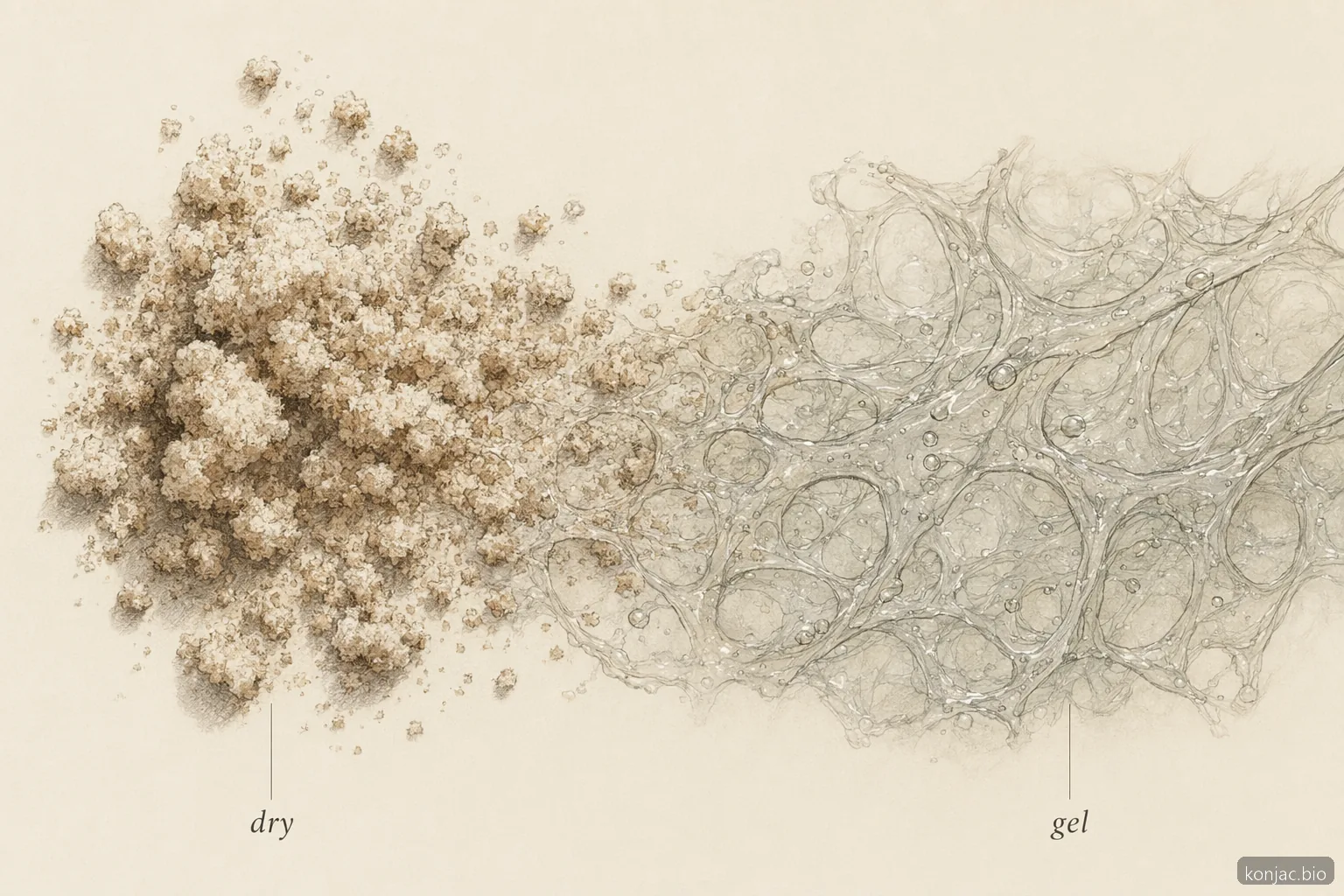
Glucomannan is a water-soluble polysaccharide from the corm of Amorphophallus konjac, commonly called konjac, and its hydration behavior is central to supplement performance konjac review. A capsule formula may need controlled swelling and reliable disintegration. A stick-pack powder may need rapid dispersion without clumping.
| Format | Preferred grade focus | Buyer specification |
|---|---|---|
| Capsules | Fine powder, controlled viscosity, low dust | Particle size range, capsule fill weight, disintegration result, microbial limits |
| Bulk powders | High viscosity, neutral taste, low odor | Viscosity method, mesh size, moisture, ash, heavy metals, serving size |
| Ready-to-mix sticks | Fast-dispersing agglomerated powder | Wettability, flowability, sachet weight variance, flavor compatibility |
| Blended fiber formulas | Compatible hydration profile | Blend uniformity, interaction with inulin, psyllium, gums, minerals, or sweeteners |
A useful purchase specification includes identity testing, purity targets, moisture, viscosity method, particle size, microbiology, allergens, pesticide screen, residual solvents if used, heavy metals, country of origin, and storage conditions. For related raw-material context, see glucomannan, konjac, and konjac powder.
Ready to source? Typical specifications, MOQ, lead time and a quote form for konjac glucomannan powder (80-95% KGM) are on the product page. Supplier: Konjac Bio Limited, Shanghai (sourcing company; specification sheet and COA from the producing factory with every shipment).

Which EFSA claims can a glucomannan supplement manufacturing brief use?
A glucomannan supplement manufacturing brief for the EU can use authorized EFSA-linked wording only when the product meets the required conditions of use.
For weight management, the exact authorized wording is: "Consumption of glucomannan in the context of an energy-restricted diet contributes to weight loss." EFSA evaluated the claim for glucomannan and body weight in adults EFSA opinion, and the EU authorized wording appears in Commission Regulation 432/2012 EU register.
For cholesterol maintenance, the authorized wording is: "contributes to the maintenance of normal blood cholesterol levels" at a daily intake of at least 4 g of glucomannan, with the relevant EFSA assessment covering blood cholesterol maintenance EFSA cholesterol.
| Claim area | Required wording | Commercial check |
|---|---|---|
| Weight management | Consumption of glucomannan in the context of an energy-restricted diet contributes to weight loss | Confirm daily dose, dose timing, water-use directions, and local-language translation |
| Blood cholesterol maintenance | contributes to the maintenance of normal blood cholesterol levels | Confirm at least 4 g glucomannan per day and retain claim support in the label file |
Do not broaden EFSA wording into unsupported outcomes. A compliant label file should connect the exact claim, serving size, daily intake, instructions for use, warning language, and the finished-product specification.
Capsules, powders, and ready-to-mix sticks: manufacturing tradeoffs
Each finished format changes the manufacturing risk profile. The same konjac glucomannan raw material can behave differently in a hard capsule, a scoopable powder, and a flavored stick pack.
Capsules are compact and familiar, but glucomannan swells in water, so disintegration and use directions matter. Capsule projects usually prioritize fill-weight accuracy, excipient compatibility, and packaging that limits moisture pickup.
Powders can deliver larger servings with fewer units, which matters when a claim requires grams per day. Powder projects should control clumping, mouthfeel, serving scoop accuracy, hydration speed, flavor masking, and container headspace.
Ready-to-mix sticks are convenient for travel and sampling. Stick packs need excellent flow through sachet equipment, low electrostatic behavior, tight net-weight controls, and a dispersion profile that works in the consumer's stated water volume. For noodle and food-format comparisons, see shirataki noodles and konjac wholesale.
How do GMP-certified contract manufacturers control glucomannan quality?
GMP-certified contract manufacturers control glucomannan quality through written specifications, qualified suppliers, batch records, in-process checks, finished-product testing, and release documentation.
In the United States, dietary supplement current good manufacturing practice requirements are codified in 21 CFR Part 111, covering areas such as production records, quality control operations, packaging, labeling, and holding 21 CFR 111. A strong contract manufacturer can show how those controls are applied to a high-hydration fiber ingredient.
For global programs, ISO 22000 can support food-safety management systems across the supply chain ISO 22000. ISO certification does not replace local supplement rules, but it helps standardize hazard analysis, supplier controls, and traceability.
- Ask for a current GMP certificate or audit summary.
- Request a master manufacturing record for each SKU.
- Confirm identity testing on incoming glucomannan.
- Review sanitation, metal detection, allergen, and environmental controls.
- Require deviation, nonconformance, and recall procedures.
- Confirm retained samples and batch-release authority.

What dissolution and disintegration testing should brands request?
Brands should request capsule disintegration, powder dispersion, viscosity development, serving uniformity, moisture, and microbiology testing for every commercial glucomannan format.
Dietary supplement methods often reference compendial approaches such as USP dietary supplement chapters for performance and quality expectations USP supplements. For glucomannan, a practical test plan also needs format-specific checks because hydration can change the consumer experience within minutes.
| Test | Why it matters | Typical buyer question |
|---|---|---|
| Capsule disintegration | Confirms capsule shell opening under defined conditions | What method, medium, time, and acceptance limit are used? |
| Powder dispersion | Assesses clumping and mixability in the stated water volume | How many inversions, seconds, or stir cycles are required? |
| Viscosity | Confirms grade consistency and hydration performance | What concentration, temperature, spindle, and timing define the result? |
| Serving uniformity | Verifies capsule, scoop, or stick-pack delivery | What is the acceptance range for net weight or active fiber amount? |
| Moisture and water activity | Supports flow, stability, and microbial control | What limits trigger investigation or rejection? |
Use directions should be consistent with the tested format. A label that tells consumers to use a specific water volume should be supported by dispersion and hydration data at that volume.
Regulatory checkpoints: DSHEA, NDI, and EU Novel Food status
Regulatory review should start before formulation lock because ingredient history, claim wording, dose, format, and market geography can change the launch path.
In the United States, DSHEA established the dietary supplement framework for products containing vitamins, minerals, herbs, amino acids, and other dietary ingredients DSHEA overview. FDA's New Dietary Ingredient process applies when a dietary ingredient was not marketed in the United States before October 15, 1994, unless an exemption applies NDI background.
For the EU, Novel Food review depends on whether the food or ingredient was consumed to a significant degree before May 15, 1997, plus the specific production process and intended use Novel Food. A konjac-derived ingredient may have different status depending on purification, particle engineering, concentration, and finished format.
- Document U.S. market history for the exact glucomannan ingredient.
- Check whether the supplier has an NDI position or notification history.
- Review EU ingredient status for the exact process and use level.
- Align claims with jurisdiction-specific wording and dose conditions.
- Keep regulatory memos in the product technical file.

How should a brand build a label-claim substantiation file?
A brand should build a label-claim substantiation file that links every claim to ingredient identity, daily dose, finished-product testing, compliant wording, and supporting evidence.
For U.S. marketing, the Federal Trade Commission expects competent and reliable support for objective product claims, with evidence quality matched to the claim type FTC guidance. For EU marketing, authorized nutrition and health claims must follow the permitted wording and conditions of use in the EU framework EU claims.
A complete glucomannan label file usually includes:
- Finished-product formula and master manufacturing record.
- Raw-material specification and supplier qualification file.
- Certificates of analysis for each batch.
- Identity, microbiology, heavy metal, moisture, and viscosity results.
- Disintegration or dispersion test reports for the finished format.
- Claim rationale showing daily glucomannan intake.
- Artwork review with serving size, directions, cautions, and jurisdiction-specific wording.
- Stability plan and retained-sample policy.
Do not rely on raw-material marketing sheets alone. A finished capsule, powder, or stick pack needs its own records because processing, excipients, fill weights, and packaging can affect the delivered serving.
Procurement checklist for selecting a manufacturing partner
A disciplined procurement process reduces launch delays and helps brands compare suppliers on evidence rather than promises.
Use the same request-for-quote template for every contract manufacturer. Ask for the target serving size, target viscosity grade, minimum order quantity, lead time, packaging format, testing scope, regulatory documents, allergen controls, and change-control process.
| Question | Strong answer | Risk signal |
|---|---|---|
| Can you run high-hydration fibers? | Shows prior glucomannan or soluble-fiber batches | Only general powder experience |
| How is viscosity tested? | Defines concentration, temperature, instrument, and time | Reports a number without method details |
| Who releases batches? | Quality unit reviews records before shipment | Sales team controls release timing |
| How are claims reviewed? | Regulatory review links claims to dose and wording | Generic label review with no claim file |
| How are supplier changes handled? | Written notification and requalification process | Ingredient substitutions without prior approval |
Before issuing a purchase order, request pilot samples, accelerated stability data if available, a full testing quote, packaging specifications, and a clear ownership statement for formulas, labels, and batch documentation.
Frequently asked questions
01 What is the best format for a glucomannan supplement brand?
02 Can a U.S. brand use the EFSA glucomannan weight-management claim?
03 What daily amount is needed for the EU cholesterol-maintenance claim?
04 What documents should a contract manufacturer provide before launch?
05 Is glucomannan always exempt from FDA NDI review?
06 Does EU Novel Food status depend only on the plant source?
07 Why is viscosity testing important for glucomannan supplements?
08 What should be in a glucomannan label-claim file?
- Scientific Opinion on glucomannan and body weight · EFSA · 2010
- Scientific Opinion on glucomannan and blood cholesterol maintenance · EFSA · 2009
- Commission Regulation 432/2012 on permitted health claims · European Union · 2012
- Dietary supplement current good manufacturing practice, 21 CFR Part 111 · eCFR · 2024
- New Dietary Ingredients in Dietary Supplements · FDA · 2024
- Dietary Supplements · U.S. Food and Drug Administration · 2024
- Novel Food Catalogue · European Commission · 2024
- ISO 22000 food safety management · ISO · 2018