What is glucomannan powder?
Glucomannan powder is a concentrated soluble fiber ingredient made from the corm of Amorphophallus konjac.
The main functional component is konjac glucomannan, a high molecular weight polysaccharide built from mannose and glucose units, described in konjac literature as the primary storage carbohydrate in the corm PubMed review. Commercial powder is valued because it can hydrate into a thick gel at low use levels, often below 1 percent in food systems depending on viscosity grade, temperature, and shear.
For supplements, glucomannan powder is usually filled into capsules, compressed into tablets, or packed into single-serve sachets. For foods, it can help with texture in noodles, bakery systems, sauces, beverages, and plant-based products when used within local food regulations.
- Botanical source: Amorphophallus konjac corm
- Main component: konjac glucomannan soluble fiber
- Common formats: powder, capsules, tablets, sachets, food blends
- Core function: high water binding and viscosity
How does glucomannan powder work in water and digestion?
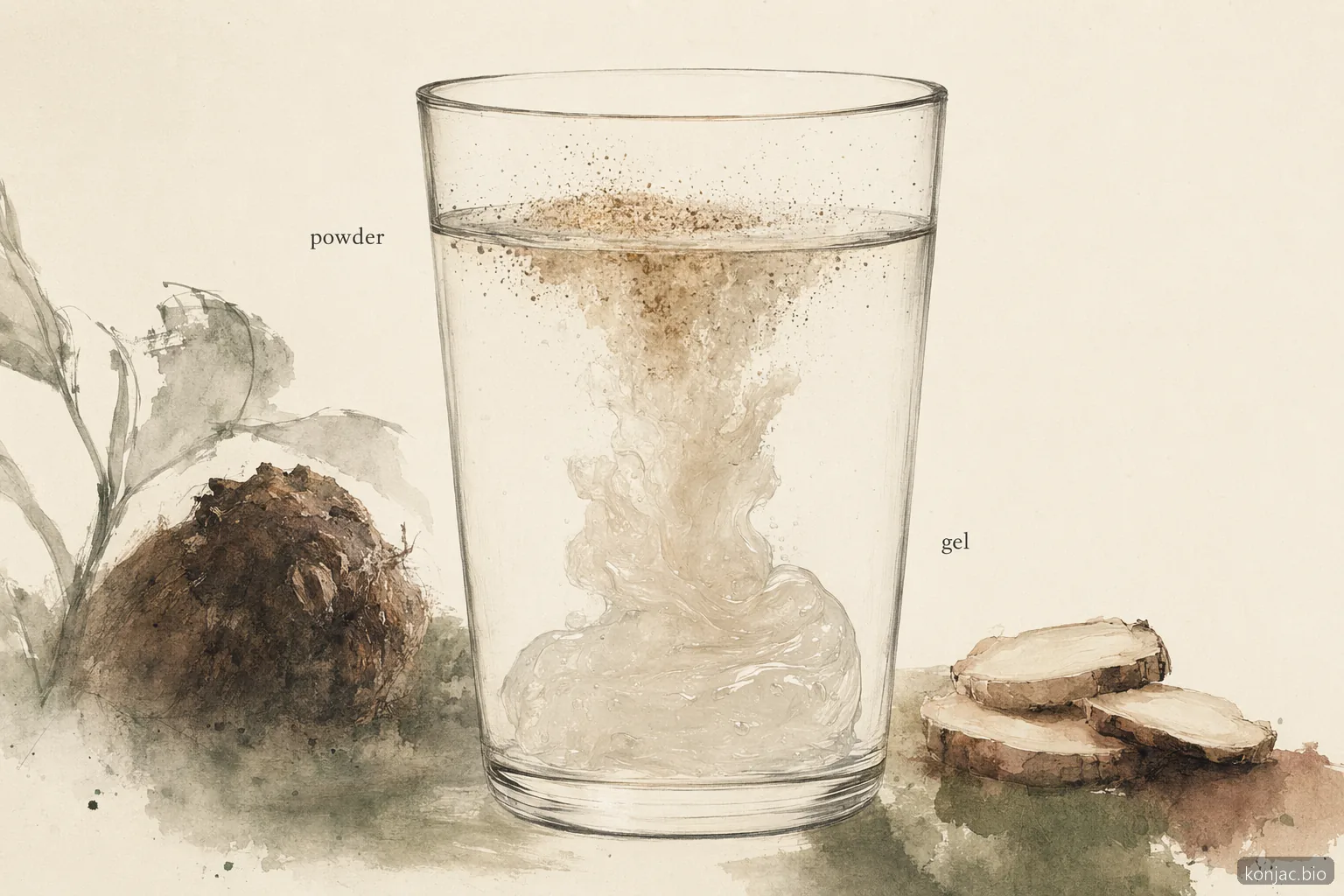
Glucomannan powder works by binding water and forming a viscous gel that slows movement through a liquid or food matrix.
This hydration behavior explains both its usefulness and its safety requirements. In a drink mix, fast hydration creates thickness. In a capsule, the same swelling property means the product should be swallowed with enough liquid and not taken dry.
Human studies and reviews have evaluated glucomannan for satiety, body weight, lipid markers, and glucose response, but results depend on dose, diet, study length, and participant profile. A systematic review in the American Journal of Clinical Nutrition reported effects on selected lipid and glucose measures across randomized trials PubMed analysis.
The FDA has also flagged a different konjac safety issue: mini-cup gel candies containing konjac can pose a choking concern because firm gels may not dissolve readily in the mouth. FDA Import Alert 35-15 covers detention of certain mini-cup gel candies, not ordinary hydrated powder, but it illustrates why water, texture, and serving format matter FDA alert.
How much glucomannan powder do adults usually take?
Adults commonly use glucomannan powder in 1 gram portions, often up to three times daily before meals with water.
The best-known European wording is the EFSA-2010 weight-management claim: "Glucomannan in the context of an energy-restricted diet contributes to weight loss." EFSA links the claim to 3 grams of glucomannan daily, taken in three 1 gram doses with 1 to 2 glasses of water before meals EFSA opinion.
That claim does not mean every product or every consumer will get the same result. The total formula, calorie intake, serving instructions, capsule size, and compliance all affect outcomes. Powder also thickens at different speeds depending on particle size and viscosity grade.
- Start low: many users begin with 0.5 to 1 gram to assess comfort.
- Use water: take each portion with a full glass of liquid.
- Separate timing: leave space from other supplements or prescription products if advised by a qualified professional.
- Avoid dry swallowing: do not put loose powder directly in the mouth.
Glucomannan powder quality specs for buyers and formulators
Quality specs decide whether glucomannan powder performs consistently in capsules, beverages, noodles, gummies, or dry blends. A good spec sheet should define identity, purity, viscosity, particle size, moisture, ash, microbiology, heavy metals, allergens, and country-of-origin documentation.
Viscosity is often the most important commercial variable. A high-viscosity grade can build body quickly in water, while a finer mesh may disperse faster but can clump if mixing is poor. Finished product teams should test the exact grade in the final formula rather than assuming one konjac ingredient performs like another.
| Spec area | Why it matters | Typical document |
|---|---|---|
| Identity | Confirms Amorphophallus konjac origin | COA, botanical declaration |
| Glucomannan content | Supports label and functional claims | Assay result |
| Viscosity | Controls thickness and mouthfeel | Method-specific viscosity test |
| Mesh size | Affects dispersion and capsule filling | Particle size report |
| Microbiology | Supports food safety release | Micro test panel |
| Heavy metals | Supports regulatory review | ICP-MS report |
For product teams, konjac.bio sources konjac ingredients at wholesale volumes and can discuss specification, pack size, and documentation through contact. The right grade is usually chosen by use case, not by price per kilogram alone.
Glucomannan powder vs konjac flour and shirataki noodles
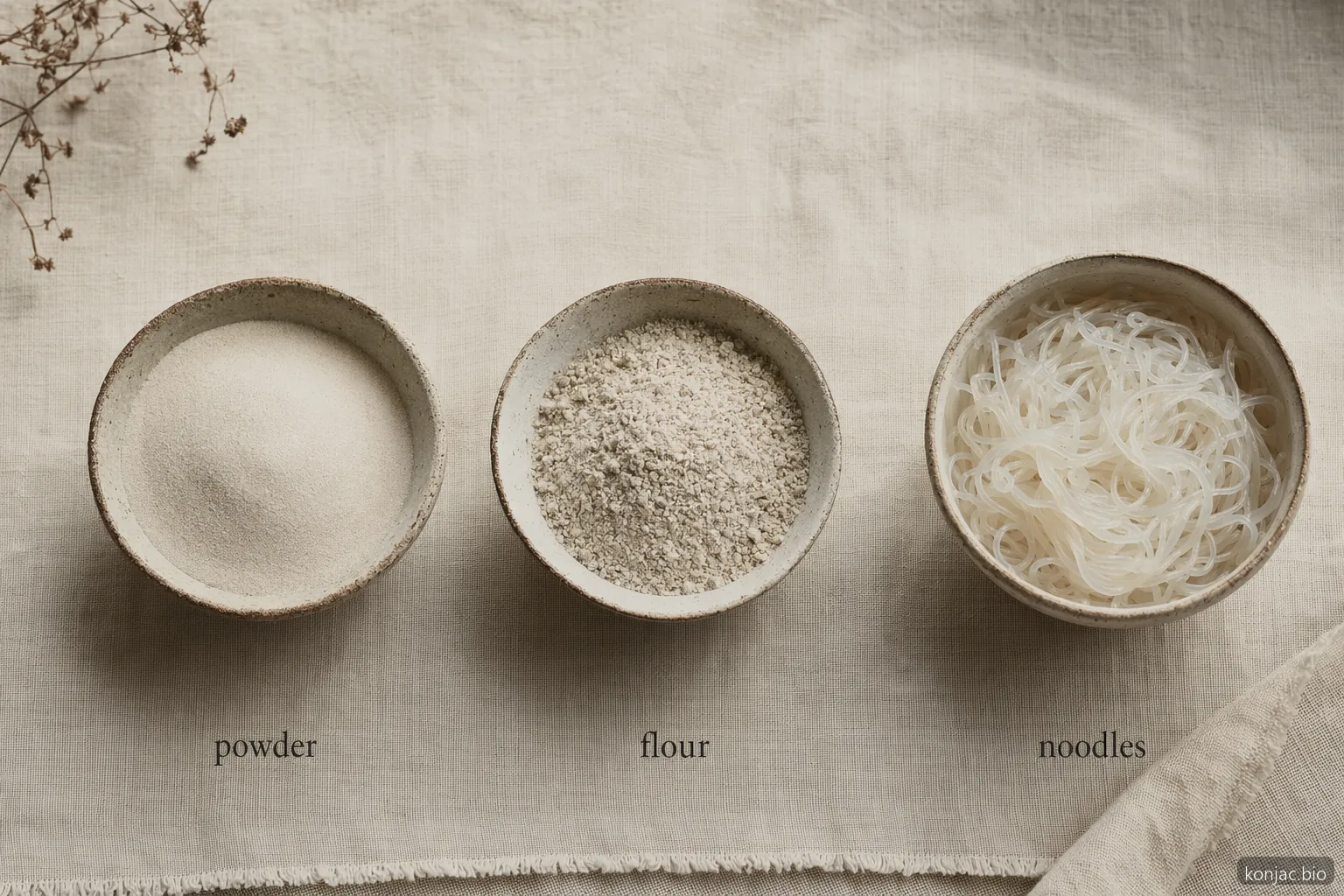
Glucomannan powder, konjac flour, and shirataki noodles come from the same plant family, but they are not interchangeable in formulation. Powder is the concentrated functional ingredient, konjac flour is a less refined plant-derived flour, and shirataki noodles are a finished hydrated food.
A supplement brand usually wants glucomannan powder because capsule fill weight, assay, and viscosity must be controlled. A food developer may compare it with konjac flour when a broader konjac ingredient is acceptable. A consumer looking for a ready-to-eat noodle is closer to shirataki noodles than to raw powder.
| Format | Best fit | Main limitation |
|---|---|---|
| Glucomannan powder | Capsules, sachets, beverages, texture systems | Needs careful hydration |
| Konjac flour | Food formulations and traditional konjac foods | Less concentrated than purified powder |
| Shirataki noodles | Ready-to-cook meals | Not suitable for supplement dosing |
For a finished product, specify the format first. A 1 gram capsule claim, a low-calorie noodle, and a sauce thickener can all involve konjac, but each one needs a different grade, process, and label review.
Frequently asked questions
01 Is glucomannan powder the same as konjac root powder?
02 What is the best way to take glucomannan powder?
03 Can glucomannan powder support weight management?
04 What side effects are associated with glucomannan powder?
05 How should manufacturers choose a glucomannan powder grade?
- Scientific Opinion on the substantiation of health claims related to konjac mannan (glucomannan) · EFSA Journal · 2010
- Effect of glucomannan on plasma lipid and glucose concentrations, body weight, and blood pressure · PubMed · 2008
- Import Alert 35-15 · U.S. Food and Drug Administration · 2024
- Dietary Supplements for Weight Loss: Fact Sheet for Health Professionals · NIH Office of Dietary Supplements · 2024
- Traditional uses and potential health benefits of Amorphophallus konjac K. Koch ex N.E.Br. · PubMed · 2010