
What is konjac gum in food formulation?
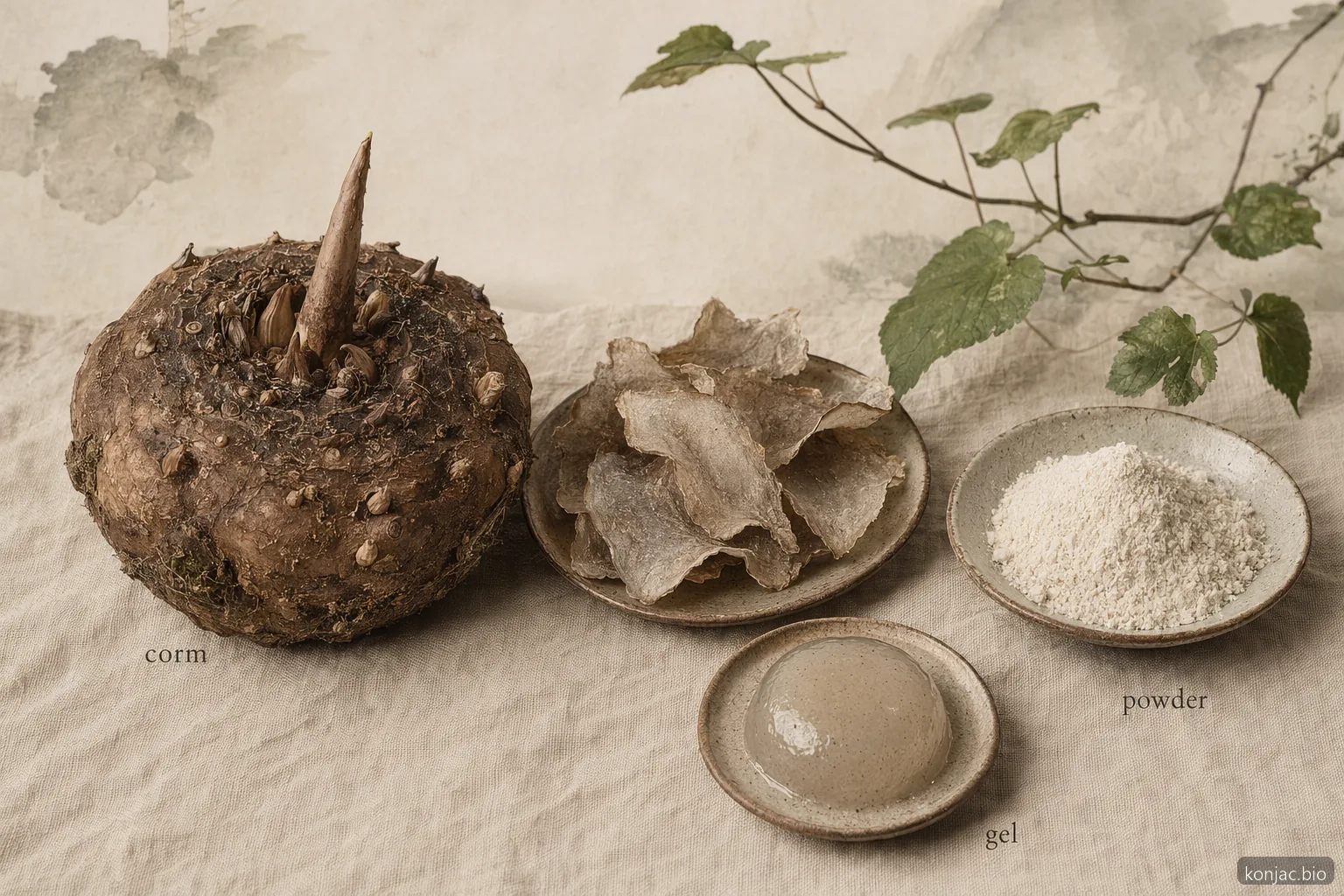
Konjac gum is a purified hydrocolloid from Amorphophallus konjac corms, used as a thickener, stabilizer, water binder, and vegan gelling ingredient.
The functional polymer is konjac glucomannan, a high-molecular-weight polysaccharide built mainly from mannose and glucose units. EFSA identifies konjac gum as E425(i) and konjac glucomannan as E425(ii) in its additive re-evaluation EFSA opinion.
For R&D teams, the commercial buying question is not simply whether a label says konjac. The useful question is whether the grade hydrates predictably, reaches the target viscosity, complies in the destination market, and holds texture after thermal processing, shear, filling, and shelf life.
How does konjac gum build viscosity and gel strength?
Konjac gum builds viscosity by hydrating glucomannan chains that bind water and increase continuous-phase thickness at low usage levels.
A practical high-grade specification often sets 1% solution viscosity at 10,000 cP or higher, measured under defined conditions such as 25 C, Brookfield spindle, speed, hydration time, and dispersion method. The test method matters because konjac hydrates slowly if powder is dumped into water without pre-blending or strong wet-out.
| Specification item | Why it matters | Buyer note |
|---|---|---|
| 1% viscosity | Predicts thickening power | Ask for method, spindle, rpm, and hydration time |
| Mesh size | Affects dispersion and lumping | Fine powder hydrates fast but needs better wet-out |
| Purity | Influences clarity, flavor, and gel strength | Compare ash, protein, starch, and sulfur dioxide if relevant |
| Microbiology | Controls food safety and shelf-life risk | Require COA limits matched to your matrix |
Konjac gum can form stronger gels when combined with selected hydrocolloids or alkaline conditions. Published food hydrocolloid literature describes konjac glucomannan as a polysaccharide used for thickening, gelling, and film-forming applications KGM review.
Synergy map: xanthan, carrageenan, starch, and locust bean gum
Konjac gum is often bought as part of a hydrocolloid system, not as a single-ingredient solution. Its best value appears when it reduces total gum dose, improves bite, stabilizes water, or replaces animal-derived gel systems.
| Pairing | Typical role | Formulation use | R&D watchpoint |
|---|---|---|---|
| Xanthan gum | Elastic gel and suspension | Sauces, fillings, plant-based meat binders | Too much xanthan can make texture stringy |
| Kappa carrageenan | Firm gel and clean slice | Dairy alternatives, vegan gel cups, processed analogues | Ion balance affects gel strength |
| Starch | Water-binding and body | Noodles, bakery fillings, refrigerated sauces | Check heat cycle and retrogradation risk |
| Locust bean gum | Elasticity and freeze-thaw support | Frozen desserts, dairy-style systems | Hydration temperature can be higher than konjac |
Synergy trials should use a design matrix, not one-off bench swaps. Start with 3 ratios for each pair, such as 75:25, 50:50, and 25:75, then compare peak viscosity, gel strength, syneresis, freeze-thaw change, and sensory bite.
For carrageenan systems, review the customer’s labeling and market limits early because carrageenan and konjac may be regulated differently by food category. EU additive permissions are organized under Regulation 1333/2008 EU additives.

What usage level should formulators start with for konjac gum?
Formulators usually start konjac gum at 0.1% to 0.5%, then adjust by viscosity, gel strength, processing loss, and sensory target.
For a beverage-style suspension or pourable sauce, 0.1% to 0.2% may be enough when konjac is paired with xanthan or starch. For plant-based meat binders, dairy alternatives, gummies, or sliceable gels, 0.3% to 0.5% is a more common trial range.
- Screen: Run 0.10%, 0.25%, and 0.50% in the real formula water phase.
- Hydrate: Use the same sugar, salt, pH, and heat profile planned for production.
- Measure: Record viscosity, gel strength, water loss, and sensory firmness after 24 hours.
- Stress: Test pasteurization, filling shear, refrigeration, freeze-thaw, or ambient storage if used.
Small changes can be visible because konjac has high water-binding power. A 0.05% change may move a sauce from pourable to spoonable, especially when xanthan, carrageenan, or starch is already present.

Where does konjac gum fit in vegan-gel applications?
Konjac gum fits vegan-gel applications when a product needs water-binding, elasticity, and gel structure without gelatin.
Common targets include plant-based meat, dairy alternatives, gummies, fruit jellies, noodle systems, and structured fillings. In plant-based meat, konjac can help bind water and oil phases while supporting bite. In dairy alternatives, it can add body and reduce whey-like separation in spoonable or drinkable formats.
| Application | Konjac function | Common co-texturizer |
|---|---|---|
| Plant-based meat | Binding, juiciness, bite | Methylcellulose, starch, xanthan |
| Dairy alternatives | Body, suspension, water control | Carrageenan, starch, pectin |
| Gummies and jellies | Elastic gel, chew, shape retention | Carrageenan, agar, starch |
| Noodles | Firmness, water-binding, texture | Calcium salts, starch, fiber blends |
Jelly formats need an extra regulatory and safety check. The FDA has issued consumer alerts on mini-cup gel candies containing konjac because of choking hazards FDA alert, and EU additive rules include restrictions for jelly mini-cups EU additives.
Processing controls for hydration, heat, shear, and pH
Konjac performance depends on wet-out, hydration time, thermal history, shear, pH, salts, and the order of addition. A strong lab result can fail at plant scale if powder disperses poorly or hydrates after the main shear step has ended.
Use these process controls during trials:
- Pre-blend dry powders: Mix konjac with sugar, starch, or another dry carrier before adding water.
- Add under agitation: Create a vortex, then add slowly to reduce fish-eyes and lumps.
- Allow hydration time: Measure viscosity after a fixed hold, often 30 to 60 minutes in lab screening.
- Control heat: Heat can improve hydration in many systems, but late high shear can break weak structures.
- Check pH: Acidic systems may need extra validation for viscosity, gel strength, and storage stability.
Alkaline processing can change konjac behavior by promoting stronger network formation. That is useful in some noodle and gel systems, but it must be validated against flavor, color, mineral choice, and local additive rules.
What regulatory checks matter for konjac gum buyers?
Konjac gum buyers should confirm additive identity, allowed food category, maximum level, label name, and country-specific restrictions before scale-up.
| Market | Regulatory checkpoint | Buyer action |
|---|---|---|
| European Union | E425(i) konjac gum and E425(ii) konjac glucomannan are addressed in EFSA’s re-evaluation EFSA opinion | Check Regulation 1333/2008 category permissions and Regulation 231/2012 specifications EU specs |
| United States | In the United States, glucomannan has no dedicated section in 21 CFR Part 184; in the EU it is an authorized food additive under E425. | Review intended use, cGMP limits, and any applicable FDA GRAS notice file FDA GRAS |
| Export markets | Local positive lists may use different names, INS numbers, or category limits | Confirm with local counsel, importer, and customer quality team before launch |
Do not assume one approval covers every matrix. A vegan gummy, a refrigerated sauce, a plant-based meat analogue, and a dry blend can fall under different food categories, even when the same konjac grade is used.
How should konjac gum be specified, stored, and qualified?
Konjac gum should be specified by functionality, compliance, and handling data, then stored cool, dry, and sealed to protect hydration and viscosity.
A B2B specification should include botanical source, additive identity, viscosity method, particle size, moisture, ash, pH, microbiology, heavy metals, allergen statement, GMO statement, residual solvent statement if relevant, and country-of-origin documentation. For larger launches, request a 3-lot comparison before locking the supplier.
Storage is simple but important. Keep bags sealed, away from steam lines, off the floor, and protected from condensation. A practical warehouse target is below 25 C and below 60% relative humidity when feasible, with first-expire, first-out stock rotation.
Supplier qualification should also cover food safety systems. Ask for HACCP documentation, a third-party certificate such as ISO 22000, FSSC 22000, BRCGS, or SQF, and a corrective-action process for viscosity drift, microbial excursions, or packaging damage.
Frequently asked questions
01 Is konjac gum the same as konjac glucomannan?
02 What viscosity should I specify for high-grade konjac gum?
03 What is the starting use level for konjac gum?
04 Does konjac gum work with xanthan gum?
05 Is konjac gum allowed in the European Union?
06 What is the U.S. regulatory status of konjac gum?
07 Can konjac gum replace gelatin in vegan gummies?
08 How should konjac gum be stored?
- Konjac: The Plant Behind Shirataki, Jelly, Flour, and Sponges
- Glucomannan Guide: Benefits, Dosage, Safety, and Forms
- Konjac wholesale sourcing from Shanghai: powders, E425 gum, noodles, OEM foods
- Konjac Gum (E425) for Food, Gummies, Beverages, and Plant-Based Formulation
- Shirataki Noodles: The Complete Guide to Konjac Pasta
- Re-evaluation of konjac gum and konjac glucomannan as food additives · EFSA · 2017
- GRAS Notice Inventory · FDA · 2024
- Regulation (EC) No 1333/2008 on food additives · EUR-Lex · 2008
- Regulation (EU) No 231/2012 laying down additive specifications · EUR-Lex · 2012
- Import Alert 33-15: Detention Without Physical Examination of Gel Candies Containing Konjac · U.S. Food and Drug Administration · 2024