
What glucomannan side effects are most common?
The most common glucomannan side effects are gastrointestinal: gas, bloating, abdominal fullness, loose stool, or constipation.
Glucomannan is a highly viscous soluble fiber from Amorphophallus konjac. Like psyllium, beta-glucan, and other fermentable fibers, it can change stool water content and gas production as gut bacteria adapt. The NIH Office of Dietary Supplements lists glucomannan adverse effects as mostly mild digestive effects, including flatulence and soft stools, in its weight loss supplement review.
Side effects are more likely when someone starts with a full serving immediately, stacks glucomannan with other fibers, or takes it without enough water. A cautious first week often uses half the label serving once daily, then increases only if digestion remains comfortable.
| Side effect | Typical trigger | Practical response |
|---|---|---|
| Bloating | Rapid fiber increase | Use a smaller serving for 3 to 7 days |
| Gas | Gut fermentation | Separate from other high-fiber supplements |
| Loose stool | High dose or sensitive gut | Reduce serving size and increase slowly |
| Constipation | Too little fluid | Take with a full glass of water |
Why can glucomannan side effects become serious?
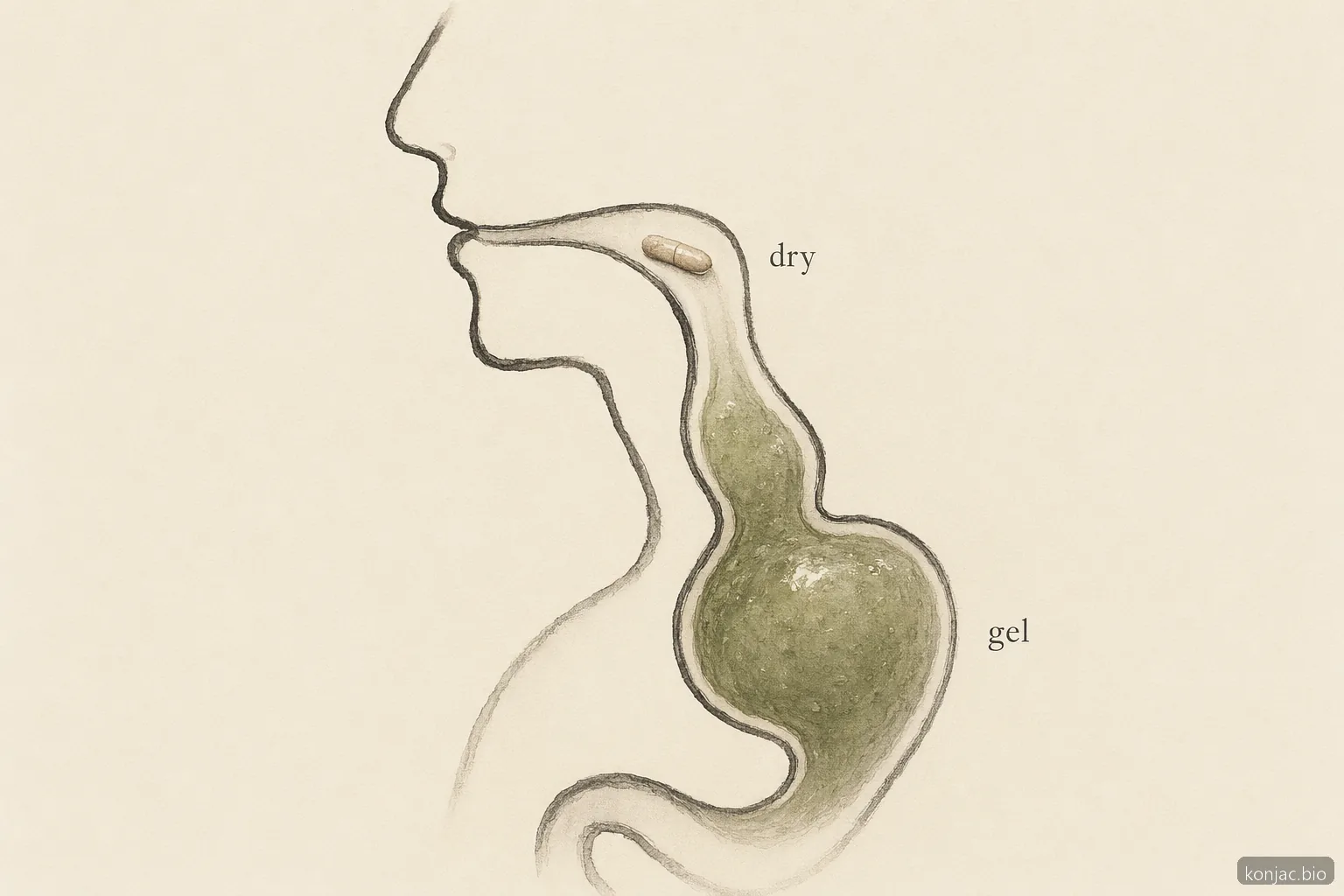
Glucomannan side effects can become serious when the fiber swells before reaching the stomach, especially if dry tablets, capsules, or powder are swallowed with too little liquid.
Konjac glucomannan absorbs water quickly and forms a thick gel. That property is useful in foods, but it also explains why supplement instructions commonly require a full glass of water. EFSA’s authorized weight-management wording is specific: “Glucomannan in the context of an energy restricted diet contributes to weight loss,” with conditions requiring 3 g daily in three 1 g doses, each with 1 to 2 glasses of water before meals, as described in the EFSA opinion.
The U.S. FDA has also acted on choking hazards in small gel candies containing konjac. FDA Import Alert 33-15 covers gel candies containing konjac because their texture, size, and shape may create a choking hazard, especially for children, as listed in the FDA alert.
Supplement risk is not the same as mini-cup jelly risk, but both involve the same physical issue: hydrated konjac can become a firm, slippery gel. Powder should be mixed fully before drinking, capsules should be swallowed with adequate water, and dry powder should never be eaten directly.
Who should be cautious with glucomannan side effects?
People with swallowing difficulty, prior esophageal narrowing, sensitive digestion, pregnancy, breastfeeding, or complex medication schedules should be cautious with glucomannan side effects.
Glucomannan may slow the movement of stomach contents and may reduce absorption of some oral medications if taken at the same time. A practical spacing rule is to take medications at least 1 to 4 hours away from concentrated fiber supplements, unless a qualified professional gives different instructions.
People using medications that affect blood glucose should be especially careful because soluble fiber can influence post-meal glucose response. EFSA has evaluated glucomannan for several health claims, but approved claims do not replace individualized advice, and supplement timing can matter.
- Swallowing concerns: avoid dry tablets, dry powder, and low-water use.
- Children: avoid concentrated gel products unless specifically formulated for age and texture safety.
- Older adults: pay extra attention to swallowing comfort and hydration.
- Medication users: separate doses and confirm timing with a qualified professional.
- Pregnancy or breastfeeding: use only with professional guidance.
For broader context on how dose changes tolerability, see our guide to glucomannan dosage.

Safe-use checklist for glucomannan supplements
Safe glucomannan use is mostly about water, gradual dosing, and choosing the right format. The same gelling property that supports satiety and texture can become uncomfortable or unsafe when the product is used dry or in excessive amounts.
- Read the serving size. Many glucomannan supplements provide 500 mg to 1,000 mg per capsule or serving.
- Start below the full serving. A half serving for several days can reduce bloating and gas.
- Use enough water. Take capsules or mixed powder with a full glass of water, not a sip.
- Do not eat dry powder. Mix powder completely into liquid or food before consumption.
- Separate from medications. Use a spacing window unless a qualified professional gives different instructions.
- Stop if swallowing feels difficult. Do not continue if the product catches in the throat.
EFSA’s cholesterol claim for glucomannan is also tied to intake conditions. The approved wording is “Glucomannan contributes to the maintenance of normal blood cholesterol levels,” and the beneficial effect is obtained with a daily intake of 4 g, described in the EFSA review. That does not mean higher is better. Higher intakes can increase digestive discomfort.
konjac.bio sources konjac powder and glucomannan at wholesale volumes for food, beverage, and supplement teams. For specs, documentation, and pricing, contact us.
Capsules, powder, foods, and drinks compared
Supplement form changes how quickly glucomannan hydrates and how easy it is to use safely. Capsules are convenient, powders are flexible, and foods spread the fiber through a larger water-containing matrix.
| Form | Main safety concern | Best practice |
|---|---|---|
| Capsules | Swelling before reaching the stomach | Take with a full glass of water |
| Tablets | Slower disintegration and throat lodging | Avoid if swallowing tablets is difficult |
| Powder | Clumping or accidental dry intake | Mix fully before drinking |
| Shirataki noodles | Digestive fullness from fiber and water | Rinse, cook, and use normal portions |
| Gel foods | Choking risk if small, firm, and slippery | Avoid small firm gels for children |
Konjac glucomannan has a long history as a food hydrocolloid because it thickens and gels at low inclusion rates. A safety review indexed in PubMed concluded that konjac glucomannan has a low toxicological concern when used appropriately, while noting gastrointestinal effects at higher intakes in the safety review.
For people using glucomannan for appetite management, the form and timing can be as important as the gram amount. See our related guide on glucomannan weight loss for the difference between EFSA-approved conditions and typical supplement marketing.
Frequently asked questions
01 Are glucomannan side effects dangerous?
02 Can glucomannan cause constipation?
03 Can glucomannan cause diarrhea or loose stool?
04 Should glucomannan be taken with medications?
05 Is glucomannan safe before meals?
06 Who should avoid glucomannan supplements?
- Scientific Opinion on konjac mannan and body weight reduction · European Food Safety Authority · 2010
- Scientific Opinion on konjac mannan and normal blood cholesterol · European Food Safety Authority · 2009
- Import Alert 33-15: Detention Without Physical Examination of Gel Candies Containing Konjac · U.S. Food and Drug Administration · 2024
- Dietary Supplements for Weight Loss: Health Professional Fact Sheet · NIH Office of Dietary Supplements · 2022