What is glucomannan glucomannan in supplement terms?
Glucomannan glucomannan refers to konjac-derived glucomannan used as a dietary fiber ingredient in capsules, powders, sachets, and functional foods.
Chemically, glucomannan is a water-soluble polysaccharide made mainly of glucose and mannose units, and konjac glucomannan is extracted from the corm of Amorphophallus konjac. A human nutrition review describes glucomannan as a soluble fiber used in clinical nutrition trials for body weight, lipids, and glucose markers PubMed analysis.
The key commercial reason glucomannan is different from many plant fibers is viscosity. When dispersed correctly in water, it forms a thick gel that can increase fullness, change mouthfeel, and improve texture in low-calorie foods. That gel behavior also explains why particle size, viscosity grade, and mixing instructions matter on a finished product label.
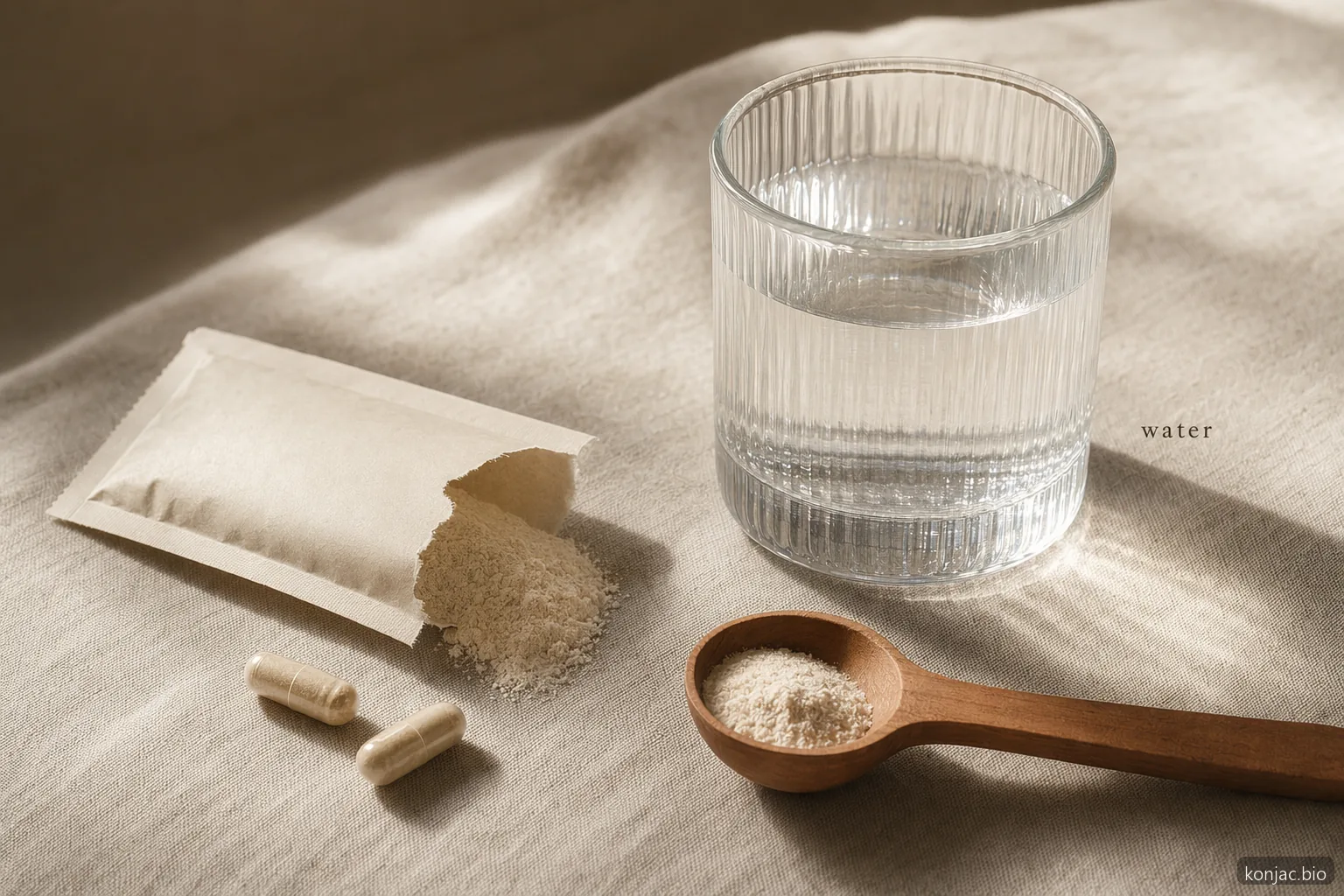
For consumers, glucomannan usually appears in three formats: 500 mg to 1,000 mg capsules, loose powder measured by scoop, or pre-portioned sachets. For food manufacturers, it is also used in shirataki noodles, konjac gels, fiber blends, and reduced-calorie formulations.
How does glucomannan glucomannan work in the gut?
Glucomannan glucomannan works by absorbing water and forming a viscous gel, which increases bulk and may support fullness before meals.
The gel-forming property is central to glucomannan’s supplement use. In trials summarized in the PubMed analysis, glucomannan intake was associated with reductions in total cholesterol, LDL cholesterol, triglycerides, body weight, and fasting blood glucose compared with control groups. These outcomes are associations from controlled studies, not guarantees for every user.
The European Food Safety Authority evaluated glucomannan for weight management and allowed the claim: "Glucomannan in the context of an energy restricted diet contributes to weight loss." EFSA ties that claim to 3 g of glucomannan daily in three 1 g doses, each taken with 1 to 2 glasses of water before meals EFSA opinion.
Hydration is not a small detail. Dry glucomannan can swell quickly, so supplement instructions should emphasize water volume, timing, and suitability for the user. Powders should be stirred into water and consumed promptly before the gel becomes too thick.
Glucomannan glucomannan dosage, timing, and label checks
The best-cited European weight-management condition is 3 g per day, split into three 1 g servings before meals with 1 to 2 glasses of water EFSA opinion.
Many commercial products use 500 mg capsules, so a 1 g serving often means 2 capsules. Powder products may use a scoop, but label accuracy depends on powder density, mesh size, and whether the scoop is level or heaped.
| Use case | Typical format | Practical label check |
|---|---|---|
| Pre-meal satiety support | Capsules or sachets | 1 g serving, water instruction, meal timing |
| High-fiber drink mix | Fine powder | Dispersibility, flavor masking, viscosity grade |
| Low-calorie noodles | Konjac gel food | Net carbs, serving size, water-packed weight |
| Functional food formulation | Powder ingredient | Purity, mesh, viscosity, microbiology |
A 2014 systematic review of randomized trials found that glucomannan supplementation did not produce a statistically significant body-weight reduction across all included studies, which shows why product claims should stay precise and source-based PubMed review. For a dose-focused companion page, see glucomannan dosage.

What safety issues should buyers check before using glucomannan?
Buyers should check choking warnings, water instructions, capsule size, allergen controls, and whether the product is appropriate for the intended user.
EFSA states that the beneficial effect for the approved weight claim is obtained only when glucomannan is consumed with 1 to 2 glasses of water before meals, and it also notes a choking warning for people with swallowing difficulty or inadequate fluid intake EFSA opinion. Finished product labels should make this instruction visible, not hidden in small print.
The FDA has also flagged choking hazards for mini-cup gel candies containing konjac because the gel can be difficult to dissolve once lodged in the throat FDA alert. This warning is most relevant to small gel candy formats, but it reinforces a broader point: konjac texture and swelling behavior must be designed around safe use.
People taking multiple oral products should separate glucomannan from them unless a qualified clinician gives different instructions. For a broader safety checklist, see glucomannan side effects.
Choosing a glucomannan format for capsules, sachets, and foods
Format choice depends on dose accuracy, hydration speed, texture target, and how the user will actually consume the product.
Capsules are convenient because they mask texture and taste. Their limitation is serving size: 3 g daily may require 6 capsules if each capsule contains 500 mg. Capsules also need a clear water instruction because the fiber should hydrate after swallowing, not in the throat.
Powders are flexible for beverage sticks, tubs, and food manufacturing. They need careful formulation because glucomannan can clump if added too quickly to water. Fine mesh powders hydrate faster, while coarser powders may be easier to disperse in some dry blends.
Food formats use glucomannan for structure as much as fiber. Shirataki noodles rely on konjac gel texture, while bakery or meal-replacement systems may use smaller amounts for viscosity, fullness, or calorie reduction. U.S. nutrition labeling defines dietary fiber within total carbohydrate rules, so finished foods should align ingredient use with label compliance FDA label.
For B2B buyers, konjac.bio sources konjac and glucomannan ingredients at wholesale scale with specification review available through contact. Ask for viscosity, purity, mesh size, heavy metals, microbiology, and country-of-origin documentation before approving a production lot.
Frequently asked questions
01 Is glucomannan the same as konjac?
02 How much glucomannan is used for the EFSA weight claim?
03 Can glucomannan be taken without water?
04 Are glucomannan capsules better than powder?
05 Does glucomannan support cholesterol levels?
06 Why are konjac gel candies regulated differently from supplements?
- Scientific Opinion on the substantiation of health claims related to glucomannan and reduction of body weight · European Food Safety Authority · 2010
- Effect of glucomannan on plasma lipid and glucose concentrations, body weight, and blood pressure: systematic review and meta-analysis · PubMed · 2008
- The efficacy of glucomannan supplementation in overweight and obesity: a systematic review and meta-analysis of randomized clinical trials · PubMed · 2014
- Import Alert 33-15: Detention Without Physical Examination of Gel Candy Containing Konjac · U.S. Food and Drug Administration · 2024
- How to Understand and Use the Nutrition Facts Label · U.S. Food and Drug Administration · 2024